


 |
| The Supreme Council of Health’s Food Safety and Environmental Health (FSEH) division yesterday co-ordinated a one-day seminar on ‘Food Risk Analysis- Policies and Practice’ in order to develop national food safety standards which will manage risk from “farm to plate”. |
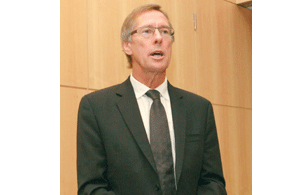
Government officials, university academia and other related personnel from various food control systems attended the seminar led by world-renowned food safety expert Dr Steve Hathway who has been pivotal in the development of international standards.
He is currently the director of New Zealand Ministry of Primary Industries (MPI) Science and Risk Assessment.
Food safety risk assessment is an emerging discipline that uses scientific methods to assess risk and make risk management decisions to ensure effective consumer protection from food-borne illnesses.
Topics covered during the lecture included international and national drivers for change for the development of effective risk-based food control systems, risk assessment concepts, the development of a risk management framework, methodologies and tools for undertaking risk assessments and case studies.
The FSEH division is strengthening its capacity to undertake food safety risk assessment to international standards while the technical and management staff from the FSEH attended a separate two-day intensive workshop on food safety risk assessment.
Having spent two weeks with the SCH studying food safety, environmental health and port health situations in Qatar, Dr Hathway said that: “Risk analysis is a holistic approach to food safety through the food control system. It has to change the current culture and move into using science to change the world. There should be a strong commitment at policy and management level to support the cause.”
He explained that risk analysis approach works best in a “farm-to-fork” food control system.
“The different entities should be incorporated into a single agency to prevent duplication and create better efficacy of the tasks. There should be a high level of co-ordination and sharing of information, resources between the different entities in the food control system in Qatar,” he said.
He stressed the importance of having a national risk assessment team to identify, differentiate and understand the risks of different types that can occur in the national food control system as Qatar imports some 90% of its food and has less knowledge about the health status of the food.
“There is clearly a lack of information on national nutrition and chemical hazards in the overall food supply in Qatar and this should be addressed by carrying out baseline work to determine specific risks associated with nutrient imbalances or chemical hazards,” he said.
FSEH manager Wassan al-Baker said that while the Supreme Council of Health had begun the process of strengthening its capacity to manage food safety risks in accordance with international best practice, it was also working as a task force member of the Qatar National Food Security Programme to review food safety policies and legislation and to design a well-integrated food safety masterplan for the development of a world-class food safety system for Qatar.
x