


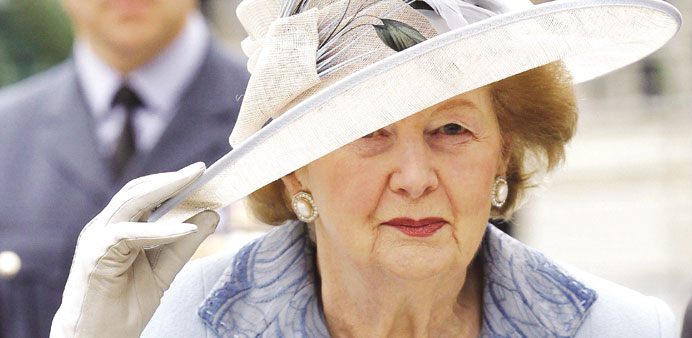
Margaret Thatcher: well-respected and unyielding “Iron Lady”.
By Gina Barreca/The Hartford Courant/MCT
Although they represented the opposite poles of femininity - the intimidating, well-respected and unyielding Iron Lady vs. the adorable, well-beloved and sassy Cutie Pie - both Margaret Thatcher and Annette Funicello shaped my universe growing up.
(Both Margaret Thatcher and Annette Funicello died on the same day, Monday, April 8. Annette Funicello was an American actress and singer. Beginning her professional career as a child performer at the age of 12, Funicello rose to prominence as one of the most popular “Mouseketeers” on the original Mickey Mouse Club. As a teenager, she transitioned to a successful career as a singer as well as establishing herself as a film actress, popularising the successful “Beach Party” genre alongside co-star Frankie Avalon during the mid-1960s.)
I wish I could sound erudite and sophisticated by saying that living in Thatcher’s England, as I did for several years, was more powerful than watching Annette in The Mickey Mouse Club.
It wasn’t.
I adored Annette, with her unashamedly Italian name, her welcoming smile and a pair of mouse ears that looked as if they protruded directly from her skull. She was one of the few girls on television who had naturally curly hair, large features and big eyebrows. She had big other things, too but I loved her for her essential Annette-ness: a confident cheerfulness, a straight-into-the-camera energy and her sheer love of being a girl.
Annette wasn’t a tomboy, or a princess, or a wimp. She was, instead, entirely one of the gang - even as a fully fledged girl.
I might not have formed the thought “It CAN be done! You can be female and be neither marginalised nor thrust out of the centre of genuine action” in words, but I bet money my tiny toddler brain was storing it all up.
I continued to be fascinated by her as Mary Contrary in 1961’s Babes in Toyland where she stands up not only for herself against a harassing boss, but for others who needed justice as well. “I suggest that you keep your smarty thoughts to yourself and stop making cheap accusations about a nice guy” she tells him after he makes a remark not often heard in a Disney movie: “Doing your job is pleasing me. Which in your case will not be difficult. You know what I mean?”
Again, as a 4-year-old, I probably didn’t understand that the evil boss, Barnaby, would need intensive sensitivity training before being readmitted to his managerial position. But I did understand that I wanted to answer back when somebody said something unfair. The magic part? Annette’s character did it with a sense of humour.
I followed Annette through Beach Blanket Bingo and How To Stuff A Wild Bikini and I watched her for signs of what “we” would become. Even then I thought she could do better than Frankie Avalon, however, and I was disappointed that her snappy answers seemed to get a little fewer and further between as Annette, I and the movies aged.
It was no joke that I thought of Annette as a sister. I’ve discovered that many women around my age (defined as “too old for work study but too young for cremation”) feel the same way. She was the Big Sister, too. She was a leader without being bossy; she was a role model without being pious or judgmental.
Thatcher was not exactly cut from the same polka-dotted cloth as Funicello. She was more like a Big Sister as Orwell might have envisioned her.
But even as a woman in my 20s who disagreed with almost every piece of political doctrine Thatcher espoused and would have argued with every change implemented under her watch in Great Britain, I admired this woman’s ability to command the stage and speak her mind.
Thatcher refused to negotiate her femininity for her right to be in the centre of the action; she was no tomboy or wimp, but another working-class girl who grew up to fight for what she believed. That what Thatcher believed was antithetical to my vision for the world did not cause me to underestimate either her influence or her effectiveness.
Besides, the prime minister also had a sense of humour (and/or good writers) and knew when to use it. “Being powerful,” Thatcher said, “is like being a lady. If you have to tell people you are, you aren’t.”
That even beats Annette’s line from Mary Contrary.
How dare I place Thatcher, the first female head of state of a Western superpower, in such proximity to a Mouseketeer? It’s OK: I don’t think Annette would have minded.
* Gina Barreca is an English professor at the University of Connecticut, a feminist scholar. She can be reached through her website at http://www.ginabarreca.com
BELOW: Annette Funicello, the dark-haired darling of TV’s The Mickey Mouse Club in the 1950s who further cemented her status as a pop-culture icon in the ‘60s by teaming with Frankie Avalon in a popular series of “beach” movies. Funicello, who died at the age of 70 on April 8, had been diagnosed with multiple sclerosis in 1987.