Guardian News and Media/London
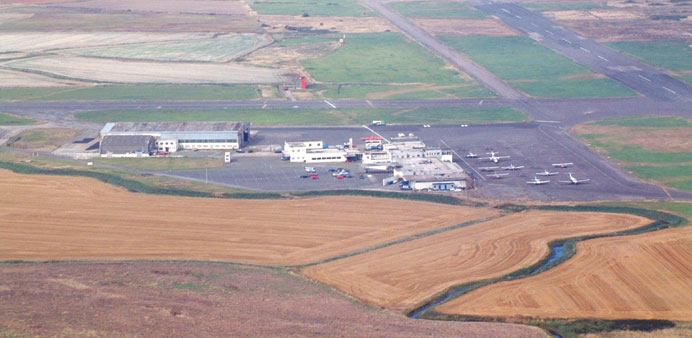
Lydd airport in Kent, wedged between Dungeness nuclear power station, Romney Marsh and a nature reserve, has been given permission by the government to extend its runway and handle up to 500,000 passengers a year.
The plan has been approved by Eric Pickles, the communities and local government secretary, and Patrick McLoughlin, the transport secretary, following a protracted dispute over an application first submitted in 2006.
The expansion of London Ashford airport, as it is formally known, is designed to ease air congestion in the south-east and create local jobs but has been fiercely opposed by environmental groups, who fear it will destroy the tranquility of the Kent coast and a nearby RSPB bird sanctuary.
The airfield has been owned by a Saudi businessman, Sheikh Fahad al-Athel, since 2001. Lydd originally opened in 1956 and at the height of its success Silver City airways, Dan-Air and other firms were carrying 250,000 people a year.
Business collapsed in the 1970s.
Shepway district council voted in favour of the plan in 2010 but the scheme was called in by central government for assessment because of its national importance. Its approval allows the construction of a runway extension that can take Boeing 737 charter flights and a new terminal building.
Opponents, who fear passenger numbers will eventually increase to 2mn a year, have six weeks to appeal against the decision at the high court.
The RSPB, which runs a nearby reserve, said it was disappointed by the outcome and was considering its position.
The organisation’s conservation director, Martin Harper, said: “This is the wrong decision as it opens the door to real damage to Dungeness, to its wildlife and the quality of life for many of its residents and risks destroying a unique asset that is enjoyed by hundreds of thousands of people.
“Dungeness is a special place for nature, which is recognised globally for the importance of its wildlife. This decision means nowhere is safe and signals that nature is in trouble in the face of unfettered growth - these are worrying times for all who care for Britain’s wildlife.”
Hani Mutlaq, Lydd airport’s executive manager, said he was delighted with the go-ahead. “I’m very pleased,” he told the Guardian. “I hope construction will start this year. At the moment we only have scheduled flights to Le Touquet in France but with a longer runway we will have the capacity for 737s that can reach destinations across Europe.”
Richard Griffiths, the planning lawyer who led the team advising the airport’s owner, said: “This is a significant decision from the government given the crossroads which aviation policy currently faces. (It) is perhaps an indication of the government’s support for aviation expansion where the environmental impacts are demonstrated to be acceptable.
“Clearly the government has accepted that there is a need to grow capacity in the country’s airports. However, whilst this is an important decision for both the aviation industry and also for infrastructure investment in Kent, questions should be asked why it has taken over six years to make a decision on these proposals.”
The decision states: “After careful consideration, (the secretaries of state) are satisfied that there would be no likely significant effects on any designated conversation sites and also that the proposals would not have a significant effect on nuclear safety, landscape or tranquillity.”