


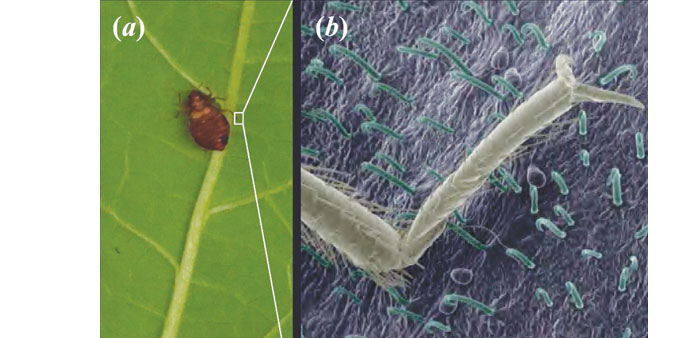
A handout combination of pictures released by the Royal Society shows a bedbug
standing on a kidney bean leaf
AFP/Paris
It’s been frozen, baked, suffocated and sprayed with toxins ... and each time the bedbug bounces back, leaving tiny bite marks on legs or arms where it takes a blood meal.
But thanks to an unusual combination of Balkan folklore and nanoscale science, the pesky critter may have met its match.
In a journal of Britain’s prestigious Royal Society, US entomologists on Tuesday reported progress in a quest to emulate anti-bedbug defence found in the hairs of leaves from the kidney-bean plant, known by its Latin name of Phaseolus vulgaris.
In rural Bulgaria, Serbia and other parts of the Balkans, these leaves are scattered on the floor next to the bed, snagging the blood-sucking little parasites during their night-time forays.
The following day, the bug-encrusted leaves are burned to exterminate the pests.
Eager to find how the trick works, the scientists used high-speed video cameras and scanning electron microscopy to study bedbugs trotting across a bed of leaves.
The investigators were surprised to find that the bedbugs were not trapped by some Velcro-like mechanism.
Instead, they discovered that the leaves are studded with extremely sharp points called trichomes that pierce the bedbugs’ legs at critical locations. Impaled on several legs at the same time, the bugs are doomed.
The next step was to copy the leaves, using them as a template for bio-mimicry. The goal is to make a bedbug barrier that is durable and can be used on any surface, not just the floor.
In terms of size and geometry, the imitation prototype closely resembles the original.
But it needs further work before it can be turned into a useful trap, for the bedbugs are only harpooned temporarily.
The reason may be that the natural trichome, about 60 billionths of a metre thick or 1/60,000th the width of a human hair, has a more flexible tip than the synthetic version.
The point of the trichome skitters its way across the bug’s cuticle surface before lodging in a leg crevice.
“Nature is a hard act to follow, but the benefits could be enormous,” said Michael Potter of the University of Kentucky, part of the team led by Catherine Loudon of the University of California at Irvine.
Bedbugs are an ancient scourge driven back by DDT and other then-legal pesticides in the post-World War II period.
They inflict costs of at least $250mn each year in the United States alone, according to the US National Pest Management Association.