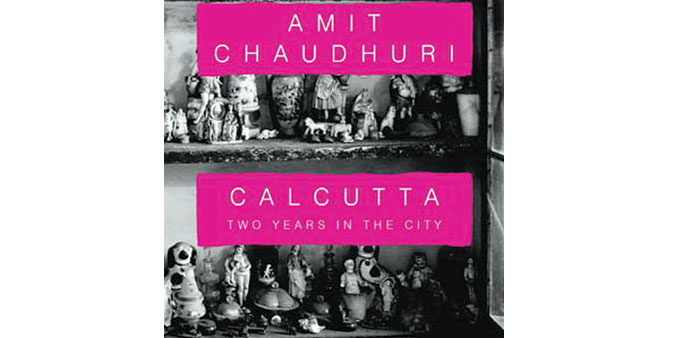
By Amit Chaudhuri
By Sukhdev Sandhu
What is Calcutta? Macaulay thought it “a place of mists, alligators and wild boars.” Kipling saw it as a city of dreadful night and “one of the most wicked places in the universe.” Depending on which European prognosticator one reads it’s a black hole, a leprous pit, a basket case, a Marxist junk space.
Writing in 1903, Lord Curzon at least spurned such millenarian metaphors only to succumb to imperial self-adulation: “Calcutta is in reality a European city set down upon Asiatic soil, and that it is a monument — in my opinion one of the most striking extant monuments, for it is the second city to London in the entire British Empire — to the energy and achievements of our race.”
For the novelist Amit Chaudhuri, who was born in Calcutta and left England to move back to the city in 1999, such verdicts don’t even warrant refutation. His is a strange book — equal parts memoir, literary history, sad-eyed sitcom — that may seem to belong to the growing genre of works of Indian urbanism — think Suketu Mehta’s Maximum City, Altaf Tyrewala’s Mumbai Noir, Sam Miller’s Delhi: Adventures in a Megacity — but is more becalmed than delirial, meandering rather than teeming with Dickensian energy. Though it begins by quoting an observation made by a homeless woman (“We may be beggars, but we aren’t mad”), it’s also far from being a work of subaltern reportage.
Modernity is Chaudhuri’s subject, his cause. His Calcutta, or at least the one he fell in love with when he was younger, offered “a self-renewing way of seeing, of inhabiting space, of apprehending life.” This isn’t the modernity of the condominium classes. It’s not the modernity of gleaming towers or digital billboards or starchitect-designed galleries. If anything — and the book has an epigraph from Baudelaire’s The Painter of Modern Life — it’s an aesthetic sensibility that finds in urban dereliction “something compelling, perhaps even beautiful”, that regards “noise and stink” as oxygen, and that believes Calcutta, even when young, was never new; rather it “was born with the aura of inherited decay and life”.
This sensibility wasn’t shared by or even apparent to the likes of Kipling. But, for Chaudhuri, it’s present in the work of many artists from the 1860s to the 1970s: in Iswar Gupta whose The English New Year contains verses that describe a dinner at an Englishman’s house with the exultant onomatopoeia of Bob Cobbing’s sound poetry (“Chupu chupu chup chup chop chop chop / Shupu shupu shup shup shop shop shop”); in the riotous satires and antic argots of Bankim Chandra Chatterjee’s The Night-Owl’s Sketches; in Tagore’s “restless travelling between genres, his experiments in poetry, fiction, art, and even fashioning a persona”; in the films of Satyajit Ray and Ritwik Ghatak.
All were impelled by a challenge that Tagore articulated best: “Something undreamt of was lurking everywhere, and every day the uppermost question was: where, oh where would I come across it?”
Much has changed in recent decades. Chaudhuri, to borrow the title of an Iain Sinclair anthology, depicts Calcutta as a city of disappearances. Older buildings get demolished, a fusty bookstore he visited as a child just to sniff its books now mostly sells CDs and stationery, the megaphoned communist harangues of street-corner ideologues have become scarcer: globalisation — its enticing malls and multiplexes — produces a texture deficit, creates a simulation of life that Chaudhuri finds less vital than the peeling surfaces and paradoxically fertile dereliction of old.
He illustrates this transformation most tellingly by examining changes in the food landscape. Chinese food, he argues, used to be found in any neighbourhood with “an ethos of loiterers killing time on workday porches and signs with a particular kind of English lettering denoting the Chinese were nearby”.
Now there exist places like the fancy Pan Asia, a restaurant whose title “implied there were no neighbourhoods; there were lounges, constituting brief arrests on overnight journeys”.
There’s nothing that Chaudhuri, whose father worked for Britannia Biscuits, likes better than writing about food. High tea, sandwiches, chicken, croissants: he has an extraordinary ability to recall the taste of and dining rituals around almost everything he’s ever eaten.
He describes macaroni as “the blunt, midget-like, pug-nosed cousin” of spaghetti. Posh Indians, he says, view olives as “the putative source of an oil which is occasionally applied to the bodies of infants and the aged”. Calcutta, for whom modernity was its “bread and butter”, becomes a kind of alimentary canal, a place one apprehends with the stomach as much as the eye or ear.
Chaudhuri, for all his occasional disquisitions on history and politics, is at his best when he’s in pointillist reverie. He’s a master of the miniature, half-glanced details rather than sweeping panoramas. His efforts to adopt a more journalistic or sociological approach come across – deliberately, I think – as absurd: when a beggar girl follows him, “I thought I’d end her pursuit by giving her a few rupees; then it occurred to me that, since I was writing about the city, I may as well have a conversation with her.”
Other studies of Calcutta will offer quotable statistics, dates of key events, incisive critiques of its politicians and property developers. Chaudhuri’s book, by turns grouchy and affectionate, sometimes diaristic and sometimes meditative, is all the richer for presenting the city as a series of unexpected memory tugs.
If Delhi is the voice of power and bureaucracy, and Mumbai is the sound of showbiz cacophonies, Calcutta is ghosts and whispers, strange resonances, elusive melodies. Chaudhuri may believe that the city today exists “without space, without a past, without a real appetite”, but his drifting, formally bold anti-narrative is rich in presence and sings a beautiful tune all of its own. — Guardian News & Media
thrillers roundup
thrillers roundup
Petite Mort
By Beatrice Hitchman,
Serpent’s Tail
There’s a touch of Angela Carter about Beatrice Hitchman’s beguiling debut Petite Mort a sly thriller concerned with doubleness and duplicity that’s both a primer in the early history of French cinema and a reflexive study in female self-fashioning or should that be “self-editing”? The fictional Petite Mort is a silent film from 1914, presumed lost in a fire that destroyed a section of the Path studio where it was made. In 1967, the height of the New Wave, a print is found by a suburban widow in her basement, but with a crucial scene inexpertly chopped out: a “doppelganger” special effect that may shed light on the subsequent murder trial of its star, Adle Roux.
Hitchman gives us Adle in the late-1960s “present” being interviewed by a journalist; then, in parallel, a series of back-stories starting with her initial escape from provincial drudgery: her entree to the film world was a job as a studio seamstress making velveteen costumes for absinthe fairies. We meet her mysterious director-lover Andr Durand and his volatile film-star wife Terpsichore, whose assistant Adle becomes en route to stardom. Complex and cerebral, Petite Mort is softened by beautifully drawn characters, lightly drizzled period detail and an abiding suspicion that love and cinema might be part of the same illusion. Hitchman worked as a film-maker and editor before taking a creative writing MA, which explains her eye for nerdy details like the flies that swarm around the studio attracted by chemicals from the film-strip factory, and fascination with the primitive optical effects, often adapted from stage tricks.
Gone Again
By Doug Johnstone
Faber
Its title (Gone Again) and set-up (a wife’s sudden disappearance) suggest unsubtle Gillian Flynn exploitation, but Doug Johnstone’s third thriller has an elegant clarity rooted in its sure-footed rendering of photographer Mark’s relationship with his son. Mark has a violent streak he once hit his mother-in-law, and we witness him punching a mother at the school gates but that can’t mean he murdered wife Lauren, can it? One of Mark’s theories is that Lauren was suffering from a recurrence of pregnancy psychosis.
The Quickening
By Julie Myerson,
Hammer
Rachel and Dan’s dream honeymoon on Antigua goes coffin-shaped when pregnant Rachel starts sensing a shadowy, oppressive presence who maybe the ghost of one of her over-solicitous husband’s former schoolmates. Myerson can churn this stuff out in her sleep — a more apt title might be The Quota Quickie. But while she draws self-consciously on doomy-holiday classics like The Comfort of Strangers and Don’t Look Now, that doesn’t mean the results aren’t worthwhile. On the contrary, she’s superb at freighting innocuous everyday banter with ambiguity and dread. The Quickening keeps us guessing until the end, though it would be even more effective if Myerson had spaced out her set piece shocks a bit more.
We Are Here
By Michael Marshall
Orion
Like his breakthrough Straw Men trilogy, Michael Marshall’s chilling We Are Here posits the world as a sort of multidimensional palimpsest, taking what’s essentially a psychotic intuition and normalising it. David, a writer about to have his first novel published, is in New York meeting his agent and editor when he has a run-in with a man at Penn Station a man David both does and doesn’t recognise and who says simply “Remember me”. A parallel plot-line follows couple John and Kristina as they help a female friend who thinks she’s being stalked. She is, of course, but not in the ordinary sense. In We Are Here the mass of humanity we barely notice on our way to work contains members of a loose confederation of “shadow people” who exchange messages and have designated roles (Cornermen, Fingermen). Are these characters ghosts? Are they “real”, in the sense of being solid and visible to everyone? Are they, perhaps, spurned, forgotten people from our lives who, for whatever reason, have not forgotten us? It sometimes feels as if Marshall is wrestling this massive concept into shape as he goes along, and the early chapters’ opacity may frustrate even fans. But this is still an intelligent and profoundly unsettling novel.
The Catch
By Tom Bale
Preface
Tom Bale’s awareness of the old creative writing mantra “character is destiny” pays off addictively in The Catch. Bale sets up the personalities of friends Robbie and Dan so carefully that we’re fascinated to see how they react when they accidentally kill a lecherous old man whom Robbie has ripped off, then attempt to cover it up. It’s proof that, sometimes, it’s enough for a thriller to be solid, purposeful and well written. — By John O’Connell, Guardian News & Media