


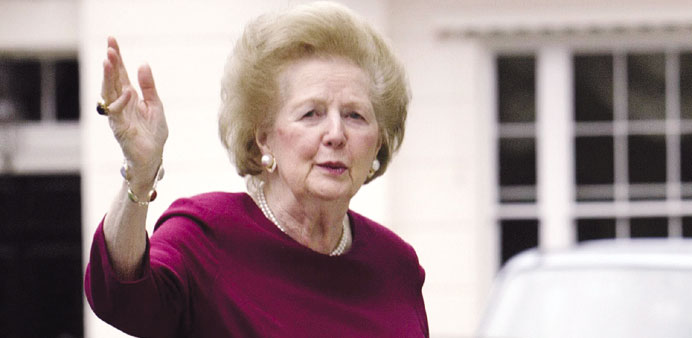
Agencies/London
Former prime minister Margaret Thatcher, the controversial “Iron Lady” who dominated a generation of British politics and won international acclaim for helping to end the Cold War, died following a stroke yesterday. She was 87.
World leaders paid tribute to Britain’s only woman prime minister, whose years in office from 1979 to 1990 saw her take on trade unions, go to war in the Falklands and wield her signature handbag against the European Union.
Queen Elizabeth II said she was saddened by Thatcher’s death and Prime Minister David Cameron cut short a European trip, although mining leaders and Irish republicans said she left a bitter legacy.
Red white and blue Union flags flew at half-mast over Buckingham Palace, the Houses of Parliament and the prime minister’s Downing Street official residence in a sign of mourning while mourners left flowers outside Thatcher’s house.
Britain announced plans for a ceremonial funeral with military honours, although it is a step short of the full state funeral of the kind accorded to monarchs and World War II premier Winston Churchill.
“It was with great sadness that I learned of the death of Lady Thatcher. We have lost a great leader, a great prime minister and a great Briton,” Cameron said. “She didn’t just lead our country, she saved our country.”
Thatcher suffered from dementia in recent years - her illness becoming the subject of a biographical film starring Meryl Streep - and appeared rarely in public.
She was last in hospital in December for a minor operation to remove a growth from her bladder.
The former Conservative Party leader was the 20th century’s longest continuous occupant of Downing Street.
Right-wingers hailed Thatcher as having hauled Britain out of the economic doldrums but the left accused her of dismantling traditional industry, claiming her reforms helped unpick the fabric of society.
Her health worsened in the years after she was forced out of office in 1990 and the former premier had to be repeatedly reminded that her husband Denis had died in 2003, her daughter Carol once revealed.
Thatcher was told by doctors to quit public speaking a decade ago after a series of minor strokes. “It is with great sadness that Mark and Carol Thatcher announced that their mother Baroness Thatcher died peacefully following a stroke,” her spokesman Lord Tim Bell said, referring to Thatcher’s children.
Bell said she died while staying at the Ritz Hotel in London.
Britain’s 86-year-old queen, who shared weekly chats with Thatcher during her 11 years in power, was “sad to hear the news of the death of Baroness Thatcher,” Buckingham Palace said.
Downing Street said that with the Queen’s consent Thatcher would receive a “ceremonial funeral with military honours” at St Paul’s Cathedral in central London. A date has not yet been announced.
A private cremation would follow later, it said, adding that the arrangements were at the request of Thatcher’s family.
British newspapers reported that the former premier had herself requested that she did not receive a state funeral, knowing that it would prove divisive.
Cameron flew back to London from Madrid where he had been in talks with Spanish premier Mariano Rajoy on reforming the European Union, while a visit to Paris to meet President Francois Hollande had also been cancelled.
Reaction was mixed in Britain. “It’s a crying shame, she’s a good woman,” said law firm employee Alan Whiteford in London. But David Hopper, regional secretary of the National Union of Mineworkers (NUM) in northeast England, said few tears would be shed in his industry, one of the hardest hit by Thatcher’s policies. He said: “I’m having a drink to it (her death) right now. It’s my 70th birthday today and it’s one of the best I’ve had in my life.”
On the world stage, Thatcher built a close “special relationship” with US president Ronald Reagan which helped bring the curtain down on Soviet Communism. She also fiercely opposed closer political ties with Europe. President Barack Obama said the US had lost a “true friend” and the world “one of the great champions of freedom and liberty.” German Chancellor Angela Merkel, whose country was divided by the Iron Curtain, said Thatcher was an “extraordinary leader” while Hollande said she left a “profound mark” on Britain.
Gorbachev, whose good relations with Thatcher played a part in ending the Cold War, said she would live on in “memory and in history.”
Poland’s former president and anti-communist icon Lech Walesa said she did a “great deal for the world”. European Commission head Jose Manuel Barroso meanwhile hailed her “contributions” to the growth of the EU, despite her famous reservations about continental European integration.
Thatcher was born Margaret Hilda Roberts on October 13, 1925, in the market town of Grantham, the daughter of a grocer. After grammar school and a degree in chemistry at Oxford University, she married businessman Denis in 1951 and two years later had twins, Carol and Mark. She was first elected to the House of Commons in 1959 and succeeded former prime minister Edward Heath as opposition Conservative leader in 1975 before becoming premier four years later.
Her enduring legacy can be summed up as “Thatcherism” - a set of policies which supporters say promoted personal freedom and broke down the class divisions that had riven Britain for centuries. Pushing her policies through pitched Thatcher’s government into a string of tough battles, while she also had to deal with unexpected setbacks. When Argentina invaded the remote British territory of the Falkland Islands in 1982, Thatcher dispatched troops and ships, securing victory in two months. In 1984 Thatcher survived an Irish Republican Army bombing.
Most memorable quotes
“In politics if you want something said, ask a man; if you want something done, ask a woman.” — 1965
“I don’t think there will be a woman prime minister in my lifetime” — as education secretary in 1973. She became Britain’s first, and so far only, woman prime minister in 1979.
“Where there is discord, may we bring harmony. Where there is error, may we bring truth. Where there is doubt, may we bring faith. And where there is despair, may we bring hope.” — Quoting St Francis of Assisi, on her 1979 election victory.
“I am not a consensus politician. I’m a conviction politician.” – 1979
“I don’t mind how much my ministers talk, as long as they do what I say.” – 1980
“We had to fight the enemy without in the Falklands. We always have to be aware of the enemy within, which is much more difficult to fight and more dangerous to liberty.” — On the 1984-85 miners’ strike which provoked some of the fiercest union opposition to her economic policies.
“We are not asking for a penny piece of community money for Britain. What we are asking is for a very large amount of our own money back, over and above what we contribute to the community, which is covered by our receipts from the community.” — At a European Economic Community summit 1979.
“To those waiting with bated breath for that favourite media catchphrase, the U-turn, I have only one thing to say: You turn if you want to. The lady’s not for turning.” — At the 1980 Conservative Party conference to colleagues urging her to soften her economic policies which were driving up unemployment.
“Just rejoice at that news and congratulate our forces and the marines. Good night gentlemen. Rejoice.” —To reporters in 1982 outside Downing Street after her defence secretary said Britain had recaptured South Georgia from Argentina.
“This is a day I was not meant to see.” — To reporters the day after surviving a deadly 1984 Irish Republican Army bomb attack on the Conservative Party conference.
“They are casting their problems on society and who is society? There is no such thing! There are individual men and women and there are families and no government can do anything except through people and people look to themselves first. It is our duty to look after ourselves and then also to help look after our neighbour.” — To Woman’s Own magazine.
“We have become a grandmother.” — On the birth of her first grandchild, 1989.
“No! No! No!” — At the House of Commons in 1990, the climax of an anti-European outburst that moved Geoffrey Howe to quit as deputy prime minister and deliver a resignation speech which called for her to be challenged for her job.
“I fight on, I fight to win.” — In November 1990, after failing to win enough votes to avoid a second round in the Conservative leadership contest. She resigned the next day.
“It’s a funny old world” — On her decision to quit in 1990.
Falkland Islands mourn, Argentines bitter over past
Falkland Islanders mourned Thatcher yesterday, revering her as their liberator after a 1982 invasion by Argentine forces, but many Argentines bitterly recalled her role in defending the South Atlantic territory. Flags flew at half-staff on the Falklands after news of Thatcher’s death on Monday aged 87. The head of the local legislative assembly said it was a day of great sadness and another resident praised her as “our Winston Churchill.” In Buenos Aires, however, one resident named Jose Raschella, 48, said: “I hope God can forgive her because I can’t.” Thatcher sent a task force to recapture the islands, known in Argentina as Las Malvinas, in an operation she considered one of the triumphs of her 1979-1990 rule. Argentina still presses its sovereignty claim over the Falklands and in the past year has stepped up rhetoric against Britain despite a referendum last month in which the islanders overwhelmingly voted to stay British. “There’s absolutely no doubt that Thatcher had a special feeling for the Islands, she led a very difficult recapture of the Islands ... and the Falklands were always in her heart,” Mike Summers, chair of the Falklands’ eight-member assembly, said from Port Stanley. “She’s a very much revered person in the Falklands for leading our return to freedom in 1982, and it will be a day of great sadness for Falkland Islanders.” Summers said a memorial service would be held but it was not yet clear when.