


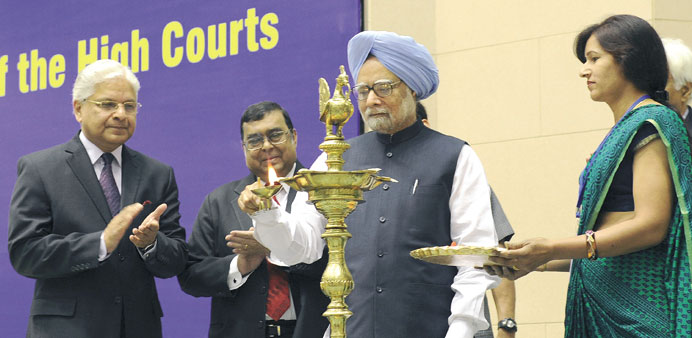
Prime Minister Manmohan Singh lights a traditional lamp to inaugurate the joint conference of chief ministers and chief justices in New Delhi yesterday. Also seen are Law Minister Ashwani Kumar and the Chief Justice of India Altamas Kabir.
Agencies/New Delhi
Prime Minister Manmohan Singh yesterday underlined the need for more action to tackle crime against women as the country reels under a spate of sex attacks that have made global headlines.
Singh said his government had moved quickly to bring about significant amendments in the criminal law dealing with sexual offences against women following the December gang-rape of a 23-year-old student in New Delhi.
“But, notwithstanding the steps that have already been taken, a great deal more needs to be done as far as offences against women are concerned,” he said at a conference of chief ministers and chief justices in New Delhi.
Attacks on women in India have been in the spotlight since December 16, when the student was brutally attacked and raped by six men on a moving bus in the capital. She died two weeks later of her injuries.
The case triggered outrage at home and abroad, prompting parliament to toughen laws to make the country safer for women.
The new law was passed the same day that a British tourist jumped off her hotel balcony in the Taj Mahal city of Agra in a bid to escape an alleged sex attack.
That incident came just days after a Swiss cyclist was gang-raped in Madhya Pradesh in a brutal assault commentators said underscored risks women face in the country of 1.2bn people.
Last week, four sisters walking home in northern Uttar Pradesh state suffered severe burns after being attacked with acid by two men on a motorbike.
Singh said the need for speedy and affordable justice had come into sharper focus in the wake of the growing crimes against women.
“Presently, over 3 crore (30mn) cases are pending in various courts across the country and 26% of them are over five years old,” Singh said, urging speedy trials to reduce the backlog.
Singh also said at a time when the demand for judicial reforms and change in the legal processes “has acquired a new urgency, we must ensure that the voice of sanity and logic is not suborned to the momentary impulses of the day.”
He termed India’s current ratio of 15.5 judges per million people as “indeed grossly inadequate,” and urged states to take the initiative in increasing number of judges to deal with the pending cases.
Chief Justice of India Altamas Kabir stressed the need for strengthening the juvenile justice system in the country, and to provide adequate protection for juveniles who are in conflict with law.
“Forty-two percent of our population in India are children. How many of us even think of children as the potential force for the future?”
“Large number of them do not have proper facilities despite the best of our efforts and intention. This leads to number of problems, particularly drug addiction is the worst problem. To address these, we have to strengthen the juvenile justice system.”
Kabir also stressed the need to protect the rights of juveniles, particularly the underprivileged children.
“We have children with good education, they are from the elite class but what about the rest? Ten to 15 years down the line when the new generation will take over, there might be chaos if these children are not taken care of.”
Two months ago, amid demands for the harshest punishment to juveniles who commit gruesome crimes against women like rape, the CJI had said: “Someone below 18 years of age comes under minor category and the law takes its course as per the law of the land.