


By Peter Townson/Staff Reporter
The question of censorship and its impact on the arts was raised at the Doha Debates last night, where 58% of the audience carried the motion “This House believes that censorship makes a mockery of the arts.”

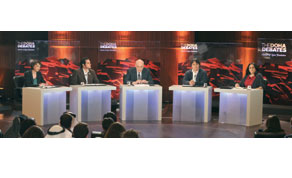
Nat Muller, Malik Jandali, Tim Sebastian, Peter Florence and Nada Shabout at the final episode in the eighth series of the Doha Debates last night. PICTURE: Nasar TK
The debate was particularly topical as Qatar and other countries in the region focus on developing and investing in art, yet continue to practise censorship in a variety of forms.
In his introduction to the discussion, Doha Debates chairman Tim Sebastian mentioned the use of pens to black out images and films being cut in cinemas here, raising the question of whether these undermine artistic integrity and the expansion of art in the Middle East.
First to speak for the motion was art critic and curator, Nat Muller who argued that censorship is completely opposed to artistic expression and leads to artists living in societies where they are unable to create their work.
She insisted that artists must be allowed to create whatever they choose, and that it is up to the audience to view, watch or listen to what they deem appropriate. This choice must be left to the audience and not made by governments or any other authorities, she said, arguing that art has the power to make an audience “see things anew” and help us form ideas.
“Sometimes it may disturb, but this is the beauty of art,” she noted, “no one is forced to appreciate art – everyone is free to dislike it or disagree, but it should not be banned.”
Iraqi American art historian, Nada Shabout took a different view, explaining that although she does not support any degree of oppression or repression, she does feel that restrictions in line with cultural sensitivities must be observed.
She said that although it is important to push boundaries, artists must do so within the realms of what is deemed culturally acceptable, enabling their voice to be heard and their work to be appreciated fully.
“There is no one who doesn’t censor themselves once in a while,” she argued, proposing that there must be a balance between what an artist can express and what is culturally appropriate for an audience.
Next to speak was Syrian composer, Malik Jandali who argued vehemently against censorship in all its forms, stating that the purpose of art, to reveal truth, beauty and the honesty of mankind, cannot be judged by any authority.
Instead, the composer who has battled attempts to censor his own work suggested that artists must be able express themselves freely, whatever the consequences of their work, referring to the importance of tolerance and acceptance throughout the history of Islam.
“Who are we to judge what is acceptable – you cannot simply erase a word from the earth, it will still be there,” he said, claiming that attempts to censor art often lead to it gaining in popularity and exposure.
The final speaker was founder of the Hay Festival in the UK, Peter Florence, who also spoke about the importance of freedom of expression, no matter whom the art could potentially offend.
In fact, he suggested that offence is a function of art, and that all cultures and societies must be open to such offence.
Unfortunately the wording of the motion led to a level of confusion and a twisting of the debate, as Florence presented his opposition on the basis of the word mockery. Rather than arguing for limiting art or censorship in any form, he suggested that censorship does more than mock the arts – “it brutalises them.”
Thus audience members who wished to see artists restricted or limited found themselves needing to support the opposition, one member of which was arguing wholeheartedly for promoting freedom of expression without any controls.
Consequently, the result of the debate became somewhat misleading and lost its significance because of this confusion.
So while the majority of the audience apparently deemed censorship a threat to the arts, the extent to which this opinion prevailed was left unresolved because of Florence’s position.
However the discussion did produce some interesting points with many of the arguments being presented well, and it was an enjoyable conclusion to what has been another thought-provoking series of the Doha Debates.
Throughout its eighth series the show has kept addressing issues pertinent to the region, and especially its youth, who continue to participate in the free speech forum and will be eagerly anticipating the next installment.