


Fisker Automotive, the struggling government-backed hybrid sports car maker, has terminated most of its rank-and-file employees in what sources said was a last-ditch effort to conserve cash and stave off a potential bankruptcy filing.
Fisker, which raised $1.2bn from investors and tapped nearly $200mn in government loans, has “at least” $30mn in cash on hand, according to a source familiar with the company’s finances.
About 160 workers were fired at a morning meeting yesterday at Fisker’s Anaheim, California, headquarters, according to a source who attended the meeting. They were told that the company could not afford to give them severance payments.
Fisker confirmed in a statement that it let go about 75% of its workforce but did not specify the number of workers affected. It called the move “a necessary strategic step in our efforts to maximise the value of Fisker’s core assets.”
“Unfortunately, we have reached a point where a significant reduction in our workforce has become necessary,” Fisker said, adding that it was still searching for a strategic partner.
The mass termination triggered a lawsuit seeking class-action status from angry former employees. A lawyer for the fired employees said he expects the company to file for bankruptcy “sooner rather than later.”
A Fisker representative could not immediately answer questions on the company’s financial position. In the past, the auto maker has declined to comment on the possibility of a bankruptcy restructuring.
The layoffs, which hit departments including engineering, public relations and marketing, are the latest symptom of Fisker’s cash crunch. In late March, Fisker put its entire US workforce on furlough. It also hired law firm Kirkland & Ellis to advise on a possible bankruptcy filing.
Fisker asked 53 senior managers and executives to stay on board, primarily to pursue buyers for the company’s assets, according to the source who attended yesterday’s meeting in Anaheim. The remaining Fisker executives also are continuing negotiations with the US Department of Energy.
Yesterday’s class action is one of several challenges Fisker has faced over the past month. In March, company founder Henrik Fisker abruptly resigned, citing “several major disagreements” with top management.
The lawsuit accuses the auto maker of violating the Worker Adjustment and Retraining Notification or WARN Act, which requires 60 days’ notice for mass layoffs. The lawsuit seeks 60 days’ worth of unpaid wages and other benefits, as well as interest.
Jack Raisner, an attorney for the plaintiffs, told Reuters that the termination is a “harbinger” of likely bankruptcy.
Raisner, who represented employees of Solyndra, the government-backed solar panel maker that terminated its employees shortly before filing for bankruptcy in 2011, said Fisker’s current situation is similar to Solyndra’s final days. “It feels like almost déjà vu.”
The Energy Department’s (DoE) loan programme has been under scrutiny ever since Solyndra’s bankruptcy. Since then, other US-backed companies have gone bankrupt, notably Fisker’s battery supplier formerly known as A123 Systems and now called B456 Systems Inc.
Fisker, which was founded in 2007, hopes to re-negotiate a DoE loan payment due on April 22, which the source familiar with Fisker’s finances said was around $10mn.
In 2009, the DoE awarded Fisker a $529mn loan as part of a US programme to finance advanced vehicle development. Fisker pledged its assets, including equipment and property, as collateral on the DoE loan, according to the loan agreement dated Sepember 18, 2009.
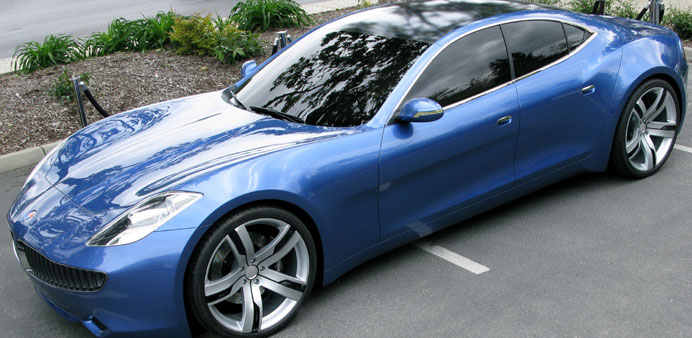
The company’s flagship vehicle, the $100,000-plus Karma plug-in hybrid, quickly won accolades for its styling and cachet with celebrities, including pop star Justin Bieber and actor Leonardo DiCaprio, who is also an investor in the company.
Fisker used $193mn of the DoE loan and earmarked the rest for a second plug-in hybrid, the Atlantic, but the DoE froze the credit line after delays in launching the Karma. The last payment from the DoE came in May 2011.
“The Department of Energy stopped payment on the federal loan in 2011 after Fisker stopped meeting their milestones, and is committed to the best outcome for taxpayers,” DoE spokeswoman Aoife McCarthy said in a statement.
“Despite Fisker’s difficulties, our overall loan portfolio of more than 30 projects continues to perform very well, and more than 90% of the $10bn loan loss reserve that Congress set aside for these programmes remains intact,” she said.
Fisker has not produced a car since July and has been seeking a financial backer to help finish the development of the Atlantic and produce it at a Delaware plant.