


By Fran Gillespie/Correspondent
The Doha Community Orchestra (DCO) is now so large and well established that it has its own Wind Symphony section.
At a concert by the Wind Symphony at American School Doha (ASD) on Tuesday evening, the audience was entertained in the first half by five ensembles from ASD - some of whom are junior members of the orchestra - ranging from a somewhat under-rehearsed rendition of Mozart’s Ave Verum Corpus by the brass players, redeemed by the Kyrie by Gabrieli, to crisp and pleasing performances of Mozart’s Divertimento in F and the saxophones playing yet another piece by the ubiquitous Mozart, whose music seems adaptable to almost any instrument.
The final performance in the earlier part of the concert was an enjoyable rendering of Australian musician and teacher John Parker’s lively and intricate In Progress by the percussion ensemble, with some fancy work with the hammers by the young musicians, accompanied by electric guitar. Parker composed the piece in 2005, he said, as an attempt to get students interested in playing tuned percussion and to introduce them to melodic improvisation, and in this he certainly succeeded, judging by the enthusiasm of the ASD players!
In all, almost 50 youngsters took part, and the standard of their performance is a credit to their dedicated teacher, Mark Seay.
The “star of the show” on Tuesday was visiting British BBC Young Musician of the Year finalist in 2012, tuba player Christopher Dunn, who happens to be the half-brother of Tim Craxton, until recently the DCO’s manager! Aged only 19, Dunn has already distinguished himself by winning the Guildhall School of Music’s most prestigious award in 2011 and participating in performances at Buckingham Palace, the Lord Mayor’s Show and last year in the Queen’s River Jubilee Pageant as part of the Mayor’s Jubilee Band.
Although for most people the tuba, the largest and lowest in tone of the brass instruments, is usually thought of as oomphing away in the background of large orchestral pieces, in recent years it has come into its own as a versatile instrument from which almost any sound can be produced, with more and more music being composed especially for it. Indeed, one media critic got so carried away recently after hearing a solo performance by a tuba that he declared, “Anything a violin can do, a tuba can do too.”
After the interval, the Doha Community Wind Symphony took to the stage, with Dunn as soloist, with a performance of British composer Edward Gregson’s recent work Tuba Concerto. The concerto follows the usual quick-slow-quick pattern, Allegro Deciso, Lente e mesto and finally Allegro Giocoso.
Opening with a lively fanfare on the trumpet, this was followed by Dunn with a solo lyrical cadenza echoing the opening theme, before the second theme was introduced, bringing out the higher range of notes from the tuba and its mellowness of tone. The second movement was quieter, with a softer performance of the opening tune by the tuba, and the third movement returned to a livelier theme with soloist alternating with the orchestra and a solo cadenza on the tuba, followed by the finale ending the performance with a triumphal flourish. Prolonged applause by the audience followed. Dunn then returned alone to give a performance of an extraordinary piece named Fnugg by Norwegian composer and soloist Øystein Baadsvik. This was the piece Dunn chose to perform last year as a finalist in the BBC Young Musician of the Year competition, and he declares it to be great fun to play and his favourite piece. It calls for entirely new techniques, including producing a beatbox sound with lip beats, and a didgeridoo-like tone produced by “multiphonics” - singing into the mouthpiece while playing at the same time, resulting in several notes at once.
A toe-tapping, rhythmic, light-hearted virtuoso performance, producing sounds ranging from squeaks and clicks to deep booming notes, it’s not hard to see why this piece has amused and entranced every audience, including the judges in last year’s competition.
The son of professional musicians - his father is a violinist with the English National Opera orchestra and his mother a harpist with English National Ballet - Dunn is currently in the first year of a five-year course in medicine at University College London.
Talking to Gulf Times, he said he started by learning the violin and only took up the tuba at the age of 11, won over by its impressive size and shininess. He has no thoughts as yet of becoming a full-time professional musician, preferring to concentrate on his medical degree.
He mentioned how often medicine and music go hand in hand, as it were, with a remarkable number of doctors also being accomplished musicians. “For me, music is something that I love and feel comfortable with,” said Dunn. “Music and medicine both involve a lot of memorising, so the disciplines are similar. Music helps me keep calm, it really goes perfectly with medicine.”
Any future ambitions? “Yes,” he said, “I’d love to play with the World Doctors Orchestra, founded in 2007 in Berlin. It goes on tour twice a year, giving performances to raise funds for medical aid projects.”
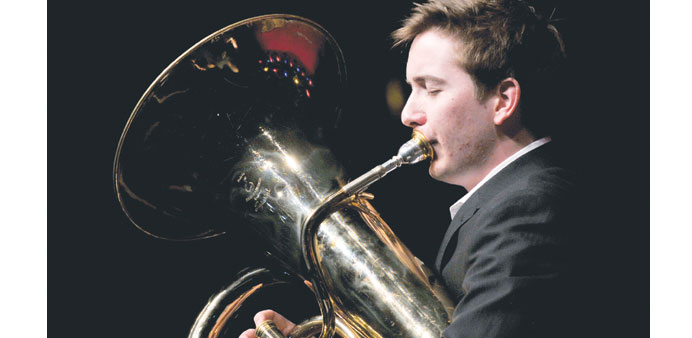
Chris Dunn giving a solo performance.