


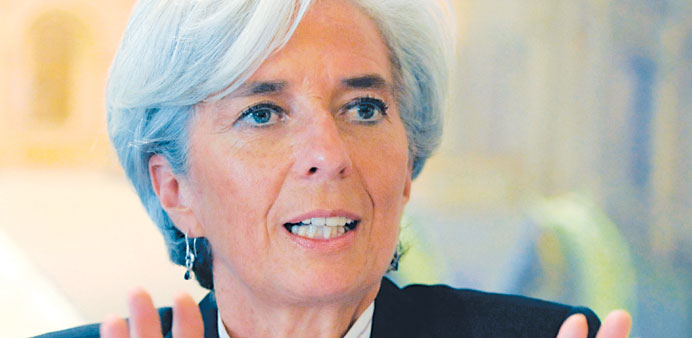
Lagarde says efforts will now “focus on completing the financial sector re-capitalisation process, gradually restoring normal financial flows and facilitating the restructuring of banks’ impaired loans”
The International Monetary Fund has agreed to provide approximately €1bn to the £10bn rescue plan for cash-strapped Cyprus, managing director Christine Lagarde said yesterday.
This would be through a three-year 891mn Special Drawing Rights (about €1bn) loan,” Lagarde said, adding that she expects the deal to go to the IMF executive board for approval in early May.
The IMF, European Commission and European Central Bank agreed with Cyprus on Tuesday the terms of a programme that will see the country drastically downsize its bloated banking sector and put state finances in order.
“The Cypriot authorities have put forward an ambitious, multi-year reform programme to address the economic challenges they face,” Lagarde said, describing it as “resolute”.
“The overarching goals are to stabilise the financial system, achieve fiscal sustainability and support the recovery of economic activity to preserve the welfare of the population.”
As part of the deal, Cyprus agreed last week to shut down bankrupt Laiki (Popular) Bank, transferring its deposits under €100,000 to the country’s largest lender, Bank of Cyprus, which will be re-capitalised.
Deposits over €100,000 at Bank of Cyprus will be subject to a still-undetermined haircut which could reach 60% of their value.
At the same time, the government imposed capital controls to prevent a run on banks.
Lagarde said efforts will now “focus on completing the financial sector re-capitalisation process, gradually restoring normal financial flows and facilitating the restructuring of banks’ impaired loans.”
Cyprus has also committed itself to raise taxes, rein in spending and carry out structural reforms in the public sector to put its public finances in order.
Lagarde said “this is a challenging programme that will require great efforts from the Cypriot population,” but that it “provides a durable and fully financed solution to the underlying problems facing Cyprus and provides a sustainable path toward a recovery.”
She added that the measures adopted “seek to distribute the burden of the adjustment fairly among the various segments of the population and to protect the most vulnerable groups. The IMF, together with its European partners, will continue to support the efforts of the Cypriot people.”
Meanwhile, the head of Greece’s biggest business group said yesterday the Cyprus crisis could tip Greece into an even deeper recession this year, urging a growth-boosting rethink of the country’s bailout programme.
“Greece is directly affected by the Cyprus crisis and based on some estimates this may chop up to one percentage point off GDP (gross domestic product),” Dimitris Daskalopoulos, head of the Hellenic Federation of Enterprises (SEB), told reporters.
Greece’s economy is in its sixth straight year of decline as Athens applies austerity policies to shore up public finances and keep bailout aid flowing, with unemployment above 26%, the highest rate in the 17-nation eurozone.
The government projects a 4.5% slump this year, bringing total economic contraction in 2008-2013 to almost a quarter— Greece’s deepest recession in peacetime history.
Cyprus’s own appeal for international help followed huge losses by its banks on their exposure to Greek debt writedowns required under bailout terms for Athens.
Cyprus absorbs about 9% of Greece’s exports. Greece’s central banker said earlier this week the crisis may shrink Greek economic output by 0.35 percentage points this year.
“With the success of the Greek bailout programme already hanging by a thread, many signs show the recession is deepening with the prospect of recovery in 2014 fading,” Daskalopoulos said.
He said the insistence on austerity by the eurozone’s core to cure the ills of the debt crisis risked breeding euro scepticism and anti-German sentiment among the suffering countries of the single currency bloc.
“The North must give and the South must change, otherwise the historic demons of Europe will find again room to act.”
Daskalopoulos spoke a day before a team of Greece’s international creditors returns to Athens to resume a review of the country’s performance in meeting bailout targets and decide whether it qualifies for payments under its €240bn bailout.
He said the protracted economic downturn and fiscal austerity were testing society’s tolerance limits and called on the government and its international lenders to retool the applied programme with growth measures.
“The bell of reforms must finally ring loudly in Greece,” Daskalopoulos said. “We cannot be fighting tooth and nail against firing a few thousand public sector workers when almost 1mn people have lost their jobs in the private sector.