


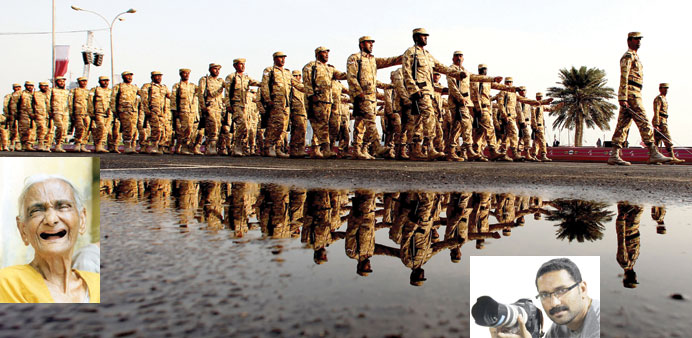
A K Bijuraj’s socially-themed short films and his photography have earned him many awards in Qatar. Interview by Nahla Nainar
Scoping life through the camera lens is both a passion and profession for A K Bijuraj. A photographer with Aspire Sports Academy, the Indian expatriate is also an award-winning filmmaker and aspiring drummer.
“I don’t feel I’m working, I love what I do for a living,” says Bijuraj in an interview with Gulf Times. Indeed, judging by the number of short films and creative media projects that he has been involved in while holding down a day job that entails him accompanying the state teams on tournaments, you are inclined to agree with him.
Among the accolades that have come his way in Qatar just in the past year are the Eco-friendly Award at the COP 18 CMP8 UN Climate Change Conference (for the film You Turn); Barwa Qatar National Day Photography Award Qatar-2012; Doha Film Institute-Sony Qatar National Day Photography Award; and the Doha Film Institute’s Social Media award for the short film TechSting.
He has already won photography awards for this year from the Qatar Olympics Committee for National Sport Day sports photography and one for the short film Miss You Paa made for the Qatar Traffic Department’s Youth Forum.
It’s hard not to be surprised when Bijuraj reveals that he started out as a teacher in a private college in Kannur, in the southern Indian state of Kerala. The history and Malayalam literature graduate wanted to be a filmmaker so badly that he never really planned for any alternative career.
But destiny had a roundabout way of getting him there.
“When I was doing my post-graduate studies, my friends started an evening daily Talipuram Times, and I joined as a correspondent, reporting on local politics. I was also involved in the Student Communist Party, and wrote a weekly column under a pseudonym.”
Why the secrecy? “My life was in danger because Kannur is a hotbed of politics in Kerala,” he said. “Besides this, at the local level, quite a lot of my relatives were prominent politicians, so I had to be careful not to get noticed.”
His friends’ paper turned out to be a good training ground for Bijuraj. “I learned all aspects of running a newspaper. That’s when I thought of taking up photography, because the visual media is more impressive, and my opportunity to write was limited,” he recalled.
Following this, a two-year internship with the leading Malayalam newspaper Mathrubhumi gave Bijuraj an opportunity to travel extensively throughout India and also pick up valuable lessons from leading photo-journalists. He joined the paper as a staff photographer in 1996.
Stills photography and filmmaking have their own challenges, says Bijuraj. “Some of the most striking images in the world are still photographs, such as the Pulitzer prize-winning picture of a vulture sitting near a starving child in Sudan in 1993 by the South African photographer Kevin Carter.” Carter later committed suicide, apparently deeply troubled by the image he had captured on film.
“We have 25 frames to tell a story in a film scene. In photography, we have to tell the same in one image. When I have a problem with photography, I use cinema techniques,” he says.
Bijuraj got introduced to Malayalam cinema through his work for the Mathrubhumi’s film magazine Chithrabhumi. Around this time, he also put on a photo exhibition titled Smrithi (Memory/Remembrance) of 101 photographs taken in old age homes around Kerala. His aim was “to show the younger generation that old age is not something to fear. We will also become old. By showing these photos, I was urging children not to abandon their parents in old age homes,” he said. The photo exhibition toured around 200 schools and colleges in Kerala.
He also made a documentary on the same subject, called Sneham pakarnnu oduvil.
Other works followed: Theruvile Aaghosham (Festival of the Street People) on how roadside dwellers celebrate festivals and a documentary Vayalarinte Kalpadukal (In the Footsteps of Vayalar) on the poet and film lyricist Vayalar.
“I made all this using old-style celluloid filmmaking. I used the camera and editing equipment and made these documentaries for a local TV channel. After that I started taking up my own production,” says Bijuraj.
Bijuraj has directed music videos as well, but what drives him most are themes on social awareness.
His first independent production is Reverse Gear, a short film on how globalisation has made a business out of fresh water. In the five-minute film, the protagonist, possibly a wealthy non-resident Indian from the Gulf, drives up to his village river while on vacation, reminiscing about the good times he has had there with his childhood friends. On arrival, he finds the same river fenced off by a multinational corporation as ‘company property.’ The only way he can reach his beloved river’s water is through the bottled mineral water being sold nearby.
After this, Bijuraj worked as an assistant director on over eight films for the commercial filmmaker Jayaraj.
But he agrees that a full-time career in filmmaking can be quite uncertain. “I want to tell people what I see, through my films. My subjects are not commercial, there’s no dance and music in them. Short films are more difficult to make, because you have lesser time to tell your story,” he says.
Bijuraj came to Qatar five years ago after resigning from Mathrubhumi. His first work in Qatar, titled Goal, on the country’s 2022 FIFA World Cup bid, was one among eight selected by the committee.
The Doha Film Institute’s 48-hour challenge saw him and his team pitting their wits together to create and film a story within two days using a line of dialogue given by the organisers (‘his moustache is very nice’) and the props of a chocolate box and a pencil.
The seemingly unconnected ideas were woven together in TechSting, a film against driving while texting, that uses innovative camera techniques in a pared down tale of two lovers sending each other short messages ahead of their actual meeting. The movie’s cataclysmic ending is shocking even though expected, which is perhaps why it earned the Social Media award from the DFI.
Miss You Paa is an equally thought-provoking work on distracted driving, told through the eyes of a child. For a Traffic Department awareness film, Miss You Paa’s setting is not the roads of Doha, but a table and two toy cars.
Most of Bijuraj’s work is uploaded on YouTube.
And the music? Bijuraj is already an accomplished player of the traditional ‘chenda’ drum of Kerala. For the past four years, he has got together with a few friends to learn Western-style drumming (you can watch one of their informal jam sessions on YouTube).
About his future plans, Bijuraj says, “My dream is to make a feature film in Arabic. I want to use drama and theatre as the background, and use local artists here. So far I have been using my friends’ circle for my film projects. I used the equipment we already have so far, and have been making ‘zero-budget’ films. It’s my dream, so I don’t know how much it will cost,” he adds.
The second project is tentatively titled Qatar’s History Through My Lens, featuring Bijuraj’s photographs of the country. “Around 25% is already done,” he says. “Qatar’s history is quite young. I’m focusing on what the country wants to show to the world as its history. My working hours at Aspire are from 5.30pm onwards. So I get a lot of time in the morning. I go out early in the morning to get the best photographs. I spend around 3-4 days a week on this.”
It is unlikely that visual media will kill the print media, feels Bijukumar, because no matter how many television channels you have, “if we want to confirm a news event, we call up the newspaper, and wait for it the next day. Now there are too many channels, and the news changes every minute. Only a newspaper can ensure the confirmation of the actual event.”
But even newspaper readership is changing, he says. “When I was studying about print media, everywhere, the news article was supported by pictures. Now, it’s big pictures and small text. I think 90% of people read only headlines and glance at the pictures. Because we are too busy, and we are looking at the newspaper only to confirm what happened yesterday on TV.”
Considering that 2013 is the centenary year of Indian cinema, Bijuraj rues that there is no interest there in preserving film history or indeed in history of any kind. “Culture is based on our history. We should preserve our history, to know how our ancestors lived. And it will help us to plan for our future,” he concludes.