


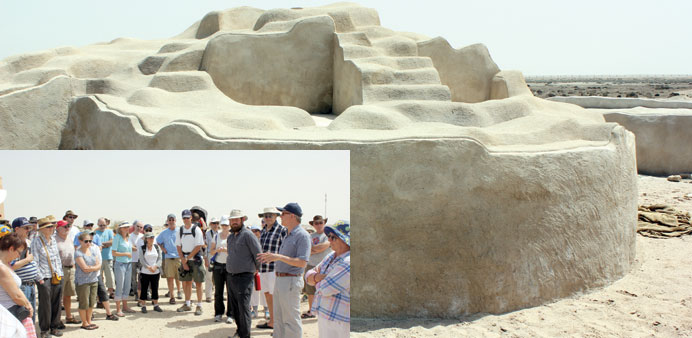
* Recently plastered tower and stairs of the palace complex, Zubara. Cover photograph: An aerial view of Al Zubara showing areas under excavation. INSET: * Dr Alan Walmsley [right] addresses members of the Qatar Natural History Group.
Al Zubara is the best example in the Arabian Gulf of a pearl fishing and trading port dating from before the modern oil-era. Fran Gillespie reports on a recent tour of the town’s excavated remains
|
|
The ancient town of Al Zubara on Qatar’s north-west coast, deserted a century ago and left to fall into ruin, is coming to life again, as a team of archaeologists uncovers the remains of the buildings and reveals details of the daily lives of the people in this once thriving port.
Al Zubara is the best example in the Arabian Gulf of a pearl fishing and trading port dating from before the modern oil-era.
Because it was abandoned so long ago, the street plan and the remains of the buildings have remained undisturbed. For many years the settlement lay silent, its walls slowly crumbling into mounds of sandy rubble littered with fragments of green-glazed water jars, coarse earthenware and sherds of blue and white porcelain.
But two centuries ago Al Zubara was a hive of busy activity, its streets crowded with people and its harbour full of fishing and pearling boats, and trading ships carrying cargoes of luxury goods to the settlement.
Last weekend members of the Qatar Natural History Group (QNHG) made a tour of the excavated remains, guided by Dr Alan Walmsley, director of the team of archaeologists from the Carsten Niebuhr Institute in Copenhagen, and his colleague Alistair Cross.
The research into Al Zubara’s fascinating past is part of the Qatar Islamic Archaeology and Heritage Project (QIAH) administered by the Qatar Museums Authority.
The 18th century town was laid out according to a plan, with narrow lanes running down to the sea. Houses were built of beach rock, or from limestone quarried on a ridge a short distance to the north of the city. A souq with rows of small shops stood near the shoreline, and there was a small industrial complex where metal was smelted in crucibles. In its heyday the population may have numbered as many as 9,000, although such a figure is an estimate.
Some inhabitants would have lived in tents or barasti (woven palm leaf) huts which now leave little trace.
One of the most intriguing sites amongst the remains of this large town is what the archaeologists dub the ‘palace complex’: a complex conglomeration of structures surrounding nine interlinked courtyards, with large, square buildings and towers of plastered limestone in the surrounding walls.
It is obvious that some of the rooms were domestic dwellings, said Walmsley and Cross, as they contain cooking places and hamam (bathrooms). These had floors with layers of tiny shells or clean white gypsum plaster, and walls whose plaster was sometimes decorated. In the courtyards are holes where water or grain storage jars and tannur ovens were once half buried.
But other buildings facing onto different courtyards were storerooms and areas where some kind of manufacturing was carried out.
The whole complex was fortified, with towers from which the building could be protected from attack from either land or sea. The discovery of two staircases leads to the speculation that some parts of the palace may have had an upper storey. The doorway to the palace was screened to preserve the privacy of the family, especially the women, from public gaze.
Examination of the contents of a nearby midden, where domestic waste piled up, has revealed that the inhabitants of the ‘palace’ enjoyed a high protein diet. Evidence, in the form of animal bones, that they ate meat more frequently than the other inhabitants of Zubara, who relied on fish as their main source of protein, is an indication that they were well-off.
Despite its grandeur and the precautions for its protection and security, said Walmsley, the ‘palace’ was occupied for no more than two or three generations.
A fort was built in 1768 at nearby Mrair to guard the town from land attack, and a wall with round towers at intervals surrounded the settlement. But the town was subjected to repeated aggression by neighbouring tribes, and in 1811a devastating attack by forces from the Sultanate of Muscat reduced it to a third of its former size. This led to the curious situation, said Walmsley, where the outer of the two walls surrounding the town, which one would normally assume to be the more recent, is actually the older of the two.
Members of the QNHG explored sections of the recently excavated walls of the older town, which had an inner ledge, a ‘fire-step’, where men could stand with their guns behind the protection of the higher, outer part of the wall. Another complex of buildings currently under excavation includes large rectangular warehouses near the harbour where goods could be stored, and small retail premises.
There are several date presses, where sacks of dates were piled up to allow dibs, the sweet sticky juice that oozes from the compressed dates, to trickle down narrow channels into collecting jars. Nearby are the remains of a fort which would have guarded the harbour and where customs officials could have supervised all goods being imported and exported.
Al Zubara was above all a pearling port, explained the archaeologists, and immense wealth poured into the town from its harvest of these treasures from the sea. There is a written record of a single robbery in the nineteenth century when pearls to the value of the income a pearl dealer could expect to make in three years were stolen!
But trade was also a very important occupation for the people of Al Zubara.
The harbour was shallow, restricting the size of the dhows that could enter it, but fleets of these vessels carried pearls, dates and jars of dibs far along the trading routes and imported tobacco from Iran, fine coffee from Yemen, food stuffs and huge quantities of pottery, especially Chinese porcelain mass produced for the export market. Coins and trading tokens from Persia, India, Turkey, Zanzibar and British-ruled East Africa, indicate how widespread was the trade.
Although it was a pearling and trading town, said the director, it is very important to see Al Zubara not only as this but also as the home of poets and scholars. It was for many years a settled community, and it is known from documentary sources that many of the inhabitants were educated and cultured citizens. It is likely that the settlement was eventually abandoned around 1900 because of the increasing difficulty of obtaining enough fresh water.
Excavations at Zubara first took place in the 1980s and then in 2002-2003. The work carried out during the last four seasons by the large team from Denmark has added an immense amount to our knowledge of this large city, which is expected in June this year to receive World Heritage Site designation from Unesco. As Dr Alan Walmsley stated, “This town really encapsulates the birth of the political and cultural framework of the modern Gulf.”
Information about the work at Al Zubara can be found on the frequently updated website http://alzubarah.qa/en/ and on Facebook at https://www.facebook.com/AlZubarah