


Reuters/Dubai
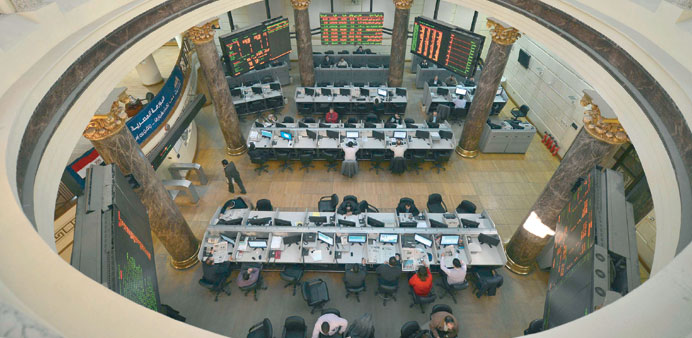
Selling pressure from foreign investors dragged Egypt’s bourse down to a near 16-week low yesterday as the country’s economic situation worsens, while Gulf markets were mixed.
Egypt’s government has hit a breaking point in its ability to pay for imports of oil, wheat and other basic commodities, forcing it to call in diplomatic favours.
The country will receive payment facilities from American and European suppliers of wheat, an Egyptian newspaper on Saturday quoted minister of supplies Bassem Ouda as saying.
Critical finances and political woes have hit investor sentiment and brought on a credit rating downgrade from Moody’s earlier in March.
Most stocks declined. Orascom Construction Industries and Commercial International Bank lost 2.5% and 3% respectively. Non-Arab foreigners were net sellers, according to bourse data.
Shares in National Societe Generale Bank declined 1.9% to 30.10 Egyptian pounds ($4.42) - its lowest since August 2012. The stock has fallen for four sessions since the Egyptian government said it would levy a 10% tax on capital gains made from selling shares to QNB.
The exchange executed the sale of NSGB shares to QNB, representing a 97.1% stake in the Egyptian lender. NSGB will be delisted from the bourse on April 7
QNB bought a 77.2% stake from NSGB’s parent firm Societe Generale, and acquired the rest from the market at 38.65 pounds per share.
Cairo’s bourse fell 1.6% to 5,099 points, its lowest close since December 11.
“The market broke the support at 5,100 on low volumes and the next support is near 4,900 points” said Mohabeldeen Agena, head of technical analysis at Cairo’s Beltone Financial. “We might see a minor rebound from current levels, which is an opportunity to sell.”
In Saudi Arabia, the index slipped 0.5%, extending declines from a 10-month high as investors booked gains in large-cap stocks.
Saudi Basic Industries Corp (Sabic) lost 1%, dragging the petrochemical sector down by 0.8%. The banking index shed 0.5%.
In Kuwait, investors bought stocks to boost share prices at the end of the first quarter but the index was little changed.
This trading tactic, known by many brokers as “window dressing”, is especially rife in Kuwait, with investors seeking to temporarily bolster portfolio performance.
Small-caps dominated trade. Gulf Investment House and Investors Holding Group climbed 5.5% and 2.2% respectively.
Selling pressure on stocks also eased as many companies filed earnings on the final day of the reporting period. Shares in firms that failed to do so will be suspended from trading today.
Logistics operator Agility rose 1.7% to a three-year high. The firm said its fourth-quarter net profit more than doubled.
Elsewhere, UAE markets were mixed with Dubai’s bourse falling 0.9% to a fresh two-month low as investors booked profits from an early-year surge.
Emaar Properties and Air Arabia declined 1.7 and 3.1% respectively.
Abu Dhabi’s benchmark gained 0.3%. Shares in Ras Al Khaimah Ceramics surge 14.7% after the company proposed a 20% cash dividend.
Elsewhere, Oman’s index fell 1% to 5,990 points, while Bahrain’s index climbed 0.5% to 1,092 points.