


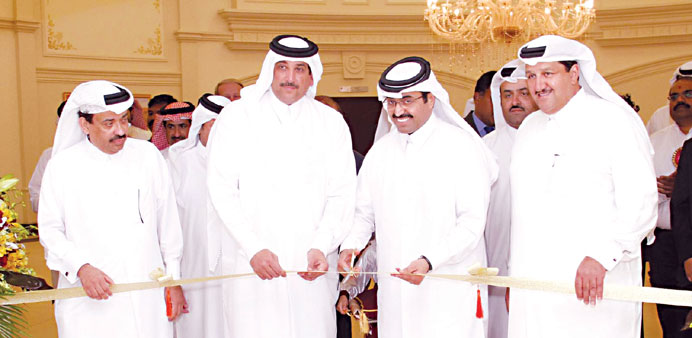
HE the Minister of Energy and Industry Affairs Dr Mohamed bin Saleh al-Sada inaugurating the annual Qatar Fertiliser Company’s Flowers and Vegetables Show in Al Banush club house in Mesaieed. Al-Sada later announced plans to take the show to an “international level”. PICTURE: Jayaram
Visitors to the Qatar Fertiliser Company’s (Qafco) annual Flowers and Vegetables Show held at Messaied yesterday had a glimpse of the activities at the Sahara Forest Project Pilot Facility in Qatar, which was launched last year.
The Sahara Forest Project Pilot Facility, developed by Yara, Qafco and the Sahara Forest Project, was opened by HH the Heir Apparent Sheikh Tamim bin Hamad al-Thani last December.
It is an environmental project on a pilot scale to demonstrate the potential of green technology in an arid region like Qatar, using seawater and solar energy for future research and commercial ventures in horticulture, freshwater generation, energy and algae production.
The Sahara Forest Project Pilot Facility has been set up in a 10,000 sq m site near the Qafco 6 facility, also inaugurated by HH the Heir Apparent at a high-profile ceremony held at the Mesaieed Industrial City on the same day last December.
According to Qafco Vice-Chairman and Chief Executive Officer Khalifa Abdullah al-Sowaidi, the Sahara Forest Project is expected to pave way for commercialisation of the green technology for large-scale implementation with a vision to produce energy, food and freshwater not only in Qatar but for world population in a sustainable manner.
Speaking to ‘Gulf Times’ about the project, its cultivation co-ordinator, Patric Brading, said: “We are trying to produce food, freshwater and energy in a sustainable way by using the resources we have abundantly such as seawater, carbon-dioxide (CO2), sunlight and desert areas, to produce what we need more of and the idea is as we do this, it is good for the environment and the people. It also has to be economically viable, that is, it has to be good for the industry.”
He explained that the key idea of the project was to use sea water as an integral part of its infrastructure around greenhouses and solar power.
“And what we can do with the sea water for example is to cool the greenhouse, in some kind of evaporative cooling. We can desalinate by producing freshwater and we can also tap into extra sea water to boost things like algae for bio-fuel production. And it is all integrated into one resource. Any waste in one area is being reused in another,” he explained further.
Brading mentioned that theoretically the project has a carbon neutral footprint by actually storing carbon in vegetation. “We are aiming at re-vegetation of the deserts. We are looking at testing the technology and find better ways of improving them and learn more before moving on to their commercial use,” he stated.
He mentioned that for the region, a larger facility will be built in Qatar, which will be semi-commercial, adding that there are plans to spread the facilities to other parts of the world, including the Sahara desert, Egypt and Jordan.
“The technologies are well proven as they are concentrated solar power for producing freshwater and greenhouses. The technology is been proven but never been integrated and it is in integration that we can produce more efficient, lower energy industry,” he claimed.
However, Brading maintained that going commercial is a step-by-step process saying: “We want to build and increase our knowledge of the technology first and see each time we are confident before attempting to go commercial.”
“Our current size is one hectare and the next aim is to go to 20 hectares and then up to 200 hectares later on. And this is where we kind of reach semi-commercial level and invite people to test the technologies. We are aiming to promote research in this area and then, we will theoretically go up to 4,000 hectares. Once we reach that level we will be making a huge difference by promoting wealth in the community and jobs for people and locking down on low-carbon green vegetation we will produce bio-fuel energy and fresh water,” he pointed out.
He added that the greenhouse situated in the centre of the facility is being used to grow crops such as cucumber, tomatoes and peppers by using sea water to achieve a much better growing environment.
“We can produce commercial crops like tomatoes and peppers and in the West we have more traditional arable farming such as barley crops and salad crops also being grown from sea water,” he added.