


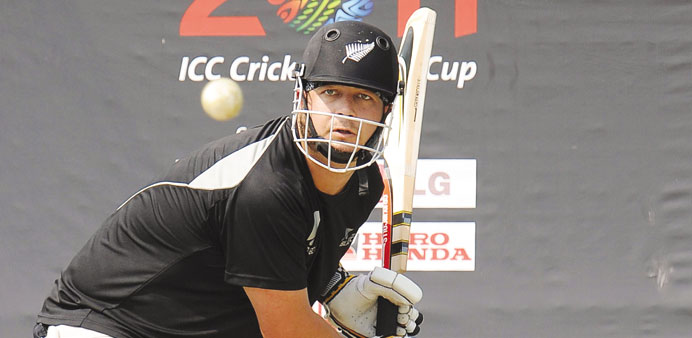
Ryder is in stable condition after a brutal assault on Wednesday.
AFP/Wellington
Battered New Zealand cricketer Jesse Ryder was showing signs of improvement yesterday and gave family the thumbs-up as police charged two men with assaulting the gifted batsman in a savage beating.
Ryder was attacked by a group of men as he left a bar in the South Island city of Christchurch early Thursday, and was rushed to hospital in a critical condition where he was placed in an induced coma.
His manager Aaron Klee said Ryder was responsive yesterday and had given the thumbs-up to medical staff and members of his family who rushed to be at his bedside.
Ryder remains in an intensive care unit in a stable condition and requires help with breathing because of an injury to his lung while the extent of his head injury has yet to be determined.
His mother Heather and his partner Ally thanked people around the world for sending messages of sympathy and police for arresting “people responsible for the heinous crime committed on our Jesse”.
“Jesse will be chuffed knowing how many people care and have reached out, including the huge number of cricket fans and players from around the world,” they said in a statement.
“We have read many of the messages online over the past 24 hours and we are keeping them for Jesse to read when he recovers.”
Police said they had charged a 20-year-old man and a 37-year-old relative of his with the assault and they would appear in court next Thursday.
“Two or three” people attacked Ryder as he left a bar and then resumed the assault when the injured player made his way to the car park of a fast-food outlet across the road, police said.
Although Ryder has a history of alcohol-related incidents and had been drinking before he was attacked, police said alcohol was not a factor in this instance.
Closed-circuit television footage showed the 28-year-old Ryder shaking hands with one of his alleged attackers moments before the assault started, according to bar owner Steve Holmes.
Holmes told Fairfax Media after reviewing the footage that the assault was “completely unexpected”.
He said Ryder, who had been drinking with his Wellington teammates after losing a season-ending match against Canterbury, was leaving the bar when one of the attackers called out to him.
Ryder went back to talk to the man and the two appeared to chat before shaking hands, Holmes said.
After a few minutes he said the “body language changed” between the two. Ryder walked out of the bar and the man followed him, seemingly yelling after him.
“There was no altercation until the cricket team left basically,” he said. “No one was heavily intoxicated, it was just a mediocre Wednesday night.”
Regan Harvey, who witnessed the assault and has given a statement to the police, believed Ryder was the target of an unprovoked “hate fight”.
Harvey was drinking at the bar when he heard the fight erupt.
“As I walked out there were a couple of guys beating up this one guy on the ground” and one of the attackers gave “two massive kicks” into Ryder’s stomach and rib cage, he said.
Ryder is on a self-imposed exile from international cricket while he addresses “personal issues” and has rejected calls to return to the New Zealand team despite an outstanding domestic season.
He last played for New Zealand a year ago in a one-day match against South Africa.
He was dropped for the next game when he breached team rules and went drinking in a bar where he verbally reacted to taunts from a member of the public.
Ryder was due to fly to India this weekend to compete for the Delhi Daredevils in the lucrative Indian Premier League. The team has wished him a speedy recovery.
Ryder—huge talent with human frailties
AFP/Auckland
New Zealand cricket’s wild child Jesse Ryder, seriously injured in a vicious assault this week, is a huge talent with the bat who struggles with alcohol demons and is a self-confessed bad boy.
In a tumultuous international career marred by a string of disciplinary lapses, the powerful all-rounder averages 40.93 in 18 Tests but last year went into self-imposed exile to sort out his “personal issues”.
The 28-year-old, who continues to catch the eye in domestic competition, has rejected all overtures to return to the New Zealand team, despite public clamour for his recall.
In the early hours of Thursday morning, Ryder was rushed to hospital after being assaulted as he left a bar in the South Island city of Christchurch.
Ryder had been drinking with his Wellington teammates after a season-ending loss to Canterbury, but police said alcohol was not a factor in the beating he sustained. Witnesses said the attack appeared unprovoked.
But drink has frequently been at the centre of Ryder’s troubles and the player has in the past sought psychological help to help get his career back on track.
In a 2010 interview he revealed how his life changed when his parents split.
“Dad bounced when I was about 14; he just took off man. He just dropped me off at a mate’s one day and said he’d see me in a week. He never came back,” he told the Sunday News.
“That’s probably where that rebel streak and badness comes from. I just didn’t have any boundaries once he left.”
His formative teenage years were spent moving around friends’ homes, sleeping on their couches and forming an association with alcohol.
“I guess I could be classed as a bad boy and it’s true, I did like going out (drinking). It wasn’t so much fighting, more so just getting on the beers with the boys.”
But his cricket talent shone through and by the time he left school the left-handed batsman was already on the New Zealand radar. In 2008, he made an inauspicious start to his Test career, scoring one and 38 on debut against Bangladesh but the following year he made his maiden Test century against India and followed up with a career-best 201. Yet the career of the New Zealander, who has also taken Test and one-day international wickets with his right-arm medium, has frequently been disrupted by alcohol-related incidents.
During the 2008 home series against England his season ended early when he cut his hand trying to break into a bar toilet after a night out drinking following a one-day international victory. The following year he was dropped after another night out because he missed a team meeting and was unable to train.
That stung Ryder because it was the players and not officials who told him they would not tolerate such behaviour.
“At that stage, we had peer assessments and that was the worst thing. I never want to let the boys down,” he said.