


By Kamran Rehmat/Islamabad
|
|
It certainly helps that Imran Khan has had a distinguished cricket career and that his swansong was winning the World Cup in a “boy-on-the-burning-deck” avatar.
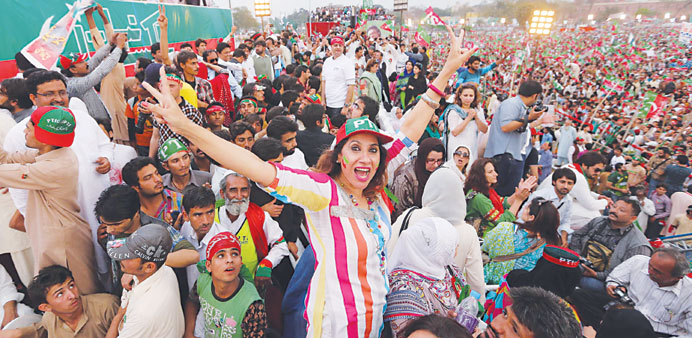
The feat was like a fairytale rooted in one man’s belief to perform the mission impossible against all odds and its 21st anniversary this week — just two days after his comeback rally in Lahore — would certainly have rekindled the fire as was evident at the rousing, if rain-drenched, rally.
Where cricket has helped Pakistan’s greatest captain is in doing the hard yards at 60 and keeping himself fresh: he still maintains physical fitness by workout and despite often falling short of required sleep and timely meals thanks to unbearable demands placed by his Pakistan Tehrik-e-Insaf (PTI) party, he even keeps a steady stream of tweets going out.
It also works in his favour that he has tremendous self-belief — surely borne out of previous career or life-changing events when detractors laughed off his ambition(s) and he proved them wrong almost every single time.
Building one of the world’s premier cancer hospitals with an impressive free treatment profile for the poor after a 10 year-long struggle to put it together with massive donation campaigns, and turning a mediocre Pakistani cricket team into world beaters are just two examples of how he has defied the odds and defined courage and conviction.
It is also a testament to his perseverance that he has guided his PTI into a viable alternative despite lacking the resources and significantly, going against the grain of established electoral politics in Pakistan.
Last week at the public rally, he took oath from around 80,000 office bearers who were directly elected by the members of PTI in an unprecedented, if long drawn out intra-party poll, which was deemed impossible by naysayers.
The exercise was also reckoned to be counterproductive since it would bring fissures to the fore, resulting in disgruntled elements, especially those at the losing end, who would then switch party loyalty.
In fact, Khan was seen as naive to indulge in an exercise, that as well as virtually taking him into political hibernation while his rivals lapped up turncoats and forged alliances, was pregnant with the potential to disintegrate the party.
However, what has happened is that despite the bickering and the odd desertion, PTI has rung a paradigm shift in how politics may now have to be followed after ordinary people — including a village tailor — have been able to canvass and become office bearers on the strength of popular vote.
The detractors are now struggling to explain the dénouement even as the party has survived dire predictions to sustain itself. Potential voters are bound to note this stark difference in how the PTI and the other two mainstream parties — the Pakistan People’s Party (PPP) and Pakistan Muslim League-Nawaz (PML-N) — run the show. The PPP and PML-N have a strong dynastic make-up and it is well nigh inconceivable for them to pitch-fork a party worker for a parliamentary seat.
The PTI experiment is likely to put the leadership of these parties under pressure although at this stage, they would be hard-pressed to change an approach built around a lifetime of family holdings.
PTI’s public meeting on 23rd March — the country’s National Day — was its first major show of force after a nearly five-month hiatus thanks to the intra-party poll during which critics had begun to wonder if its tremolo had waned to the effect that it was no longer a major player.
But the road show last week has firmly put that to rest. It was also the first public rally by any party after the announcement of the election date of May 11, and coming in the stronghold of former prime minister Nawaz Sharif’s PML-N, which is widely favoured in a slew of opinion polls to win the next elections, it is bound to set the stage alight.
As in 2011 when the PTI first announced its arrival as a major force in Lahore, the PML-N has once again been caught unawares. Likely, the complacency this time was triggered by the induction of droves of turncoats and new alliances that the party has forged in the last few months.
Sharif is now under pressure to reinforce the strong footing he had taken for granted in central Punjab. But it may not be all that easy to do so although the election frenzy is a useful medium to tap into.
The PTI’s comeback weeks away from the election will certainly ignite the passion of its workers who are fresh from the net practice of having gone through an extensive intra-party poll exercise. In the past, the lack of experience was a major chink.
However, much as the average PTI activist or supporter believes, the party is far from having acquired the ability and capacity to “sweep” the polls — which its leader continues to harp on.
While the PTI is generally assumed to have been able to force swathes of urban-based population particularly in Punjab and Khyber-Pakhtunkhwa provinces to think along the lines of giving it a chance against the status quo parties, its singular failure has been to hit the straps in rural Pakistan, where 63% of voters reside.
Perhaps, PTI has been hemmed in by the fact that rural Pakistan is still dominated by clan politics and financial/administrative muscle and that voting here is not driven by any notion of change. But this should not have been a deterrent, only a motivator, to try to change the mindset however difficult.
But it seems like other contenders the PTI, too, has concentrated its math on the 148 National Assembly seats on offer from Punjab — the corollary is that whoever controls Punjab is more than likely to claim a stake at the Centre, too.
Perhaps, if the PTI had taken the intra-party poll drive to the rural areas right after its game-changing rally in Lahore in 2011, it would have built enough momentum to rise as a truly national force by now. Currently, it has no support base in interior Sindh or Balochistan.
Having said that, Pakistan is abuzz with a challenger who is at least walking the talk of change.
♦ The writer is freelance journalist based in Islamabad. He can be reached at [email protected]