By Steven Rea
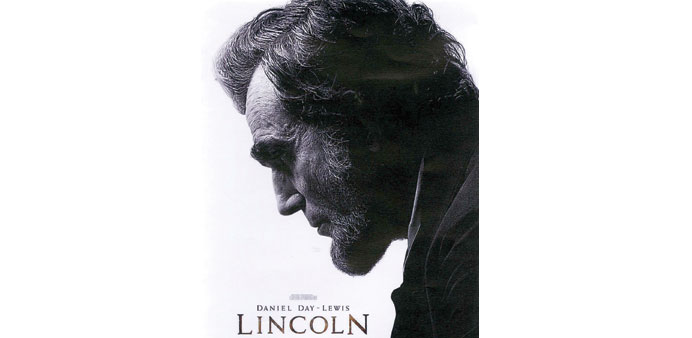
FILM: Lincoln
CAST: Daniel Day-Lewis, Sally Field, Tommy Lee Jones, David Strathairn, Joseph Gordon-Levitt, Hal Holbrook, Gloria Reuben, Jared Harris
DIRECTION: Steven Spielberg
A bearded wraith, his brow etched with deep grooves, skulks around in the dead of night. Tall and bent, his shoulders wrapped in a wool throw, he’s a chilling figure in a cold, dark house.
His house is the White House, and the wraith is Abraham Lincoln, 16th president of the United States. In Lincoln — Steven Spielberg’s Oscar-winning penetrating portrait of a nation’s leader at a moment of epic crisis — Daniel Day-Lewis delivers an utterly extraordinary performance, his voice aquiver, his body angular but pliant, moving with a creaking, spongy gait down the corridors of the iconic residence on Pennsylvania Avenue. The Civil War has taken hundreds of thousands of lives. And Lincoln’s determined campaign to outlaw the trade in human beings (“If slavery is not wrong, nothing is wrong,” he wrote) is being thwarted by a recalcitrant Congress.
Lincoln begins with bayonets and mud and muskets, soldiers of the Union and the Confederacy in close, miserable combat, but for the most part, the action in Spielberg’s handsome piece of history is verbal, emotional, electric. With a screenplay by Tony Kushner, adapting Doris Kearns Goodwin’s Team of Rivals: The Political Genius of Abraham Lincoln, the film masterfully captures the dual dilemmas facing the president in the final months of his life: how to bring the war between the states to an end and heal a broken land, and how to eradicate slavery, once and for all.
And though his goals were lofty, the country-lawyer-turned-commander in chief was savvy enough to know that deals needed to be made, scores settled, patronage jobs promised, if he was to win over the anti-abolitionist Democrats in the House of Representatives.
And so, Lincoln is as much about the process of the American political system — then, and (yes) now — as it is about the people who preside over it, who manipulate it, try to master it. This is one of Spielberg’s key achievements: that he introduces a gang of boisterous, contentious statesmen, pols, and lobbyists (William Seward, Thaddeuus Stevens, Edwin Stanton, Preston Blair) and manages to keep track of who they are, and how they are allied with, or opposed to their president.
But Lincoln is also a human story, and Day-Lewis, armed with Kushner’s eloquent prose, brings his subject to life with grace, humour, and soul. The president was, by history’s accounting, a wild man of a storyteller, and there are wonderful scenes here where Lincoln veers off on colourful narrative jags, regaling soldiers, or telegraph operators, or members of his cabinet, or his wife, with metaphoric rambles whose implications are not always clear.
Perhaps it’s the alchemical way the actor gets under the skin of his character, but Day-Lewis’ channelling of Honest Abe makes everyone else’s job all the more challenging. Tommy Lee Jones, as the Pennsylvania “Radical Republican” Thaddeus Stevens, is up to the task, with his wrinkles and wigs and wry, watchful manner; Jared Harris makes a third-act appearance, puffing on a cigar and bringing a battleworn wisdom to the part of Ulysses S Grant.
But Sally Field and Joseph Gordon-Levitt, as Lincoln’s wife and eldest son, never really get their footing. Field, especially, has trouble finding the centre of gravity for the slightly loony Mary Todd Lincoln. And Gordon-Levitt, as Robert, the son who wants to enlist — but who is forbidden to do so by his personal commander in chief — broods and sulks accordingly. Yet this filial drama seems insignificant, somehow. Lincoln’s relationship with his younger son, Tad (Gulliver McGrath), is more credible and compelling — the president curls up alongside his sleeping boy on a rug in front of a White House fireplace, or watches as Tad surveys a collection of tintype portraits of slaves.
But never mind a few misguided casting choices; Lincoln is an exceptionally good film, elevated by a superhuman star turn, and by the energy and invention its director displays in telling a story that doesn’t rely on action and special effects.
Instead, it relies on a pivotal moment in America’s history, looking at it through the eyes of the man at the maelstrom’s centre, trying to wield his might, and do what he believes is right. — The Philadelphia Inquirer/MCT
Rote family comedy
By Mark Olsen
FILM: Parental Guidance
CAST: Billy Crystal, Bette Milder, Marisa Tomei, Tom Everett Scott
DIRECTION: Andy Fickman
Things aren’t what they used to be in the world of Parental Guidance, not just with the kids but parents too.
In this lazy, smugly self-satisfied movie starring and produced by Billy Crystal, the comedian apparently wanted to say a thing or two about modern “helicopter” parenting techniques from the perspective of an old-school, been-there grandparent.
Crystal and Bette Midler portray the less-popular “other grandparents” to the three children of their only daughter, played by Marisa Tomei. (Tom Everett Scott is Tomei’s husband; it is difficult to recall if his character has a name.)
Tomei and Scott reluctantly call upon Midler and Crystal to watch their kids so the younger couple can take a trip away together. The children’s highly regimented lifestyles immediately begin to fall apart upon the arrival of their new temp caretakers.
Parental Guidance is intended as an inoffensive diversion for multiple generations who have run out of post-holiday dinner chitchat, a fact underscored by its something-for-everyone cameo appearances.
There’s skateboarder Tony Hawk, actor Gedde Watanabe (who played Long Duk Dong in Sixteen Candles) and even former Brooklyn Dodgers pitcher Ralph Branca (who gave up the legendary The Giants Win the Pennant home run).
Perhaps the whole family is also meant to enjoy the sight of Crystal being struck in the crotchal region with a baseball bat, causing him to vomit chili-dog onto a young boy?
Midler seems wildly underutilised throughout. Only she, Tomei and Bailee Madison as Tomei’s daughter inject a few precious moments of warmth.
The whole story seems geared to somehow proving that Crystal’s character was right all along, that they could all do better with a magic combination of old-fashioned discipline and a little loosening up.
In Judd Apatow’s new comedy This Is 40, a mother and father tell their two children they’d like them to spend less time with their electronic devices and more time doing things like building forts or playing kick the can. The teenage daughter squeals with exasperation, “Nobody does that crap, it’s 2012!”
As if to prove the point of how deeply, wilfully out of touch the worldview of Parental Guidance really is, Crystal and Midler share a moment of rain-kissed reverie teaching their three grandchildren to play, you guessed it, kick the can. In a film set in 2012. — Los Angeles Times/MCT
Being and nothingness
FILM: Straight A’s
CAST: Ryan Phillippe, Anna Paquin, Luke Wilson, Powers Boothe
DIRECTION: James Cox
Scott (Ryan Phillippe) has been in and out of rehab for the past 10 years. He surprises his high school sweetheart Katherine (Anna Paquin) by showing up unexpectedly. His dead mother has appeared to him and told him to return home and see his brother Williams (Luke Wilson), now married to Katherine, and his sick father (Powers Boothe). Katherine’s two children are enthralled with Scott, and Katherine begins to feel a connection between the two again. William is away on business, and struggling with fidelity issues of his own. Scott’s carefree life keeps him a certain distance from the family, but his presence is something that will change everyone’s life forever.
I’m still not sure why this is titled Straight A’s aside from some side conversation Scott has with Katherine’s son. This scene tries to make sense of the movie in that no one should always strive to be perfect, and sometimes things aren’t. Death is something that works into that theme as well. Unfortunately nothing is tied together well enough to matter.
I was left wondering what difference Scott had made in anyone’s life and it felt less meaningful with the inevitable ending. William isn’t home but for a few hours with Scott, and his father wants nothing to do with him. As much as Straight A’s reaches for spirituality, it lands far from its goal and comes off as a trite movie that doesn’t understand the values it purports to have. The ending is also incredibly contrived and drawn out, it doesn’t fit with the rest of film. Or maybe it does, as every choice here seems to be the safe one.
Nice direction and strong acting can’t save this snooze-fest of unrelenting nothingness. — By Trevor Anderson, moviemavericks.com
(DVDs courtesy: Saqr Entertainment, Doha)