


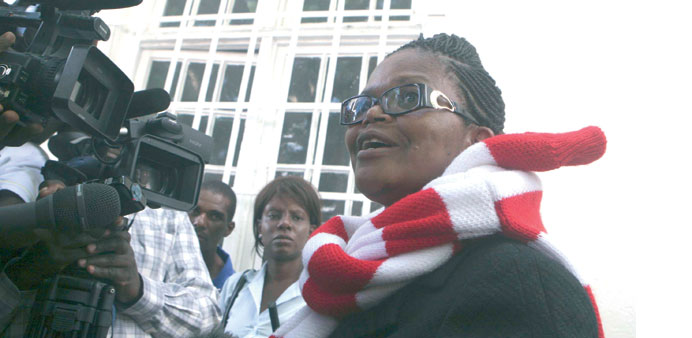
Leading Zimbabwean human rights lawyer Beatrice Mtetwa was released on bail yesterday after spending a week in jail in a case that has raised concerns about a crackdown by President Robert Mugabe’s security forces before elections.
Mtetwa, who has won international awards for her defence of journalists and opposition politicians, and four aides of Mugabe rival Prime Minister Morgan Tsvangirai were arrested on March 17, a day after Zimbabweans voted to curb presidential powers.
Mtetwa was charged with obstructing police after officers said she shouted at and took photographs of police when they were searching the home of one of the Tsvangirai officials.
The aides were charged with breaching official secrets laws and will appear before the high court on Tuesday to seek bail.
High Court Judge Joseph Musakwa, granting bail of $500, described Mtetwa as “forceful, combative and abrasive” but said the male police officers could have easily restrained her if she was hindering their work.
“If she was a commando she would take no prisoners,” he said in a court room packed with lawyers, relatives and two cabinet ministers from Tsvangirai’s Movement for Democratic Change (MDC) party. Anti-riot police stood guard outside the court house.
Musakwa set aside an earlier decision by a magistrate to deny Mtetwa bail, saying it was not often a lawyer was arrested while representing a client. Mtetwa was defiant after her release, telling reporters outside the High Court that her arrest was an attack on the country’s human rights lawyers and she would not be the last.
“I was just being used as the first example but there will be many to follow as we get into the elections mode,” Mtetwa said, wearing a red and white prison jersey over her shoulders which she said was a souvenir from a detained inmate. “I will not be cowed, I was doing my job,” she said.
EU suspends most sanctions against Zimbabwe, retains Mugabe on the list
AFP/Brussels
The EU yesterday suspended an assets freeze and visa ban against most Zimbabwean firms and people on its sanctions list in reward for a “credible” March referendum, but President Robert Mugabe and a handful of others remained on its blacklist.
Commending the people of Zimbabwe for “a peaceful, successful and credible vote” to approve a new constitution on March 16, the European Union announced it “has today agreed to immediately suspend the application of measures against 81 individuals and eight entities.”
EU officials withheld immediate details on names but a European diplomat speaking on condition of anonymity confirmed to AFP that Mugabe was among 10 Zimbabweans still targeted by the decade-old European Union measures.
The sanctions were originally imposed in 2002 on the grounds of political violence, human rights abuses and the failure to hold free and fair elections.
Mugabe’s ZANU-PF party immediately dismissed the lifting of sanctions as “non-event”, arguing it was not looking for a “partial removal of names from the list.”
“We are looking for the total and unequivocal lifting of sanctions which were not justified in the first place,” said ZANU-PF spokesman Rugare Gumbo.
“We are not looking for a partial removal of names from the list. We are looking for the total and unequivocal lifting of sanctions which were not justified in the first place.”
Yesterday’s removal of dozens of names from the blacklist was the largest since a policy U-turn last July, when on Britain’s suggestion the 27-nation bloc pledged to lift sanctions should the country hold a “credible” vote on a new constitution.
A total 21 Zimbabweans out of 112 on the EU blacklist, and one of 11 firms, had already been removed in February after Harare announced a firm intention to hold the vote.
At the referendum almost 95% of Zimbabweans came out in favour of a new constitution that would trim Mugabe’s powers and pave the way for new elections, expected to be held later this year.
Mugabe and his long-time rival Prime Minister Morgan Tsvangirai both backed the draft, which limits presidents to two five-year terms in office, boosts parliament’s powers but abolishes the post of prime minister.
Drafting a new constitution was a key condition of reforms agreed in 2008 when Mugabe was forced into a power-sharing deal with arch-rival Tsvangirai after a violence-marred presidential election.
The EU said yesterday that it welcomed calls for national reconciliation and peaceful political activity by Zimbabwe’s leaders, including the president and premier, but remained concerned by reports of political intimidation and harassment.
“The EU urges all leaders to ensure that their commitment to peace and transparency are respected by all groups and services of the security authorities,” it said.
“A number of key decision makers will remain subject to restrictive measures until peaceful, transparent and credible elections have been achieved.”
The suspension of sanctions - aimed at promoting reform in the southern African nation - follows in the steps of the lifting of EU sanctions on Myanmar.
The EU diplomat said that controversial mining firm, the Zimbabwe Mining Development Corp, remained on the EU blacklist.
NGOs and diplomats claim the state-owned ZMDC, a major diamond and gold mining company which operates five diamond mines in the Marange fields, was channelling money to Mugabe’s ZANU-PF.
The EU urged “effective observation” of the upcoming general election and welcomed a commitment by regional grouping SADC to send “a robust observation mission”. Brussels stood ready to provide support to the mission, the statement said.