


AFP/Reuters/Sydney
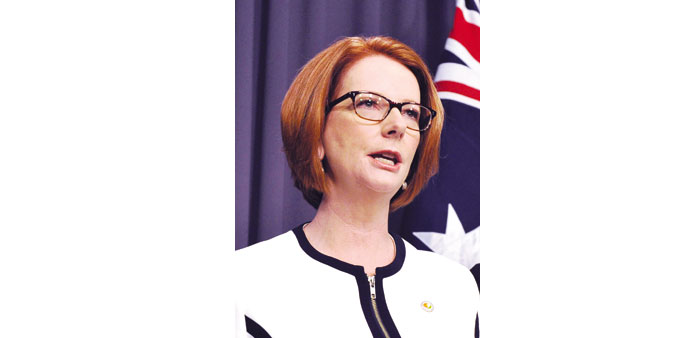
Australian Prime Minister Julia Gillard has accused her Labor party of self-indulgence after a farcical leadership coup against her, saying she was “appalled” by the events in an election year.
In announcing a cabinet reshuffle after key ministers backed former prime minister Kevin Rudd to take her job, the nation’s first woman leader admitted that “while purpose has driven us on, unity has eluded us”.
“And that unity spectacularly eluded us last week,” she told reporters.
“Like Australians around the nation, I was appalled by the events of last week.
“My political party, the Labor party that I love very dearly, was self-indulgent. Our eyes were on ourselves rather than ... being focused on the nation.”
The centre-left party has been riven by infighting as it slumps in opinion polls to lows from which it is widely seen as near-impossible to win the September 14 national election.
Several cabinet members who lost confidence in Gillard had pushed for a return to Rudd’s leadership given his enduring popularity with the electorate.
A leadership vote was called but Rudd failed to stand and has since said he will never challenge again.
“It was an unseemly display but out of that has come clarity,” Gillard said. “It is now very clear indeed that I have the confidence of my colleagues to lead. The leadership contest that has been within Labor is over.”
In the fallout, Martin Ferguson and Chris Bowen resigned as ministers for resources and tertiary education respectively, while Simon Crean, who held the portfolios of arts and regional development, was sacked for calling the leadership challenge.
The ructions forced Gillard to shake up her cabinet, her second reshuffle in as many months, with former adviser to oil and gas company Woodside, Gary Gray, named as Ferguson’s replacement.
Environment Minister Tony Burke was given responsibility for the arts portfolio while Trade Minister Craig Emerson took on the added duties of tertiary education.
Matt Thistlethwaite will become parliamentary secretary for Pacific island affairs, replacing Richard Marles who quit after supporting Rudd.
Transport and Infrastructure Minister Anthony Albanese was promoted despite being a Rudd confidant, adding regional development to his responsibilities.
Gillard also said the Climate Change Department, which has overseen the introduction of a controversial carbon tax, would now be merged with the Industry Department, and would be overseen by Climate Change Minister Greg Combet.
However, Gillard made no changes to the crucial Treasury or Finance Ministry, held by Deputy Prime Minister Wayne Swan and Penny Wong respectively.
Ferguson was regarded as a business-friendly minister and a strong supporter of the mining industry in Gillard’s cabinet.
Some A$400bn ($418bn) has been invested in Australian resources projects in the past decade, with a further A$200bn in liquefied natural gas projects, but the boom appears to be slowing.
The mining employer group Australian Mines and Metals Association said Gray was well known to the industry and should help attract investment to the sector.
Gray joined the Labor party in 1974. He quit the party in 2000 to work for conglomerate Wesfarmers and later as a public relations adviser for Woodside Petroleum, in order to help shape its defence in a takeover battle with Royal Dutch Shell.
Shell eventually withdrew its bid after it was deemed harmful to the national interest by then-Treasurer Peter Costello, thanks in part to Gray’s campaign to muster public sentiment against Shell.