


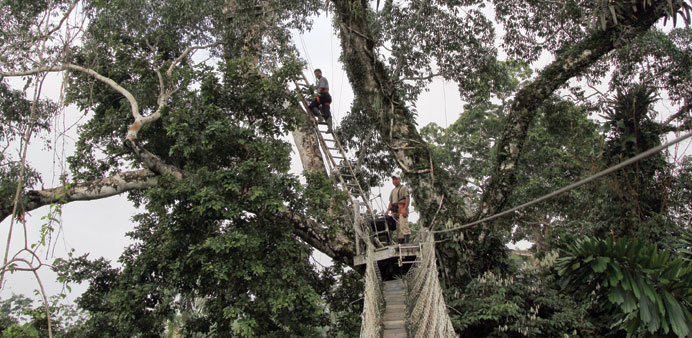
A climb to a high perch about 48m high at the Tiputini Biodiversity Station. A walk through the Canopy bridge, which is 38m high or a climb to the highest perch requires a double harness for safety reasons. Photo by Ole Mathismoen, Aftenposten, Norway.
By Bonnie James
The Tiputini River in eastern Ecuador gurgled as it flowed past the drifting boat. A soothing breeze wafted in. Orion’s Belt glittered in the night sky. Intermittent croaks filled the air.
“That is a canopy-dwelling frog, Hyla boans, calling for a mate,” said conservation biologist Professor David Romo, co-director of the Tiputini Biodiversity Station (TBS) run by the Universidad San Francisco de Quito on 650 hectare of pristine lowland rainforest on the edge of the million hectare Yasuni National Park.
Hyla boans dwells in the rain forest canopy and comes down to search for a mate. The male also digs a nest in the river bank mud so that the female can lay eggs.
This frog is just one of the thousands of life forms that inhabit Yasuni National Park, ‘the biologically richest place on Earth.’
A Unesco world Biosphere Reserve since 1989, Yasuni is one of the most intact sections remaining in the Amazon Basin and home to two of the last indigenous communities living in voluntary isolation to preserve their ancient cultures and traditions — the Tagaeri and Taromenane, both belonging to the Waorani ethnicity.
Because of its unique location at the intersection of the Amazon, the Andean Mountains, and the Equator and its function as a biological refuge during the last ice age, Yasuni is home to 2,704 species of vascular plants, 596 species of birds, 382 species of freshwater fish, at least 169 species of mammals, 151 species of amphibians, and 121 species of reptiles.
There are also more than 100,000 species of insects per hectare, the highest number in the world, and 80% of them do not even have scientific names. Every year, more species are being discovered in Yasuni.
To borrow the words of environmental scientist Professor Kelly Swing, who chose the site for TBS in 1994 and later became the founding director, Yasuni hosts ‘about one-tenth of all life on the entire planet Earth.’
TBS, located on the north bank of the Tiputini River, along the north central border of the Yasuni National Park, is around eight hours away from the capital city of Quito (A 30 minute flight to the town of Coca, followed by a two-hour trip through the Napo River to Pompeya, another two hour in an open bus, and a final two-hour journey up the Tiputini River, is required to reach the TBS).
The irony is that Yasuni also holds an estimated 846mn barrels or 20% of Ecuador’s oil, which the country is proposing to keep underground indefinitely by mobilising a $3.6bn Trust Fund, established in partnership with the United Nations Development Programme, to finance renewable energy projects.
The Yasuni-Ishpingo Tambococha Tiputini (ITT) Initiative, named for the three oil fields it contains, has to date got $330mn, including the pledges, secretary of state Ivonne A-Baki had told Gulf Times recently during a visit to Ecuador.
A salient feature of the conservation programme is that it aims to avoid the emission of 1.2bn metric tonnes of carbon dioxide, comprising 407mn metric tonnes stored in the ITT oil reserves and 800mn metric tonnes by avoiding deforestation.
In the book Yasuni, Tiputini and the Web of Life, conservation photographer Pete Oxford has listed some incredible facts:
“A single tree in the Yasuni National Park was found to be home to 43 species of ants — more species than in the entire UK.
“In one hectare (100m x 100m) of Yasuni forest, more than 650 different tree species have been counted. This is more than the total number of tree species found in the US and Canada taken together.
One hectare of forest to close to Yasuni was found to contain 87 species of amphibians, almost half the number in the US and three times as many in the whole of Western Europe. This particular one hectare patch of forest is now gone.
“Yasuni as a whole contains 50% more frog species than the entire US and Canada combined. There are 100 species of bats believed to occur in Yasuni alone.”
A large area of rain forest surrounding the Yasuni National Park has been decimated over the past decades on account of oil exploration. As Oxford notes in his book, “the Maxus oil road, from Pompeya to the Tiputini River, built in the early 1990s through pristine wilderness has caused large swathes of the rain forest to be cleared and for several years now, serves as a conduit for the illegal sale of bush meat, supplied by the indigenous people, who have developed a taste for the modern world’s comforts.
“It is not unusual to see the tribals selling bush meat and buying canned tuna. The ‘Westernised’ world has corrupted them,” a wildlife researcher told Gulf Times.
Oxford mentions in his book that “Waorani Indians living close the Maxus oil road are armed these days with Western weapons. They travel in vehicles provided by the oil company and hunt the mega fauna for the bush meat trade, destroying the forest at a breakneck speed.”
Despite all these challenges, during a recent three day trip to the TBS, I was able to see a sloth, brown woolly monkeys, squirrel monkeys, pink river dolphins, scarlet macaws, toucans, and a number of butterflies and insects — which according to Professor Swing is a ‘stunning success’ for a visitor to the Amazonia.
But for how long Yasuni will remain protected? Only time can answer this question.
BELOW:
1 A squirrel monkey looks up on a tree beside the Tiputini River.
2 A brown woolly monkey seen deep inside Ecuador’s Amazon rain forest.
3 A view of sunset and moon rise (top of the trees, right side) over the Tiputini River.
4 One of the numerous species of butterflies in Yasuni. The ‘eye’ on the wing is meant to intimidate predators.
5 Myriad shades and hues of green is a typical feature of the Amazon rain forest.
6 Indigenous guide Froilan explains in Yasuni about a ‘Walking Palm’ or Socratea tree with four-foot high stilt roots that allow them to ‘shift location.’ The new roots grow toward better light and as a result the tree itself moves. The process is slow and the tree does not actually visibly walk, but over a period of one year, a single tree can move up to 3ft from its original position.