


By Steff Gaulter
Many of us who live in Qatar seem to spend a lot of time on holiday, or planning where to go on our next adventure. Often people will e-mail me to ask what they should pack when they go away, or simply blame me if it turns out that it was the rainy season when they arrived at their chosen destination. If you are planning on going somewhere in the next month or so, this is the best time of year to visit a number of very different locations.
March is the beginning of spring in the northern hemisphere and the beginning of autumn in the southern hemisphere. This means the weather in many parts of the world is on the turn; the northern hemisphere is warming up after the depths of winter, the southern hemisphere is cooling down after their blazing summer. Most places aren’t too cold or too hot. For those countries which spread north to south over a great many latitudes, this makes March and April the best times to visit.
One of those places is Argentina, which stretches 4,000km (2,500 miles) from north to south. In the north is a tropical rainforest, whereas in the south some of the mountains are covered in snow and ice for the entire year.
Within the tropical rainforest, on the border with Brazil and Paraguay, are Iguazu Falls. The vast waterfalls span a width of 2,800km, and are so impressive that in the 1930s when the United States’ First Lady Eleanor Roosevelt first set eyes on the falls she exclaimed “Poor Niagara”! As you might expect in a tropical rainforest, the temperatures at Iguazu can be very high. Between December and February, which is summer in Argentina, the average daytime temperature is over 31°C (88°F), which can be rather unbearable when walking around the complex of waterfalls and jungle trails. By April, the average maximum temperature has dropped down to a far more manageable 27°C (81°F).
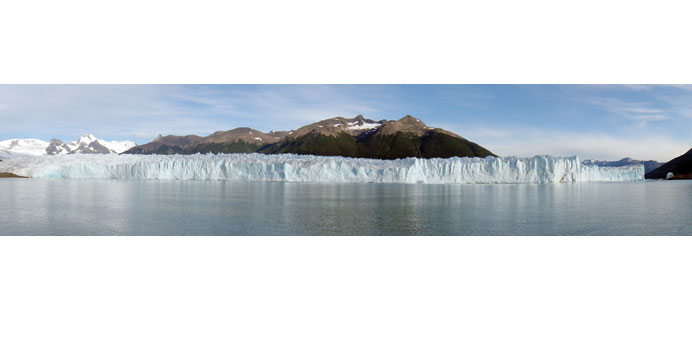
You may think that winter would be a better time to visit the north of Argentina, but if you visit Iguazu in winter, then you will probably also end up visiting other parts of the country in winter too. Your tour could well include the Los Glaciares National Park in El Calafate. This is home to the impressive Perito Moreno glacier, which in winter expects a maximum temperature of just 4°C (39°F). In March, however, the temperature is a far more bearable 16°C (61°F).
March is the start of autumn in Argentina, when many parts of the country are at their best. However, whatever time of year you chose to visit Argentina, it would definitely be a good idea to take an umbrella with you. Water is plentiful, particularly in the northern rainforests which seem to have a magnetic attraction to rain. My parents have a wonderful photo of themselves at Iguazu, when it’s absolutely throwing it down. They’re both wearing particularly fetching transparent ponchos, but the plastic doesn’t seem to have helped, though, and they’re both looking like drowned rats!
Another place which is a great destination in March and April is Vietnam. This country measures 1,650km (1,025 miles) north to south. Obviously this is less than half the length of Argentina, and it doesn’t get nearly as cold as southern Argentina either, but the advantage of March is that the rainy season hasn’t started yet.
The rains of the summer monsoon move northwards, following the sun as it tracks north in the northern hemisphere’s summer, then move south again as the sun retreats southwards for the winter. The rains usually start in Ho Chi Minh city in the south of Vietnam in May, and the rains finally clear again in December.
Many people who visit Vietnam will visit Ho Chi Minh city in the south, Hoi An in the centre of the country and Hanoi in the north. As well as being a fascinating city in its own right, Hanoi is also the starting point of trips to the picturesque Halong Bay.
I only wish that I had taken my own advice when I travelled to Vietnam a few years ago. We decided to travel in October, which had I thought about it, I would have known instantly that it was the middle of the rainy season. We’d been inspired by the British television programme Top Gear, whose presenters had been on a trip from the south to the north on mopeds. Unfortunately for us, time didn’t allow us to replicate their trip exactly, so we did a similar tour, but by plane. The first time I suspected that I may have made an error was when we were forced to wait in our plane on the tarmac of Ho Chi Minh airport for an hour, as there was a tropical depression passing over our destination of Hue. When we eventually arrived in Hue everything was pitch black. We wondered if we’d arrived in a tiny hamlet, until we realised that there was a power-cut and everything was flooded. There was even damp seeping through the wall of our hotel room.
From Hue, we took the train to Da Nang as the views from the windows were supposed to be spectacular. Unfortunately it was throwing it down and we couldn’t see a thing. A few days later when we arrived in the National Heritage Site of Hoi An, the entire town was flooded and the majority of it was only reachable by boat.
Floods and power-cuts generally don’t make for a great holiday, so it is definitely wise to check the climate before you travel to a region! I would love to explore more of Vietnam and Argentina, but next time, I would travel in April.
(The author is Senior Weather Presenter at Al Jazeera English channel. She can be contacted on [email protected]
or on Twitter at @WeatherSteff)