


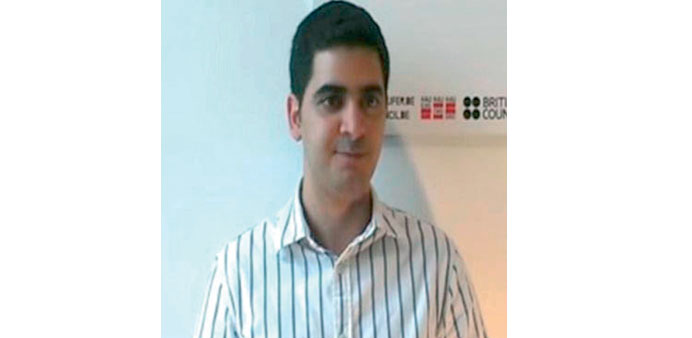
Ayman Mhanna ... internal political divide in Lebanon also translates into attacks on journalists.
By Salman Siddiqui/Staff Reporter
The Syrian crisis is deeply affecting Lebanon, says Lebanese human rights expert Ayman Mhanna. He is the executive director of the Samir Kassir eyes (SKeyes) Center that was established in Beirut in November 2007 following the assassination of Lebanese journalist and historian Samir Kassir in 2005.
Speaking to Gulf Times during a recently concluded workshop held by the Doha Centre for Media Freedom, he said that Lebanese journalists too were getting killed and injured during the coverage of the Syrian crisis.
“The situation in Lebanon today is deeply affected by the crisis in Syria. A journalist, who worked for a leading media group, was killed on the Syrian-Lebanon border in April last year,” he said.
He was referring to the slain Al-Jadeed TV cameraman Ali Shaaban, who was killed in a gun attack from the Syrian territory in the border town of Wadi Khaled.
Explaining the objectives of his centre, he said they have two goals, one is to monitor violations of press freedom and culture in the Middle East; and second is to defend the rights and freedom of expression of journalists and intellectuals.
When asked about the state of press freedom in Lebanon, he said that theoretically, Lebanon has one of the most open media environments.
He said that many countries in the Middle East can learn from Lebanon where freedom of speech for media exists in both letter and spirit. Journalists do not face restrictions on what they are allowed to write or report on. There are also laws in place that protect journalists.
However, while everything looks good on paper, journalists in Lebanon also routinely get threatened and physically assaulted. Moreover, the perpetrators too are never caught. “Since Lebanon’s independence in 1943, 16 journalists have been killed,” he said. But sadly none of the criminals who murdered these journalists were caught.
“Out of the 16 journalists who were killed in Lebanon’s history, none had his or her case dealt with any court. Not even one was arrested or punished for killing a journalist, let alone arrested for slapping or physically assaulting a journalist,” he added.
Speaking about assaults on journalists in Lebanon, Mhanna said “During demonstrations, which are very frequent in Lebanon, (there are numerous cases of) journalists and photographers getting physically assaulted by both security officers and others in a climate of total impunity. There has been absolutely no action taken against those who violate the press freedom and no one has been made accountable.”
Mhanna said the internal political divide in Lebanon also translates into attacks on journalists.
Lebanon has a thriving media scene. There are approximately 15 Arabic newspapers, one English daily and also a French daily. There are also around 9 news TV channels. However, what a journalist may or may not write often depends on the editorial line of different publications.
“It all depends on the editorial line of the newspaper. Every single topic can be covered but not in every newspaper. The editorial line of the newspaper still has lots of influence over journalists,” he said.