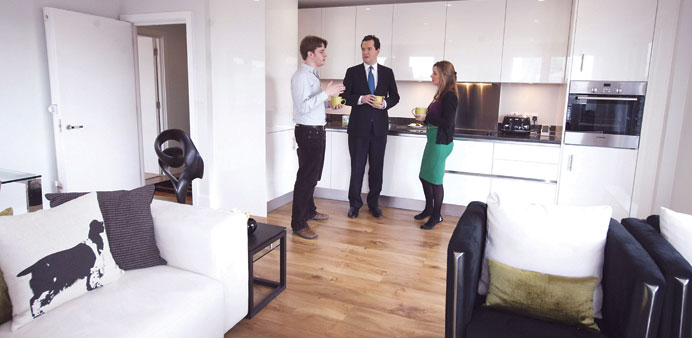
Chancellor of the Exchequer George Osborne meets Rick Newton and Emily Sandercock, who have recently bought an apartment at a development of new homes in south London.
Guardian News and Media/London
The government’s £12bn scheme to help homebuyers by offering mortgage guarantees could be used by wealthy homeowners to fund a second property, it has emerged.
The mortgage guarantee is the second part of the Help to Buy scheme unveiled in the chancellor’s budget, and from January 2014 will offer government backing on high loan-to-value (LTV) home loans.
Under the plans, borrowers will be able to get access to 95% mortgages with the government guaranteeing a portion of the loan to reduce the mortgage lender’s risk.
Although designed to help those who are unable to raise a big enough deposit to finance a property without assistance, the small print of the scheme does not rule out wealthy borrowers taking up the offer of a mortgage guarantee from the government.
Speaking on Radio 4’s Today programme, George Osborne said he did not want the scheme to help people buy second homes, but refused to say they would be banned from doing so.
“The mortgage market is an extremely complex thing. The intention of the scheme is absolutely clear, which is that it is for people who want to get their first home or have a home and want to move to a bigger home, because perhaps they have got a bigger family.
“We are working with the industry to get a scheme that works.”
The outline of Help to Buy released by the Treasury says that to be eligible for the guarantee a mortgage must: Be a residential mortgage and not buy-to-let; be taken out by an individual or individuals rather than an incorporated company; be for a property in the UK with a purchase value of £600,000 or less; have a LTV of between 80% and 95%; be a repayment mortgage and not interest-only.
David Hollingworth of mortgage brokers London Country said it was unlikely there would be much demand from buyers looking to use the scheme to fund a second home purchase.
“If you have got no money to put down (as a deposit), how much pent-up demand is there for going out and borrowing a huge amount to buy a second home?”
Hollingworth also said lenders may be unwilling to lend to second homebuyers with very small deposits, even with a government guarantee.
“Second homes are generally a higher risk than first properties, so typically either lenders shy away from them or they want a bigger deposit.
“To afford to buy a second property, buyers will have to show they can pay both the mortgage on it and on any existing mortgage. If they have no existing home loan they may be better off remortgaging their main property to raise a large deposit, as interest rates are much lower for borrowers who put down at least 40%.”
Sue Anderson from the Council of Mortgage Lenders said it was unclear what kind of rates would be available on mortgages offered under the new scheme, partly because the government had not outlined how much it would charge lenders to use the guarantee.
I am staying as chancellor, insists defiant Osborne
George Osborne yesterday vowed to stay as chancellor - and defended his Budget as a “hard road” to recovery. Asked on ITV’s Daybreak if there was a vacancy coming up at the Treasury, he grinned and replied: “Well, not for a while.” It was a strong indication that Osborne, whose fourth Budget was resisting opposition attempts to uncover a pasty tax-style weakness, is being supported against a group of Right-wing Conservatives pressing for a change of direction. In the first full day of debate on the Budget, shadow chancellor Ed Balls highlighted evidence that Osborne had resorted to moving money around to avoid breaking his promise to reduce the deficit each year. He said: “The deficit is hugely high and it is not changing.” Labour also said the massive expansion of government schemes to help people buy homes could act as a subsidy for those buying second homes, which are unpopular in many areas of shortage. To Labour’s charge that second-home buyers might get help, a Treasury spokesman warned against “knee-jerk reactions” and pointed out that parents helping young couples buy a starter home could be counted as second-home buyers.