


|
|
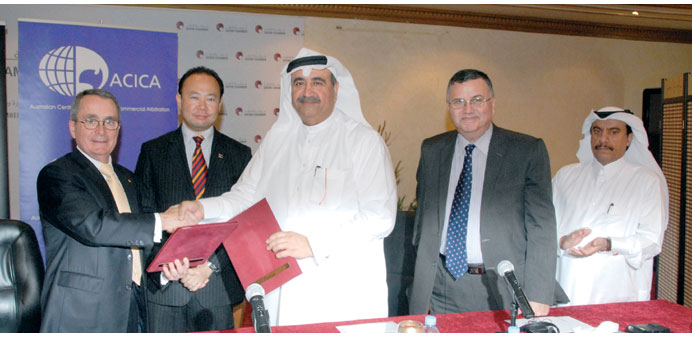
A new chapter in the history of international commercial dispute resolution was opened yesterday with the Qatar International Centre for Reconciliation and Arbitration (QICRA) and the Australian Centre for International Commercial Arbitration (ACICA) signing a co-operation agreement in
Doha.
The deal was inked by Abdulrahman Abduljaleel Abdulghani, QICRA president and Qatar Chamber board member, and Professor Doug Jones, ACICA president.
“There is no doubt that arbitration has become the preferred means for businesses, especially for those who are internationally active to settle disputes that may arise with other companies and need alternatives to ordinary courts, which suffer backlogging and prolonged litigation processes in several countries,” Abdulghani said.
“This co-operation, without a doubt, will directly support the movement of trade and investment between Qatar and Australia.”
The agreement will also allow both parties to use each other’s countries as “neutral venues” to hold international tribunals for arbitration and reconciliation between businessmen in professional discord. While arbitration needs both parties’ willingness for participation and it can’t force an accused party to show up for hearings, it does offer a scope of non-aggressive and quick settlements with full confidentiality.
Jones expressed optimism and stated that the “co-operation between arbitration centres around the world is a critical part of the harmonisation of international arbitration”.
“I should emphasise though that, in the context of the co-operation agreement, the ACICA and the Australian International Dispute Centre are not in any way intending to or seeking means to compete with arbitration centres in this region,” he assured.
Pablo Kango, Australian Ambassador to the GCC, was also present.
Jones said that in many commercial contracts there is a clause stipulating that arbitration should take place, in a different country to where the commercial dispute arises or to where the companies in dispute are domiciled,” he said. “So, for example, a Qatari company and a German company in a commercial dispute in Doha may elect to have the dispute arbitrated neither in Qatar nor in Germany. This is where we see Australia as an increasingly attractive option as a third party provider of a neutral
venue.”