


Qatalum, a joint venture of Qatar Petroleum and Hydro Aluminium of Norway, yesterday signed an agreement with Qatar University’s Centre for Advanced Materials (CAM) to create a faculty chair position.
The Qatalum/Hydro faculty chair in aluminium will be a three-year position, with the relevant person based at CAM, developing applied research programmes related to aluminium applications and their end-use.
They will also be required to establish and develop close collaborations with universities across the world, which are leading the way in this field of materials science. CAM already has strong bilateral ties with the Norwegian University of Science and Technology (NTNU).
The research programme will be integrated with the QU undergraduate senior student projects and graduate theses as relevant.
CAM Director Dr Mariam al-Maadeed, Qatalum CEO Tom Petter Johansen, deputy CEO Khalid Laram and Hydro vice president Hilde Aasheim announced the partnership at QU in the presence of Dr Sheikha al-Misnad, QU president.
“It will play an important role in developing our research capabilities and knowledge related to aluminium applications and the work undertaken through this will be accessible not just by graduate students but also senior undergraduates,” said al-Maadeed.
“The centre of excellence for aluminium materials within CAM will grow to be an institute for the global aluminium industry, a world-recognised entity where innovations, challenges and solutions are addressed, where international best practice is critically examined and taught, and where the next generation of experts in this important industry can be nurtured,” Laram said.
“This venture will build competence for solving important challenges for the aluminium industry on important issues like energy saving/recovery, carbon dioxide capturing, environmental friendly technology and operational healthcare,” he added.
“We will co-operate to create an even stronger competence cluster in Qatar,” Aasheim said.
The remit for the faculty chair will be to provide recruitment basis for Qatalum and the local aluminium downstream industry; develop aluminium materials competence in Qatar by establishing building blocks, Masters and PhD programmes as supported by NTNU; to launch research programmes on aluminium and its application appropriate for Qatar and the GCC; promote and develop applications for aluminium in humid and corrosive climates; assist launch of National Priorities Research Programme (NPRP) with core resources from Hydro and CAM; and promote aluminium as a green recyclable and
versatile material.
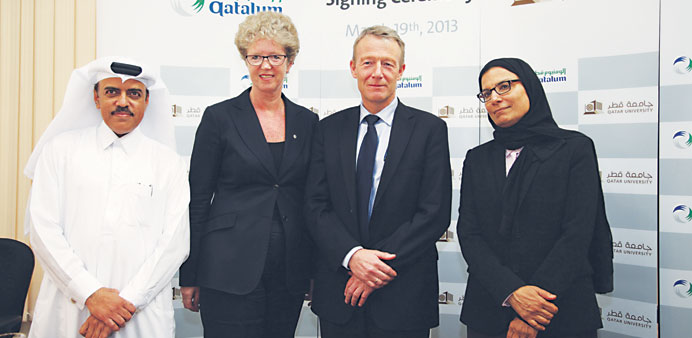
Qatalum officials along with the QU president during an announcement.