


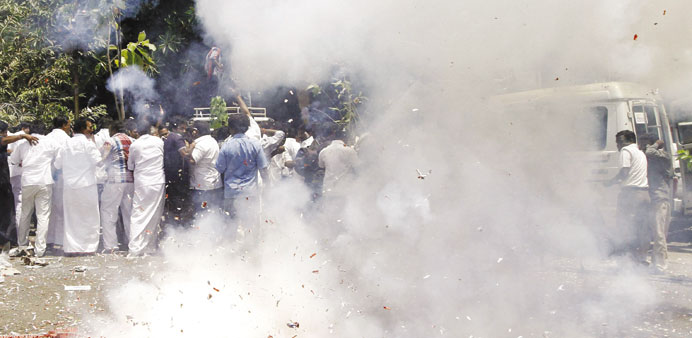
Supporters of Dravida Munnetra Kazhagam (DMK) light firecrackers to celebrate after their party pulled out of the UPA, outside the party’s headquarters in Chennai yesterday.
Agencies/New Delhi
A key regional ally pulled out of India’s ruling coalition yesterday, jeopardising Prime Minister Manmohan Singh’s economic reforms but posing no immediate threat to the minority United Progressive Alliance (UPA) government, which can survive with the support of other parties.
The withdrawal of the Dravida Munnetra Kazhagam (DMK) could hamper the government’s efforts to rein in the budget deficit, spur growth in Asia’s third-largest economy and stave off the threat of a downgrade by global credit ratings agencies.
DMK leader M Karunanidhi told a press conference in Chennai the party would not offer outside support to the government and would withdraw its five federal ministers.
In a possible sign of policy paralysis to come, a powerful regional party that supports the government in parliament, the Samajwadi Party (SP), said it would not back bills aimed at liberalising pensions and insurance. The government had hoped to pass the reforms in this session of parliament.
“With the federal elections next year, political stability is key for all economic reforms. This will surely delay the economic reforms to some extent,” said Rupa Rege Nitsure, chief economist, Bank Of Baroda, Mumbai.
In other reform bills, the government wants to change land acquisition laws to make it easier for companies to buy land for industrial and infrastructure projects. Also planned are a food security bill to provide subsidised more grain for the poor, the setting up of an anti-graft ombudsman and the approval of an ordinance providing for harsher punishment for perpetrators of sex crimes.
The DMK, which draws its support from Tamils in Tamil Nadu, announced its withdrawal from the coalition in protest against the government’s perceived dithering on a UN resolution on war crimes in neighbouring Sri Lanka between that country’s Sinhalese-majority government and its own minority Tamils.
It was not immediately clear what impact the withdrawal of the DMK would have on the bills as the party has previously expressed support for the land acquisition and food security measures.
But the withdrawal heightens the chance that the government will call a snap national election if it is unable to pass major legislation, although neither the ruling Congress Party nor the main opposition Bharatiya Janata Party has shown much appetite for early polls. Elections need to be held by May 2014.
“The government has lost majority. All the reforms including insurance and pension will now be put on the back burner,” said BJP spokesman Rajiv Pratap Rudy.
BJP leaders said they had no immediate plans to call for a confidence vote in parliament.
Finance Minister P Chidambaram said the government was stable, adding there was a chance the DMK could change its mind. The DMK has climbed down in the past after threatening to withdraw from the coalition.
“There is no crisis,” Chidambaram told reporters.
But the coalition, already a minority in parliament, will be more than ever at the mercy of powerful but fickle regional parties for support, especially the SP and the Bahujan Samaj Party (BSP), both based in Uttar Pradesh.
The DMK has often pressured the Indian government to do more to protect Sri Lanka’s minority Tamil population.
It wants the Indian government to introduce stronger language into the UN resolution, including the use of the word “genocide” to describe the deaths of Tamils during Sri Lanka’s civil war. The government has yet to give a response on what its position on the resolution would be.
The DMK has 18 seats in the Lok Sabha, the lower of house of parliament, which made it the biggest ally in Singh’s coalition. Its pullout is the latest blow, following the withdrawal of another ally, the Trinamool Congress, last year in protest against the government’s reforms.
The government needs 271 seats out of 543 to survive any possible confidence vote. After the pullout of the DMK, the Congress alliance has about 235 seats, but they could narrowly survive any vote with the outside support of the BSP and SP.
“No one expects the government to fall, but the drop in numbers will affect its stability,” Parsa Venkateshwar Rao, a political columnist for the DNA daily newspaper, said.
Parliamentary Affairs Minister Kamal Nath said: “We are not looking at early elections. We are confident of the numbers with the DMK or without the DMK.”
Political columnist B G Verghese said the move was typical political brinkmanship by the DMK.
“I see the pullout as a lot of bluff and blackmail by the DMK,” he said.
“I don’t see any threat to the Congress government. Minority governments have functioned in the past and done very well.”
BJP not mulling no-trust motion against govt
The Bharatiya Janata Party said yesterday it was not planning to move a no-confidence vote against the ruling United Progressive Alliance as it wants the government to fall on its own.
“The Congress-led government has neither the trust of the people nor of its own allies. They should get out,” BJP leader M Venkaiah Naidu said.
The BJP’s response came after the Dravida Munnetra Kazhagam pulled out of the UPA.
“Nothing is well with the Congress. It is no longer capable of running the country,” he added.
The main opposition party also said that the Congress was not fit to rule the country any more.”The Congress-led UPA government is in an ICU. It is a lame-duck government surviving on the support of two contradictory parties,” BJP leader Rajiv Pratap Rudy said.
He, however, added: “We will not bring a no-confidence motion. We want the government to fall on its own.” Rudy also said the UPA government’s allies were now trying to find excuses to abandon the “sinking ship” of the Congress. “One after the other the UPA’s allies are trying to find excuses and break away. None of them wants to carry the burden of the Congress to the next general elections,” he said.
Meanwhile, Tamil Nadu Chief Minister J Jayalaltihaa ridiculed DMK leader M Karunanidhi for quitting the UPA, saying he should have done so in 2009 when the Liberation Tigers of Tamil Eelam was crushed.
She accused Karunanidhi of covering up his earlier blunder when he failed to act when Colombo militarily crushed the LTTE.
“The plan of Karunanidhi will not succeed and the people of Tamil Nadu will teach him a lesson,” she said. “People are fed up with such dramas enacted by Karunanidhi.”
Jayalalithaa attacked Karunanidhi for demanding that a resolution against Sri Lanka be passed in Indian parliament.