


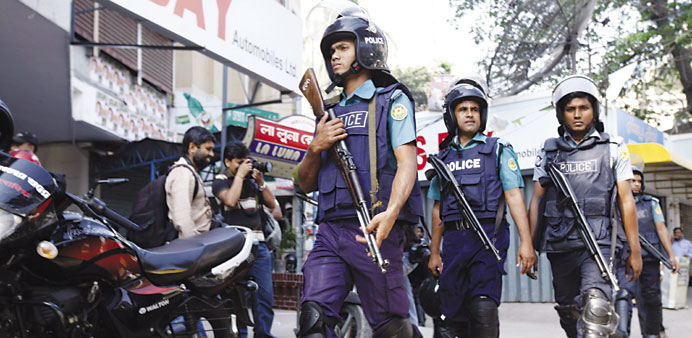
Members of the police force patrol in the streets during the second day of the 48-hour long countrywide strike called by the main opposition Bangladesh Nationalist Party (BNP) in Dhaka yesterday.
AFP/Dhaka
A student leader of Bangladesh’s ruling party was hacked to death in a northern town yesterday as violent clashes marked the second day of strike called by the country’s opposition parties.
Main opposition Bangladesh Nationalist Party (BNP) and its 17 allies have enforced the strike to protest the arrest of over 150 of its senior leaders and activists in a recent police raid in its headquarters in the capital Dhaka.
The arrests followed deadly unrest stemming from the trials of 10 leaders from country’s largest Islamic party Jamaat-e-Islami and two from the BNP for atrocities committed during the nation’s 1971 war of independence against Pakistan.
The student leader of the ruling Awami League (AL) was hacked to death allegedly by BNP supporters during clashes at Gopalpur, local police chief Monir Hossain said. “We have arrested 12 BNP supporters in this connection,” he said.
Clashes, torching of vehicles and vandalism were also reported in other parts of the country, including the capital Dhaka.
Railway official Abul Kalam Azad said a train derailed early yesterday in northeastern Moulvibazar district after suspected opposition activists removed plates from the track. He said 15 passengers were slightly injured, while the derailment forced authorities to suspend operations in the region.
Explosions of crude bombs were also reported in parts of Dhaka, where schools and most businesses were closed amid tight security with thousands of officers patrolling the streets. Traffic was thin on the usually-clogged streets.
Police said they fired rubber bullets and tear gas at protesters in northwestern city of Rajshahi after the strikers threw petrol bombs and rocks at the law enforcers, leading to the injuries of seven policemen.
The current strike, the 14th since the start of the year, has disrupted life across the country. Schools and businesses were closed and motorways were empty, as deliveries between rural areas and cities were suspended.
Top trade groups have asked the opposition to call off the strike, saying it was hurting the key garment export. They said some Western retailers have diverted orders from the country amid worries over timely
shipments.
Security was tight in the capital yesterday, with about 10,000 policemen and border guards patrolling the strike-hit empty streets, police said.
Bangladesh’s rough political world has become increasingly violent in recent months. The opposition alliance is demanding restoration of a caretaker government to oversee elections expected to be held by early next year.
Prime Minister Sheikh Hasina initiated the war crimes trials in 2010 and three verdicts have been handed down. Ten of the defendants convicted or on trial are from Jamaat-e-Islami, the country’s largest Islamic party, while two others belong to the BNP, headed by former prime minister Khaleda Zia.
The tribunal sentenced a senior Jamaat-e-Islami party leader to death last month, a decision that sparked violent clashes between opposition activists and police that left at least 86 people dead. The opposition says the trials are politically motivated. Authorities deny that.
Zia was expected to attend a meeting with her party’s senior policymakers yesterday to decide their next protest plans. She recently indicated that she wanted to continue the street protests rather than hold discussions with the government.
The United Nations, the United States, Canada and influential European countries have urged the politicians to resolve disputes through dialogue.
The government says it is open to talks, but Zia’s party says the government wants to use any talks to defuse the
opposition movement.
Bangladesh, a parliamentary democracy, has experienced political unrest since democracy was restored in 1990 after a nine-year rule by former military dictator H M Ershad. Zia and Hasina have alternated office as prime ministers since then.
Enforcing shutdowns, which often turn violent, is a common tactic by the opposition to try to embarrass the government.