


By R Fernandes
We all want to lead an active life. It is something that we would like our children to do as well. Thanks to Qatar’s National Sport Day, most of us even give the aspect of fitness some much needed attention.
In a busy urban world how do children perceive fitness? Does it factor in their long list of school assignments and exam packed schedules? We asked a few students from schools in Doha for their responses.
Eight-year-old Taleb, of Qatar Canadian School (QCS) says, “I love being active. Once I finish an activity I feel good because when I run, I know that I am doing something healthy for my body.”
Delhi Public School-Modern Indian School (DPS-MIS) recently held a highly anticipated Sports Day for first and second graders at Al Ahli Stadium. The theme of the event was health and fitness and it was wonderful to see students perform yoga and take part in relay races during the day. Apart from this, students also took part in a number of songs and dances which they prepared for well in advance.
G Mala, Vice Principal (junior wing), of DPS-MIS says, “Adequate physical activity, good food habits and a healthy lifestyle is found lacking in the young generation and this turns out to be a matter of concern. While pondering this, we in DPS-MIS felt sport is the right medium to inculcate in our tiny tots of Grades 1 and 2 the consciousness about healthy living. Hence we chose the theme ‘Health and fitness — Go for it’ and worked on organising our Sports Day. Nearly two months of regular practice with due stress on discipline, fair play and teamwork resulted in achieving our aim and it turned out to be a total success.”
DPS-MIS student Samuel says, “Our Sports Day made us aware of good food habits, especially in today’s world where we eat lots of junk food and invite health hazards. It was great fun doing and watching the exercises.”
Sigrid Olsen is the principal of Qatar Canadian School (QCS). She says, “Ours is a newly accredited school by the Province of Alberta, Canada in Doha. With the accreditation of the school, many new initiatives have been undertaken regarding student wellness, which are in alignment with Alberta programmes.”
She adds, “The school has implemented daily Physical Education (PE) from kindergarten to Grade 9 and has also increased the offerings of after school programming with a focus on physical activity. Students may participate in jump rope club, soccer teams and tennis lessons.”
Charles of QCS adds, “Once we finish our sports activities in school, we feel pumped up to do anything!”
DPS-MIS is also striving to make a difference in all around development. The school has recently shifted to a bigger facility in Wakrah with an indoor swimming pool, gymnasium and badminton courts on its premises.
With rising obesity rates in adults as well as children, there has never been a better time to promote physical activity as a means of improving the health of our children.
Olsen says, “QCS teams participated in girls and boys soccer on Sports Day. The school organised a school sports day the day prior to National Sport Day, here in Qatar, where all students were given the opportunity to participate. Additionally, a large number of staff and students participate in the Terry Fox Run on an annual basis. The school has developed a wellness framework which guides the planned activities and actions in the areas of improving student nutrition, student wellness, and student activity.”
“At QCS we are very active, with our sports day and after school activities and play. We should always be active because then we would be more healthy. I love being active,” says Elslah.
“At QCS we have a lot of activities including recess twice a day, PE every day and after school activities. We do lots of active things like running, walking, jogging or play sports. Everyone should always be active so they can work and be fit,” says Hama.
Nathan of Grade 2 from DPS adds, “Through Sports Day we learnt how vegetables and fruits keep us healthy. Exercise makes us strong, young and smart.”
Rita Misra, a teacher from DPS-MIS adds, “Leadership, teamwork and determination as an experience on the field is valuable for developing young minds in their future life. Two months of hard work of practice was fruitfully implemented as observed from the marvellous performance of small children. Active participation, support and enthusiasm from the parents helped the minors of DPS-MIS to raise fitness awareness amongst small children.”
Making sport relevant
Studies have shown that school age children need at least 60 minutes of physical activity a day. As children get older, increasing demands on their time can make getting a full hour of exercise a challenge. And some youngsters get caught up in sedentary pursuits like watching TV and surfing the Internet. Even doing a lot of studying and reading, while important, can contribute to inadequate physical activity. Teens and pre-teens alike need adequate amount of physical burn off time to keep their bodies and minds alert.
Being active is a key component of good health for all school-age kids. It will strengthen their muscles and bones and ensure that their bodies are capable of doing normal kid stuff, like lifting a backpack or running a race. It also will help control their weight and decrease their risk of chronic illnesses, such as high blood pressure and type 2 diabetes.
Fifth grader Rita from QCS is aware of the dangers of lack of exercise. She says, “People should be active because if you are not active, you will be fat and die earlier. I hope everyone exercises and stays healthy.”
Keeping children motivated
Sustaining a child’s interest in any project can be a challenge. Whether it’s swimming, football or dance, if your child doesn’t enjoy an activity or feels frustrated by failure, it may be time to switch to something else. That doesn’t mean the time spent on these activities was wasted. Ask your child what activities they would like to try next. Achieving this transition smoothly, without making a child feel like a failure, can prevent negative feelings about sports and physical activity in general.
It may be worthwhile to remember that though many sports programmes are available for preschoolers, it’s not until about the age of six or seven that most youngsters have the physical skills, the attention span, and the ability to grasp the rules needed to play organised sports.
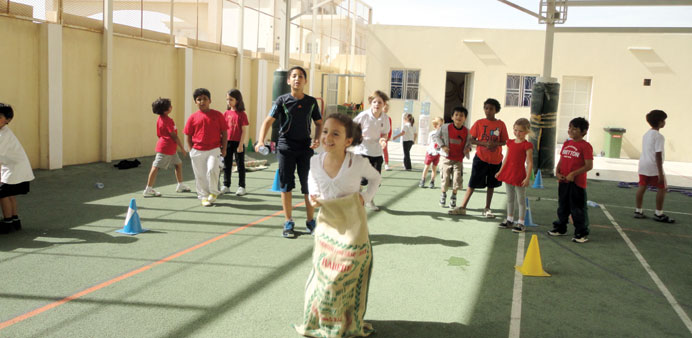
A sack race in progress at the Qatar Canadian School (QCS).