


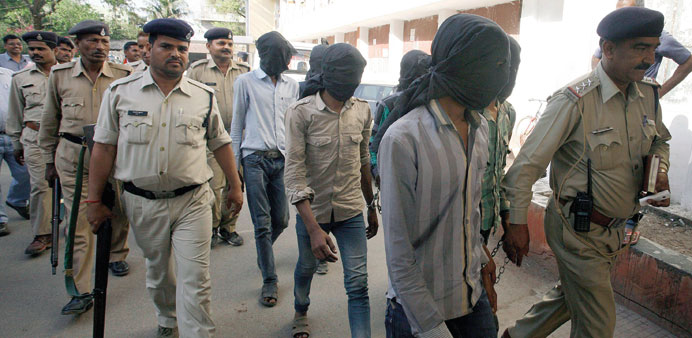
Suspects arrested in connection with the gang-rape of a Swiss tourist are taken to a court in Datia town, Madhya Pradesh yesterday.
Agencies/Bhopal
Six men appeared in court yesterday over the gang-rape and robbery of a Swiss cyclist holidaying in India, an assault which has rekindled alarm about the safety of tourists and rising sex crimes.
The six, who were detained after Friday’s attack on the 39-year-old victim in Datia district in the central state of Madhya Pradesh, were brought before a local magistrate.
“The magistrate sent the accused on a one-day police remand (custody),” said Datia district deputy police chief R S Prajapati. “These men will be now further questioned.”
The victim has agreed to stay in the country to co-operate in the investigation and identification of the culprits, officials said.
The latest incident comes three months after the fatal gang-rape of a 23-year-old physiotherapy student on a bus in Delhi sparked nationwide outrage.
Five of the suspects, all farmers in their twenties, were paraded in front of television cameras late on Sunday. They were dressed in jeans and shirts but with black cloth covering their faces.
The sixth man, 19, was detained in Uttar Pradesh overnight and brought back to Datia.
Only four of them will be charged with gang-rape, which carries a minimum sentence of 10 years, because testimony from the victim said two of them were “only present at the crime scene,” said M L Dhody, another Datia police officer.
All the men face robbery charges as police say the group stole a laptop, a mobile phone and Rs10,000 ($185) from the victim and her 30-year-old husband, who was tied up before the sexual assault.
“The six of them have confessed to their roles in the crime,” Dhody said.
Indian law does not permit statements made in police custody to be used as evidence during trial.
The Swiss couple arrived in the country last month and were cycling through northern India on a trip that included a stop in the Taj Mahal city of Agra.
The suspects allegedly saw the pair pitching their tent on Friday night in a remote forested area in Datia and attacked them. The Press Trust of India news agency said at least one of them was armed with a shotgun.
After being treated in a local hospital, the couple are now in New Delhi recovering and have pledged to stay to help police identify the rapists.
They have “expressed their readiness to fully co-operate in the ongoing investigation and identification process. They will continue to stay in India for the moment,” a Swiss embassy statement said yesterday.
Last month the Swiss foreign ministry issued an advisory for its nationals travelling in India, warning that sexual violence was on the rise across the country.
The Delhi attack last December spurred countrywide protests over the treatment of women in Indian society and the inadequacy of laws dealing with sexual crimes.
Under a new bill approved by the cabinet last week, rapists face a minimum 20-year jail term and the death penalty if the victim dies from injuries or is left in a persistent vegetative state.
In January a South Korean student holidaying in Madhya Pradesh, India’s largest state, said she had been raped and drugged by the son of the owner of the hotel where she stayed.
Tourism Minister K Chiranjeevi said in a statement that he was “anguished” by the “heinous” crime and called for tourists to take greater precautions.
He “felt the need for a more concerted effort by involving all state governments, so that all tourists are advised to inform their nearest police station whenever they venture out into remote areas,” a statement from his office said.
Cabinet keeps age of consent at 18 years
IANS/New Delhi
The government yesterday bowed to political pressure against lowering the age of consent for sex to 16 years, and approved the anti-rape bill by agreeing to stick to 18 years, but women activists said the provision could be misused.
The cabinet, chaired by the Prime Minister, met again yesterday evening to take up the bill after a consensus over the issue was arrived at during two rounds of an all-party meeting earlier in the morning.
The all-party meeting had at first failed to reach a consensus following major differences over the government’s bid to bring the age of consent to 16 years.
According to government sources, the cabinet agreed to stick to 18 years as age of consent following suggestions at the all-party meeting. They said the Bharatiya Janata Party (BJP) and the Samajwadi Party (SP) were among the parties which had reservations over lowering the age of consent to 16.
The sources said the age of consent was 16 years under the Indian Penal Code but was raised to 18 in the anti-rape ordinance promulgated by the government in February this year.
However, following inter-ministerial consultations, the government thought of lowering it to 16 in the proposed Criminal Law (Amendment) Bill, 2013.
At the all-party meeting, several political parties suggested the age of consent should be 18 years since the minimum age of marriage for girls was also 18, sources said.
The sources said the government was now confident this version of the anti-rape bill, which will be introduced in the Lok Sabha today, will be passed in this session.