


By Ayman Adly /Staff Reporter
The popular uprisings have profoundly changed the political, economic and social landscape of several countries in the Arab World, speakers at the Al Jazeera 7th Forum have said.
As part of the event, the Al Jazeera Centre for Studies organised a panel discussion on ‘The new regional powers and the rising global powers: common challenges’. Issues relating to the Arab Spring, including religious and ethnic minorities in the transitional contexts, sectarianism and its complex effects, Iran’s nuclear programme and its related complications in the Gulf region, the rise of Islamist movements and transborder challenges were discussed at the forum.
“Events in the past two years have created new political realities in the Arab World. These include the role of emerging democracies, the changing power dynamics, the challenges of engaging international powers as well as the transformation of media in the region,” said Sheikh Ahmed bin Jassim al-Thani, director general of Al Jazeera network, in his introductory message to the forum.
Speakers discussed the complex nature of relationship between Iran and the Gulf states, especially the former’s disputed nuclear programme and the security implications on the neighbouring countries.
“The problem is that the nuclear programme has started in a secret way, which justifiably raises the concerns of the Gulf states and the world,” said Dr Abdulla Baabood, a senior political analyst on the Gulf region.
He added that Iran is strategically located, and especially after the fall of the former regime in Iraq, there is a security imbalance in the region. Further, he pointed out, the Iranian policies have only helped in escalating tensions, negatively impacting its relationship with other nations.
Dr Baabood explained that there is only a small difference between what is peaceful and not peaceful in nuclear pursuits. However, Iran could take various initiatives to review its stand and make clear its intentions. He said that Iran has the right to generate power through nuclear energy, which aims to meet around 20% of its electricity consumption, yet it has to take into consideration the concerns of the neighbouring countries.
Abdolamir Mousavi, Director of Strategic Studies at International Relations Center in Tehran, explained that Iran had previously invited GCC countries to send their experts to visit the nuclear sites. Also, Iranian President Mahmoud Ahmadinejad had suggested an open dialogue but his call went unheeded.
He also denied the existence of any Shia-Sunni divide and said the only conflict is with Zionism, stressing that Iran has a legitimate right to protect itself with all means and retaliate in case of foreign attacks.
The Arabic translation of a book titled ‘The Invisible Arab’ by Marwan Bishara, a senior political analyst, was launched during the event. The author, who signed some copies of his books, said that the democratic process currently underway in many countries of the region is for the common good. He pointed out that the process of change currently taking place has the potential for bettering the lives of the people.
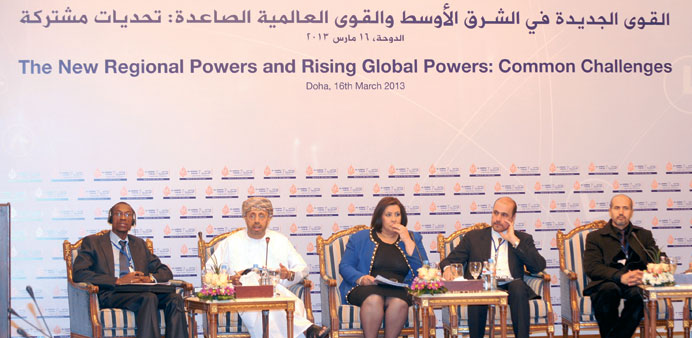
Panellists at one of the discussions at the forum.