


A unique photography project has captured more than 40,000 images of large fauna in Ecuador’s Yasuni National Park, and made it evident why the ecologically rich region should be saved, writes Bonnie James
|
|
A camera trap project run by wildlife researcher Diego Mosquera is helping to confirm the abundance of rare and elusive species in Ecuador’s Yasuni National Park, hailed by conservationists as ‘the biologically richest place on Earth.’
A Unesco world Biosphere Reserve since 1989, the million hectare Park in eastern Ecuador is one of the most intact sections remaining in the Amazon Basin, which is the world’s oxygen and fresh water ‘factory.’
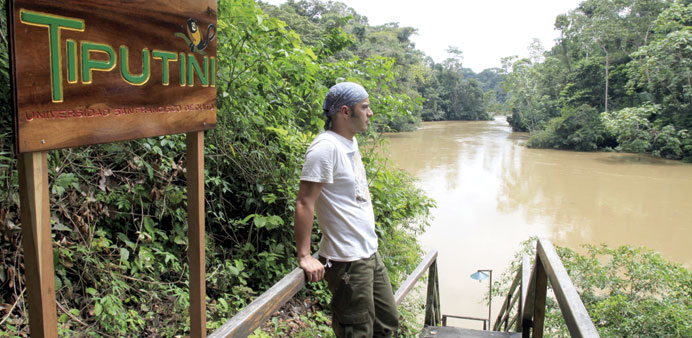
Gulf Times recently visited the Tiputini Biodiversity Station — run by the Universidad San Francisco de Quito on 650 hectare of pristine lowland rainforest on the edge of the Park — where Mosquera is the resident manager since 2005.
“Functioning on a shoestring budget, the camera trap project has recorded, over the past eight years, more than 40,000 images of large fauna, confirming that wildlife remains abundant in remote reaches of the region,” Mosquera said.
The photographs provide unequivocal evidence that Yasuni is worth saving. Incidentally, Ecuador in partnership with the United Nations Development Programme, has launched the $3.6bn Yasuni-ITT Initiative, to conserve a section of Yasuni by foregoing the extraction of 846mn barrels of oil and avoiding the emission of 1.2bn metric tonnes of carbon dioxide.
“Rare and elusive species like the short-eared dog, jaguaroundis (also called eyra cat, is a small-sized wild cat native to Central and South America), jaguars and giant armadillos have been photographed with the camera trap project,” Mosquera explained.
He has recorded over 60 species and found tremendous densities of deer, peccaries and tapirs. The densities of both ocelots and jaguars appear to be much greater than any previously reported in the scientific literature.
“These facts, in one sense, impose serious responsibility to maintain their numbers and their habitat while in another sense, impart attraction value on the world ecotourism market.”
The cameras are kept in pairs, opposite to each other. They have heat and motion sensors and record still images, which are downloaded and batteries replaced at regular intervals.
“Because my study has focused on an area without any hunting pressure whatsoever, we can assume that our site probably represents a situation very similar to what Amazonia may have been like before the first arrival of humans over 10,000 years ago,” Mosquera said.
This makes the Tiputini Biodiversity Station even more valuable as a research site due to the fact that the scientific method in its purest form requires a control point for all comparisons.
“The fact that we have established a large data set that represents a “without impact” or “before” versus “after” condition of the most biodiverse ecosystem on Earth, reasons abound to continue our studies and to make all efforts possible to maintain our site as well as the overall region surrounding us, to the greatest extent possible, free from substantial human interference, particularly hunting,” the wildlife researcher maintained.
Mosquera is currently on the lookout for funding for a new project. The goal is to deploy high-resolution camera traps, replacing the existing standard camera traps whose quality of pictures is not good enough for publishing purposes.
“With high quality pictures my ultimate intention is to work on a book and other educational materials that can become a unique environmental tool to raise awareness and educate people in the local and global community about the importance of protecting Yasuni’s wildlife,” Mosquera said.
Given that humans have great capacity to change and destroy habitats and therefore to reduce the chances of species surviving, he is convinced that with the help of the proposed book, these effects can be somehow reversed, enabling people to enjoy the beauty and diversity of species without harming them, in a beautiful, compelling, and emotionally connective way.
Although Yasuni has a protected area status, in reality imminent threats are getting closer and closer to the core of the park. The inhabitants of the park and the buffer area, both locals and indigenous, in some cases have never been able to witness their local wildlife.
“Despite the threats, the effort of the local authorities to stop indiscriminate killing and trade, apart from some isolated low success campaigns, has been limited or not existent at all. Many of the people I have talked to tell me that they have only seen animals like jaguars, ocelots
or tapirs in bush markets or
dead.
“If people don’t understand the importance and beauty of the forest and its wildlife, this will just keep going on. Despite the extensive research and effort to protect Yasuni, there have not been any formal education materials that can be distributed among local communities.
“My purpose is to show the message behind the research in a way that engages a broader audience, communicating the need to protect wild spaces. I want to be able to connect viewers with their sense of responsibility to protect and conserve what we have left, and restore what we have lost,” Mosquera added.
(More information on the proposal: http://www.indiegogo.com/projects/uncovering-yasuni-s-wildlife-through-camera-traps?c=home).
(Cover photograph of a puma and pictures on this page courtesy Diego Mosquera,Tiputini Biodiversity Station, Universidad San Francisco de Quito)
BELOW
1) An ocelote clicked as part of the camera trap project in Yasuni National Park. The million-hectare park has been a Unesco World Biosphere Reserve since 1989.
2) Red-brocket Deer
3) White-lipped Peccari
4) Short-eared Dog
5) Giant Armadillo