


Bloomberg/Mumbai
|
|
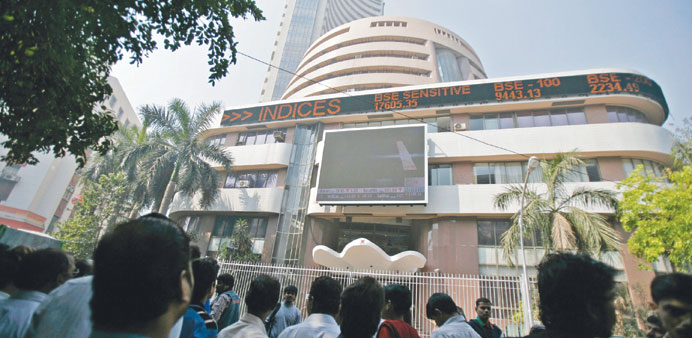
Indian stocks declined the most in about two weeks amid concern a faster-than-estimated expansion in factory output may reduce the scope for monetary easing.
The S&P BSE Sensex dropped 0.4% to 19,564.92 at the close, its steepest drop since February 28. Volumes were 20% below the 30-day average. Tata Power, India’s top generator outside government control, slid 3% after the stock was downgraded by Credit Suisse Group. HDFC Bank, the most valuable lender, retreated 1.7%.
Industrial production in January climbed 2.4% from a year ago after a revised 0.5% drop in December, data from the government showed yesterday. The median of 28 estimates in a Bloomberg survey was for a 1.3% gain. Inflation data for February are due on March 14 and the Reserve Bank of India meets for its next policy review on March 19.
“It looks like hopes for a 50-basis point cut next week have been tempered, and at best, we will only have a 25-basis point reduction,” Alex Mathews, head of research at Geojit BNP Paribas Financial Services, said by phone from Kochi in southern India yesterday.
“Some investors would also like to take a hard look at the inflation number before buying.”
The Reserve Bank of India cut its benchmark rate 25 basis points to 7.75% on January 29, the first reduction in nine months. That’s still the highest among major Asian nations.
Tata Power slid 3.1% to Rs98.05 after it was cut to underperform from neutral by Credit Suisse. HDFC Bank lost 1.7% to Rs644. Bharti Airtel, India’s largest cell-phone operator, slid 2.1% to Rs314.55.
Bharat Heavy Electricals, the biggest power-equipment maker, retreated 2.3% to Rs200.75. Bajaj Auto, India’s second-largest motorcycle maker, fell 1.5% to Rs1,955.95. Sterlite Industries (India), the nation’s largest copper producer, lost 1.4% to Rs98.65, and aluminum maker Hindalco Industries retreated 1.2%.
Reserve Bank Governor Duvvuri Subbarao has said that risks from elevated prices and a record current-account gap may limit the extent he can reduce borrowing costs.
Wholesale inflation probably eased to 6.6% in February, a Bloomberg survey shows before a report due March 14. Consumer prices rose 10.91% last month from a year earlier, one of the highest rates in the world, another report showed yesterday.
Car producers such as Maruti Suzuki India are bracing for the first industry-wide annual sales drop in a decade amid high borrowing costs. Local deliveries fell 4.6% to 1.71mn cars in the 11 months ended in February, Society of Indian Automobile Manufacturers data shows.
The 50-stock CNX Nifty Index decreased 0.5% to 5,914.1. Its March futures settled at 5,937.25. India VIX, which measures the cost of protection against losses in the Nifty, jumped 6.2 to 15.13.
The Sensex is valued at 13.8 times projected 12-month profits, compared with 14.3 times on January 25, when the gauge climbed to a two-year high, data compiled by Bloomberg show. That compares with the MSCI Emerging Markets Index’s 10.7 times.
Foreigners bought a net $185.4mn worth of shares on March 11, taking their net investment in Indian equities this year to $9.2bn, a record for the period, data compiled by Bloomberg show. They bought a net $24.5bn worth of shares last year, the most among 10 Asian markets tracked by Bloomberg.
Meanwhile, India’s rupee strengthened, after dropping the most in a week Monday, on signs exports and factory output in Asia’s third-largest economy are improving.
The rupee advanced 0.4% to 54.1925 per dollar in Mumbai, according to data compiled by Bloomberg. It dropped 0.2% Monday, the biggest loss since March 1. One-month implied volatility, a gauge of expected moves in the exchange rate used to price options, fell four basis points, or 0.04 percentage point, to 9.03%.
“Fundamentally, we are still positive on the rupee,” said Thio Chin Loo, a senior analyst in Singapore at BNP Paribas. The currency will strengthen to 53 per dollar by the end of this year, she predicts.
The rupee’s advance yesterday comes as global investors sold the greenback to benefit from the exchange rate after the Dollar Index rose to a seven-month high on March 8, according to Edelweiss Financial Advisors. While better trade data may instill faith in a recovery, the rupee is unlikely to gain much in the current environment of increasing confidence in the dollar, Emmanuel Ng, a strategist at Oversea-Chinese Banking Corp in Singapore, wrote in a report yesterday.
Bank of America Merrill Lynch recommends investors buy the dollar against the rupee on a move toward 53.28, as technical charts indicate the greenback may resume a long-term trend of appreciation towards 60. In the medium-term, the rupee may depreciate past 55.75 a dollar as long as it trades weaker than 54, Edelweiss predicts.
Three-month onshore rupee forwards traded at 55.39 per dollar, compared with 55.45 Monday, according to data compiled by Bloomberg. Offshore non-deliverable contracts were at 55.20 versus 55.33. Forwards are agreements to buy or sell assets at a set price and date. Non-deliverable contracts are settled in dollars.