


Reuters/Berlin
Chancellor Angela Merkel has urged German employers to help get more women back to work after they become mothers in a country which needs to boost its workforce – unlike much of Europe, where mass unemployment is putting pressure on political leaders.
Germany’s centre-left opposition called the conservative chancellor’s “family summit” yesterday blatant electioneering, saying that she had woken up to the problems of women and families six months before an election when she will seek a third term.
“The interests of the family should be at the centre of politics,” Merkel said in a speech.
She announced no new measures to raise the female employment rate or encourage women to work full-time but urged employers to be “open to the wishes of their male and female workers”.
The 58-year-old chancellor’s Christian Democrats (CDU) portray the traditional family as the cornerstone of society but Merkel is often accused of doing little to help women despite being probably the world’s most powerful female politician.
She faces economic and political pressure to make life easier for working mothers in a country where women who go out to work instead staying home to look after small children were once branded “raven mothers”.
The Organisation for Economic Co-operation and Development (OECD) said in a report last month that Germany should remove “impediments” to women’s participation in the workforce.
While 68% of German women have jobs, higher than the OECD average of 60%, hours worked by mothers and married women are significantly below the OECD average, it said.
Merkel introduced child benefit payments in her first term in 2006 to try to boost a dwindling birth rate, which is forcing Germany to recruit foreign workers to offset a lack of skilled labour for an economy which has proved resilient.
While Berlin is straining to find enough staff to fill its vacancies, Spain announced a plan yesterday to try to ease mass unemployment among young people, with one in two out of work due to a relentless tide of lay-offs. Some are studying German or English and emigrating in search of jobs.
Spanish Prime Minister Mariano Rajoy presented 100 measures worth 3.5bn euros ($4.6bn) over four years including tax breaks for young freelance workers and for companies that hire workers in their twenties. Many of the measures had been previously announced (see report on this page).
The OECD criticised a 2009 German government proposal to pay a welfare benefit to stay-at-home parents. This was intended to relieve pressure for thousands of new nursery places, which the state will struggle to provide from August for all one-to-three year-olds as required by law.
Critics say it amounts to a bribe for immigrants and poor people to keep their children out of kindergarten, where they have a better chance of integrating. It also gives poor mothers an incentive to stay out of the labour market.
Even Merkel’s own coalition cannot agree about the subsidy, making it a target for the Social Democrats (SPD), who aim to unseat Merkel in September.
The SPD is struggling in opinion polls partly because Merkel has co-opted centre-left issues such as opposition to nuclear power and support – albeit lukewarm – for a legal minimum wage.
The Social Democrats tried to hijack the “family summit” by promising to spend billions of euros on all-day kindergartens instead of stay-at-home parents if they win the election. This would be financed by an increase in the top-rate income tax.
The minister for family and women’s affairs, Kristina Schroeder, said companies should take some responsibility for providing childcare facilities themselves.
“You can’t always just rely on the state, so if companies really want young mothers to return to work quickly they should make a good offer,” she said.
Young parents should also have the right to work part-time for a few years and then return to full-time work, she added.
Schroeder, 35, is the first German woman to give birth while serving as a cabinet minister.
She said she also wanted to spend time with her daughter and not rely on a “24-hour kindergarten”.
Another cabinet member, Ursula von der Leyen, is labour minister while being a mother of seven. Merkel herself has no children.
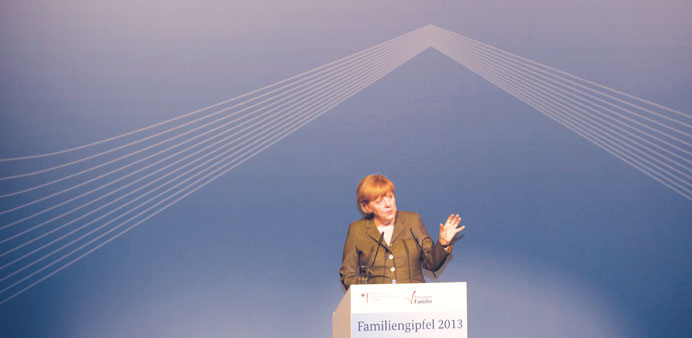
Merkel speaking at the 2013 Family Summit in Berlin.