


By Doreen Fiedler
Inside a dark hut in one of Asia’s largest slums, Barburo Ladsahib is shouting so that his pupils can hear his voice above the din of Bollywood music blaring from two ancient speakers.
“Shut the scissors, open the scissors, 4, 3, 2, 1,” he calls out while demonstrating the right dance steps to the rhythm.
The children are hopping and twirling like their teacher. He may be half-bald and sporting a moustache, but his hips are swaying like those of famous movie actresses.
And it is precisely this that the kids here want to be: famous. India’s Bollywood film industry is located just a few kilometres away, but the chic suburb there and the slum of Dharavi are worlds apart.
Sometimes, however, Ladsahib can help build a bridge to close the gap. For 30 years now he has been teaching youngsters from the slums and helped them gain minor roles in films and TV series. He says that so far 144 of his pupils have landed roles.
Jay Holmukhe is still waiting for his big film role. The 15-year-old proudly recounts how he played a beggar in the Oscar-winning film Slumdog Millionaire which was shot in Dharavi.
The shy youngster comes each week to the hut, in front of which a sign saying “5 Stars Acting, Dancing, Fighting.” He hopes that one day a director will come by and discover him. Ladsahib jokes, “Actually he comes by to look at the girls.”
Then the 50-year-old in the red trousers jumps back up and things get going again. With grand gestures he tries to animate the pupils.
“You are under arrest,” he yells and pulls out an imaginary weapon. About 25 children are sitting in front of him on a concrete floor pocked with holes and follow his instructions. Like their teacher, they’ll theatrically put on an expression of horror.
In the next class, the subject he teaches is boxing the way the action heroes do. A punch, a pivot, then a kick with the foot. The pupils laugh and then start up a small fight amongst themselves. Ladsahib suddenly get serious.
“Please don’t laugh,” he orders them. “Watch me. Learn to do it right. When you take Rs1,000 ($18.50) home, you’ll make your parents happy.” His training costs Rs600 a month, but Ladsahib says he will also teach talented pupils for free.
Ladsahib himself came to films from painting, including producing advertising signs. “On one film set, pictures had to be painted on 12 shops. I did it, and so became a friend of the scene,” he says.
This led to him getting a number of minor film parts.
He noticed that filmmakers often were searching for actors to play gangsters, hospital patients, drunks and poverty-stricken children, but could not find the right talent in the acting schools in the middle-class areas.
“So I asked myself — why not do it myself?” he said about his decision which made him one of countless talent scouts and self-taught acting coaches.
Their clientele are the Mumbai kids pursuing a dream of one day making it into the glittering world of movies.
Bollywood is a huge machine that each year churns out 900 films, for which 3bn tickets are sold.
The stars of the silver screen mostly are working in several film-shoots simultaneously, and additionally are always seen in television commercials.
In the never-ending hope of helping his charges achieve their goal, Ladsahib uses the 30sq m of a small room over his apartment as a studio in order to produce job application photos.
Beyond this, or so the signs posted along the walls say, here they can learn “how you present a scarf” or how “to pose with a biscuit” or how you portray “a hair lotion model.” And he teaches other specialities of Indian films such as sword-fighting, knife attacks and speaking one’s lines while being beaten up.
And suddenly, somebody does actually turn up at the studio. It’s an assistant casting director for a small independent film taking a look around. Excited, the boys and girls start showing off all the many different facial expressions they have mastered.
But Chaitra Yadavar tries to dampen their hopes. The film has only a small budget, she cautions, and then reveals the real reason why she came to Dharavi: “We need 20 to 25 kids who look like slum children.” — DPA
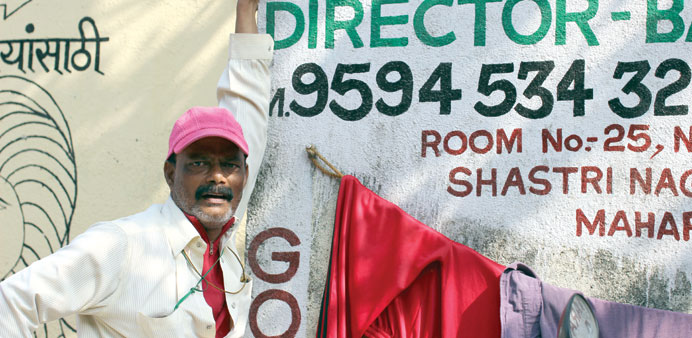
Barburo Ladsahib with the banner of his school in Dharavi.