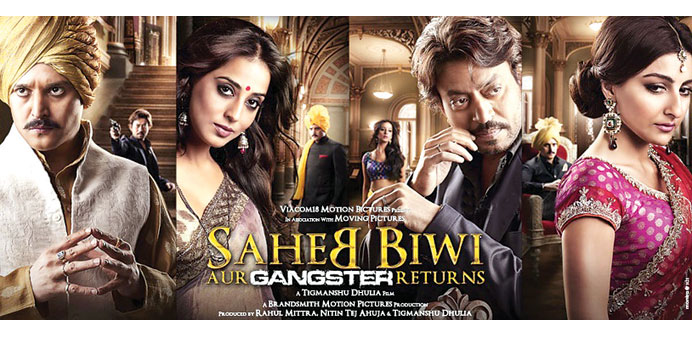
Saheb Biwi Aur Gangster Returns ... move and counter move in quick succession.
By Gautaman Bhaskaran
Sometimes one fails to notice a gem among stones or a picturesque lake along the road one rides. Or, even a genius among the ordinary. Writer-director-actor Tigmanshu Dhulia is a classic example of that gem or lake. I only realised his existence in 2010 when he had come to the Abu Dhabi Film Festival to present his Paan Singh Tomar.
By then Dhulia had already made two movies: Haasil, a love story set in the messy world of student politics somewhere in northern India, and Charas, about Himachal Pradesh drug cartels trading in marijuana. I have not been able to see these two works, but managed to catch his next work, Paan Singh Tomar.
Paan Singh Tomar floored me — also because Irrfan Khan in the title role was brilliant (In a piece I wrote then, I said he was the best of the Khans in Hindi cinema). And Dhulia, who had had an earlier stint as casting director (Shekhar Kapur’s Bandit Queen being one) and screenplay writer (Mani Ratnam’s Dil Se among others), was absolutely adept in these two areas, which undoubtedly form the vital pillars for any film to succeed.
Dhulia’s script was tight and crisp, his dialogues were punchy, and casting of Irrfan Khan was nothing short of a coup. The actor was entirely believable as the honoured steeplechase runner who turns into an equally renowned dacoit roaming the ravines and finally meeting a tragic end.
Some of my friends, given to watching brash Bollywood fare with its meaningless messages, saucy songs and degenerate dances, surprisingly loved Paan Singh Tomar, vindicating my belief that there is a large Indian community which wants to see meaningful cinema, meaningful cinema which tells a good story and engagingly so.
Dhulia’s next, Saheb Biwi Aur Gangster with Jimmy Shergill, Randeep Hooda and Mahie Gill, was a slick piece of celluloid that threw us into the decadence and opulence of a princely way of life. Here was a prince, desperately clinging on to a long abolished title of raja through dirty tricks and dirtier politicians, here was a princess, neither pure nor noble, lusting for male attention and willing to bed any rogue, and here was a gangster, immoral, unscrupulous and ready to make the most dangerous moves to push the prince off the pedestal. And his marital bed. When Hooda’s gangster, Lalith/Babloo, gets a little too ambitious, the axe falls on him. Rather, bullets rain on him. Out of this bloody carnage, Prince Aditya Pratap Singh (Shergill), rises, though wounded and wheelchair-bound. Pushing the wheels is Gill the princess, Madhavi. The message is clear, and in it we see the politics of northern India replayed, and the chance for a sequel.
Saheb Biwi Aur Gangster Returns, just out in theatres, takes off from here, and is as gripping as its prequel. Part two is completely independent of part one. Even better I think, for the new gangster is Irrfan Khan, replacing Hooda. Khan is terrific delivering his lines with almost mischievous subtlety. Here is a gangster who makes us laugh even when he is bashing up a press photographer, who had promised to get Khan’s Raja Bhaiyya aka Indrajeet Singh’s picture into the papers and fails. In some of the most tense moments in the film, Khan has a twinkle in his eye that merely gets the audience all thrilled.
He has some of the finest lines in the movie, some of the most wonderful engagements as he turns from a small-time hoodlum into a poet in love with Ranjana (a rather wooden Soha Ali Khan, and what a contrast she is to her mother, Sharmila Tagore), a royal as well.
As a prince whose family had lost its kingdom to the deviousness of Aditya Pratap’s clan, Khan’s character never lets his bitterness cloud the frames. Rather, he schemes as a cunning chess player would to get the enemy king dethroned.
The picture gets murkier when Aditya Pratap, disgusted with wife Madhavi’s (Gill returns to portray the same character as in the prequel), amoral sexual escapades, falls into the trap laid by his stepmother. He is smitten by a picture of Ranjana that his stepmother shows, but the girl’s father (a great piece of acting by Raj Babbar) abhors the idea of this union.
But who is to stop the canny Aditya Pratap, who gets Ranjana’s brother into a drug web in Dubai and dangles the boy’s freedom as barter?
Saheb Biwi Aur Gangster Returns has enough slime and sleaze, conspiracy and coercion to keep us chewing our nails for the nearly two-and-a-half hours of its run time. Dhulia’s knack of weaving wit and winsomeness into his tale of trickery and treachery is sheer delight to watch. Adding to this is a plot that moves like a game of chess, the principal men on the board tricked and traumatised in the most bewildering manner.
Punctuating this battle during some of its darkest moments is hilarity: Dhulia’s relief mechanism which has its rib-tickling highs. In one particular scene, we see a politician struggling to switch off his laptop computer on which he is seeing a blue film.
But, yes, there are flaws in the work. The seamless storytelling in the first half begins to stutter in the second, which is too crowded. And I could not miss a kind of hurry after the intermission, and the climax (lending again to a third part) is not convincing at all. Probably, in his anxiousness to wrap up his work before many more minutes tick by, he throws editing and script to the winds in the last 15 minutes.
Yet these are not what remain with us. It is the film’s haunting colours, the regal architecture of a time gone by, the colourful costumes, the sheer brazenness of the political satire, the darkness of the thriller and the vibrancy which stay with us.
Saheb Biwi Aur Gangster returns with a mesmeric bang. A must watch.
(Gautaman Bhaskaran has been
writing on Indian and world cinema
for over three decades, and may be
e-mailed at [email protected])