


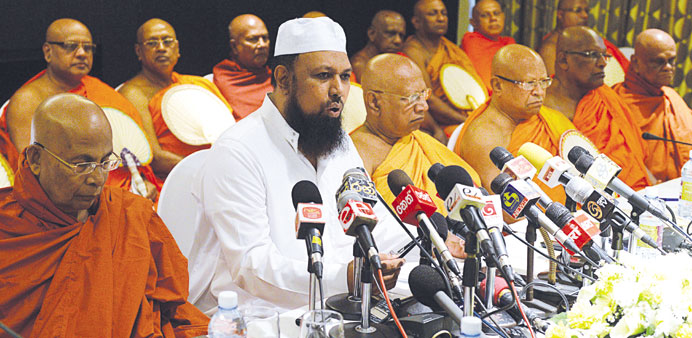
Sri Lanka’s All Ceylon Jamiyyathul Ulama Mufti, M I M Rizwe, second left, speaking during a joint press conference by Buddhist monks and Islamic clerics in Colombo yesterday.
AFP/Colombo
Islamic clerics announced the withdrawal of a halal labelling system for food in Sri Lanka yesterday “in the interests of peace” after protests from Buddhist hardliners on the Indian Ocean island.
The All Ceylon Jamiyyathul Ulama (ACJU), Sri Lanka’s main body of Islamic clergy, said the halal certificate issued by them would be used only for products that are exported to Islamic countries.
“We are giving up what is important to us. We are making a sacrifice in the interest of peace and harmony,” ACJU president Mufti Rizwe said, adding that they were keen to avoid any escalation of religious tensions.
Food manufacturers in Sri Lanka have long made all their products using halal methods and labelled them with the ACJU halal certificate.
They argued it is impractical and uneconomical to have two manufacturing processes for the same product.
The issue over the halal certification arose after a group of monks known as the Bodu Bala Sena campaigned against it and demanded its complete withdrawal.
The monks questioned the need for the ACJU to be paid for the halal certification.
A leading Buddhist monk, Venaerable Bellanwila Wimala Rathana, addressing the joint media briefing, said that as monks they were glad the issue was brought to light.
He said that he was also glad that in the end the issue was resolved amicably in a manner which did not affect the co-existence of the communities in Sri Lanka.
The halal method of killing an animal requires its throat to be slit and the blood to be drained.
The Ceylon Chamber of Commerce said that manufacturers agreed to drop the halal logo from all food with
immediate effect.
Nationalist Buddhist monks and their supporters had launched a campaign last month to boycott halal-slaughtered meat, as well as other products that carry a halal certificate.
The monks argue that Buddhists should not be forced to consume food that is prepared according to Islamic rites, saying it demonstrates the undue influence of Muslims in Sri Lanka.
President Mahinda Rajapakse, who is a Buddhist, had urged monks not to incite religious hatred.
Sri Lanka is 70% Buddhist, while Muslims comprise less than 10% of the population of 20mn. The island suffered a bloody ethnic war between 1972 and 2009, pitting mostly Hindu ethnic Tamils against the Sinhalese Buddhist majority in violence that claimed at least 100,000 lives.