


Reuters/Caracas
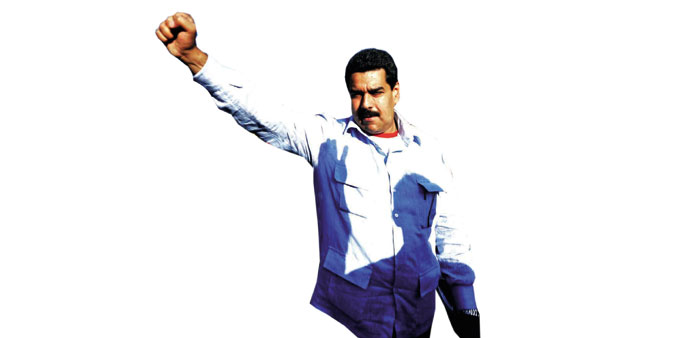
Venezuela’s charged election race kicked off yesterday with throngs attending mass at the coffin of deceased leader Hugo Chavez and vowing to back his preferred successor, Nicolas Maduro, over likely opposition contender Henrique Capriles.
The pair have until today to register their candidacies for the April 14 vote, which will determine whether Chavez’s self-styled nationalist-socialist revolution will live on in the Opec nation, home to the world’s largest proven oil reserves.
Chavez died on Tuesday at age 58 after a two-year battle with cancer.
Former vice president Maduro, 50, a hulking one-time bus driver and union leader turned politician who echoes Chavez’s anti-imperialist rhetoric, is seen winning the election comfortably, according to two recent polls.
Maduro pushed a snap election to cash in on a wave of empathy triggered by Chavez’s death, and was sworn in as acting president on Friday to the fury of Capriles.
The boyish 40-year-old Miranda state governor, who often wears a baseball cap and tennis shoes, lost to Chavez in October. But he won 44% of the vote - the strongest showing ever by the opposition against Chavez.
Capriles has accused the government and Supreme Court of fraud for letting Maduro campaign without stepping down.
Although the ruling Socialist Party is favoured to win, opposition supporters are trying to raise their spirits for a month of campaigning.
“There’s no reason to think that the opposition is condemned to defeat,” Teodoro Petkoff, an anti-government newspaper editor, said on his Sunday morning talk show.
Maduro has vowed to carry on where Chavez left off. His first official meeting on Saturday was with officials from China, who Chavez courted to provide an alternative to investment that traditionally came from the US.
He has adopted his mentor’s touch for the theatrical, accusing imperialists, often a Chavez euphemism for the US, of killing the charismatic but divisive leader by infecting him with cancer.
Former paratrooper Chavez was immensely popular among Venezuela’s poor for funneling vast oil wealth into social programmes and handouts but he railed against the wealthy and scared investors with nationalisations.
In heavily polarised Venezuela, some well-to-do even popped champagne corks to toast his death.
Thousands, though, were still queueing to see Chavez’s coffin lying in state, and emotional tributes were paid at yesterday’s service at the military academy housing the casket.
Capriles says, if elected, he would copy Brazil’s “modern left” model of economic and social policies.
Venezuela’s opposition coalition backed Capriles as its candidate on Saturday.
“I am analysing the declaration of the president of the national election commission and will tell the country about my decision in the coming hours,” Capriles said on Twitter.
With candidates assigned a campaigning window of just 10 days, and at an immediate disadvantage given the state resources at Maduro’s disposal, Capriles faces an uphill battle.
Some argue he has nothing to gain in running, but could also commit political suicide if he opts to sit out the race and effectively hand the presidency, and a raft of economic problems like sky-high inflation and a devalued currency, to Maduro.
The opposition rank-and-file is already heavily demoralised after losing last year’s presidential race and taking a hammering in gubernatorial elections.
“There’s no doubt that it’s an uphill race for Capriles,” said local political analyst Luis Vicente Leon. “Maduro is not Chavez. ... (But) the trouble is that given the race is so close to Chavez’s death, emotions get inflamed and the candidate probably continues to be Chavez rather than Maduro”.
Castro voices ‘confidence’ in Maduro
President Raul Castro expressed “absolute confidence” in Hugo Chavez’s successors, after returning home from the leftist leader’s funeral in Caracas, the Cuban press reported yesterday. Chavez was a close ally of communist-ruled Cuba and his death on Tuesday at age 58 of cancer was a major blow to Havana, which for more than a decade has relied heavily on cheap Venezuelan oil and favourable terms of trade to keep its economy afloat. Venezuela has announced it will hold elections in 30 days with Nicolas Maduro, Chavez’s handpicked successor and now interim president, who is expected to face off against businessman Henrique Capriles. Capriles, who is also the governor of Miranda state, was defeated by Chavez in October’s presidential election. “We return satisfied to see how Chavez’s great work is being continued and the gigantic support of the people,” Castro was quoted as saying.