


|
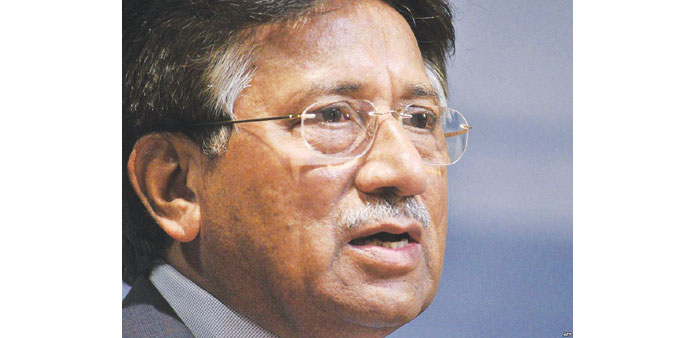
Pakistan isn’t in short supply of wannabe saviours. Following the red hot revolution drama recently enacted by Dr Tahir-ul-Qadri, a moderate cleric and dual citizen who suddenly flew into Pakistan from Canada on a self-styled mission impossible late last year, the country is now bracing up for the return of the “original” saviour - retired General Pervez Musharraf. |
So will the twain meet?
If Musharraf manages to make good on his second promise to return - he lives in self-imposed exile, dividing his time between London and Dubai, since he was forced to resign as president in 2008 - it should be one spectator sport the world wouldn’t want to miss.
The former strongman reneged on a declaration to return in January last year, citing security concerns but purportedly because he did not get guarantees from his parent institution for a safe passage. Last week, he emphasised the situation had come to a “now or never” pass, and he would leave his security in the hands of the Almighty.
It is unclear if he will have the backing of international powerbrokers, who despite tiring of the general lack of governance in Pakistan - Britain’s envoy in Islamabad recently dared to air a dollop of disappointment rather publicly - appear to be hedging their bets. With little political stock and extremely doubtful ability to create any meaningful space, they would be loathe to back the wrong horse. That is, if the horse will be able to bolt.
Musharraf, whose hand was forced after the political parties of two former prime ministers he had vowed never to allow back in politics, threatened to impeach him after winning the polls in early 2008, is no stranger to controversy, of course.
More significantly, the retired General has no dearth of enemies in the political fray, judiciary and the media, which combined, makes for a lethal cocktail. All of them have a genuine grouse or two and would be waiting on him if he lands.
As if the brew was not rich enough to unsettle Musharraf, the military whose leadership he bequeathed grudgingly to General Ashfaq Kayani in the winter of 2007, is itself wary of seeing the ex-head honcho come home Marlboro-style.
The military’s role would be critical to Musharraf’s adventure. Last year, Lt-General Shuja Pasha, the-then chief of ISI, Pakistan’s premier intelligence agency, flew into the UAE to convince Musharraf to drop his plans for a comeback.
The military’s role in the context of Musharraf’s return assumes added significance for two reasons; one, under General Kayani, the institution studiously moved away from his predecessor’s intrusive role in politics, and; two, regardless of the different path undertaken by Kayani, it would nevertheless be sensitive to any humiliation its former boss would cop.
As recently as last week, Kayani openly declared his backing for the democratic process, calibrating the intent with a commitment for his “dream of a transparent, free and fair election”.
If Musharraf comes calling that commitment will be tested. Consider: the former strongman has a slew of cases awaiting him. He may have been given a guard of honour - an event that still rankles the democrats - following his forced resignation in 2008 under peculiar circumstances but for the political forces there is no such obligation to swallow pride now.
To begin with, Musharraf faces charges of involvement in the killing of Baloch nationalist Nawab Akbar Bugti in 2006. Last year, an anti-terrorist court in Bugti’s restive province issued arrest warrants for the retired General and his aides. There is a national consensus on how that killing sent the province spiraling into lawlessness from which neither the province nor state has recovered.
Musharraf is also accused of ordering the military operation at Islamabad’s famed Lal Masjid in 2007 to evict militants - with hundreds of seminary students, including females, holed up inside the compound - despite an apparent last-minute agreement between the cleric and the government’s mediating team. It is alleged the action was taken to win brownie points with the Bush Administration for his “stellar” role in the terror war.
Musharraf has so far refused to appear before the court in the said case.
But the decision that will really come back to haunt him is the abrogation of the constitution and imposition of a sweeping Emergency in 2007 when he sacked the superior judiciary (detaining the judges and their families) before it could announce a verdict on the legality of his re-election as president in uniform.
Musharraf could do no worse when, in a decidedly cavalier move, his regime took the private electronic media off air as well. The subsequent crackdown on lawyers, who had by then, galvanised the nation into launching a popular movement against the dictator, as well as political and social activists loosened his grip on power and ultimately, catalysed his descent into irrelevance.
Abrogating the constitution is treason and a capital offence in Pakistan’s statute. Article 6 - as it is known - is punishable by death. It would probably be an exaggeration to suggest Musharraf will pay with his life eventually (if the conviction is reached); history makes that inconceivable even though the current judiciary is not shy of stamping its feet on the line.
However, some red lines do exist even at the worst of times, howsoever invisible. Perhaps, this is what Musharraf is banking on to make his “now or never” advance.
Having said that, realistically speaking, Musharraf has been away from Pakistan for a very long time and is most likely only overestimating his ambition make the cut. For one, Pakistan has undergone tremendous transformation in its journey towards sustainable democracy.
If Musharraf can see the irony of his predicament, it is that even the powerful military is sensitive to being even remotely conjectured as a conspirator against Project Democracy.
Within a week, first the DG ISPR - the public relations wing of the army - and then the chief khaki himself categorically affirmed their backing of a democratic transition with the latter even suggesting it was inevitable and the only ticket in town.
♦ The writer is freelance journalist based in Islamabad. He can be reached at [email protected]