


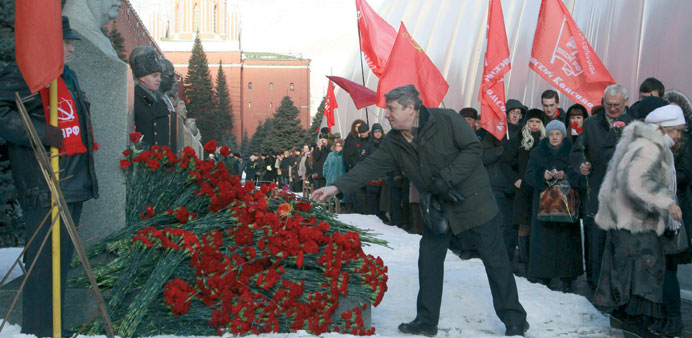
People stand in a line to lay flowers at the grave of the late Soviet leader Josef Stalin during a ceremony yesterday at Red Square in Moscow to mark his 60th death anniversary.
AFP/Moscow
Russia yesterday marked 60 years since the death of Joseph Stalin with the nation divided about whether to view him as a tyrant who slaughtered millions or a saviour who turned the country into a superpower after World War II.
Hundreds of people yesterday laid red carnations at the Red Square grave of the Soviet ruler, where his body was buried in 1961 after being displayed for several years alongside Lenin in the Mausoleum.
“There were repressions, but they should not overshadow the greatness achieved by the country,” said 48-year-old businessman Roman Fomin. “For many, Stalin means victory, economic growth and prosperity. Many people would like his return.”
Stalin’s role in Russian history has split society for decades.
His image is openly used in Victory Day celebrations for the end of World War II while the 1930s-era purges, the murderous collectivisation of the peasantry, and the feared network of Gulag camps that together claimed millions of lives are largely absent from public discourse.
“I flew in from Kamchatka,” said Larisa Tokunova, a 50-year-old lawyer from Russia’s easternmost region, calling Stalin a “genius” who turned the Soviet Union into a superpower. “If we manage to restore our country, it can only be according to his plan.”
Stalin is often praised for creating the post-war Soviet empire that stretched from the Baltic states to the Caucasus, Central Asia and beyond to the Pacific coast.
Even in Georgia, the dictator’s birthplace where the pro-Western government has instituted reforms aimed at erasing pro-Stalin propaganda, about a hundred people rallied yesterday, praising his glory.
“I haven’t heard anything about victims. Those in prison then were criminals,” said 25-year-old Marat Muzayev.
In an opinion poll this month by the independent Levada Centre, 49% of Russians said they viewed Stalin’s role as positive, while 32% disagreed.
About 55% said his death on March 5, 1953 marked the end of terror and purges and the return of many wrongly convicted people from the camps. Only 18% said they associated the date with the loss of a great leader.
The poll also found that 55% were against a proposal from the Russian authorities to return the Soviet-era name of Stalingrad to the city of Volgograd, site of a defining World War II battle.