


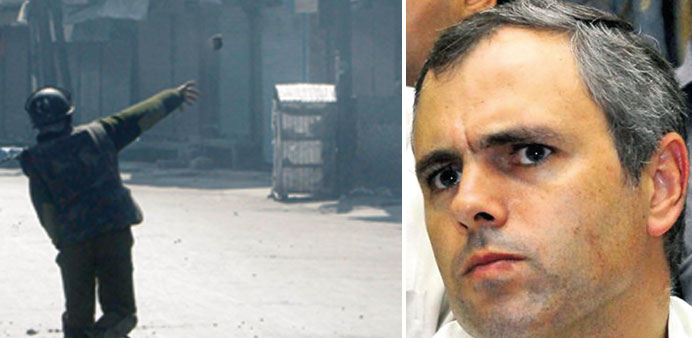
A policeman throws back a stone at demonstrators during a protest in Srinagar yesterday. Life across Kashmir remained affected for the second day due to protests and shutdown over the death of a Kashmiri student in Hyderabad. Right: Omar Abdullah.
Agencies/Srinagar
One man was killed yesterday in Jammu and Kashmir when soldiers fired at demonstrators demanding an inquiry into the death of a Kashmiri research scholar who was found hanged in the southern city of Hyderabad.
The soldiers opened fire on a “small group of stone-throwing protesters and a passer-by was killed,” a senior police official said.
The dead man was identified by police as Tahir Ahmed Sofi, a university student in his twenties. Four people taking part in the protest were injured in the firing, police said.
The protest had been called by the main separatist Hurriyat Conference alliance in Kashmir, which is demanding an impartial probe into the death of Mudasir Malla late last week. It asserts that his body bore marks of violence.
Malla was found hanged in a hostel room in Hyderabad and city police said he had committed suicide. Thousands of mourners turned out for his funeral on Monday in south Kashmir.
The separatists allege the student was murdered while the state government maintains it was a case of suicide.
Chief Minister Omar Abdullah has said there is no mystery about the death of the student since it was a case of suicide.
He also said the details of the incident have been shared with the family of the student and could be made public if the family permitted.
Abdullah broke down in the state assembly while describing the death of the passer-by in the firing.
“The opposition has walked out of the House, but I cannot do that as I am the chief minister. But please tell me how many times I will seek forgiveness and promise the families of the dead that I will get justice done for them,” he said, after losing his composure.
Noting the circumstances in which the firing took place in Baramulla, he said: “I don’t know why the bullets were fired on a small procession.”
“There were many big processions in the aftermath of the execution of Afzal Guru, but there was no firing,” he said.
“I am not a mad person that I am seeking withdrawal of the Armed Forces Special Powers Act,” the chief minister added.
Shops, offices and educational institutions were closed in most parts of the Kashmir Valley for the second day, in response to the call by the separatist group.
Internet and mobile service providers said they had been ordered by police to suspend services in Kashmir.
The northern state has remained tense since Moha Afzal Guru, a Kashmiri separatist, was executed in February in a New Delhi jail for his involvement in a 2001 attack on India’s parliament which killed 10 people.
Meanwhile, the chief minister underlined the need for working out an amicable solution to political issues of the state in accordance with the aspirations of the people of Jammu, Kashmir, Leh and Kargil.
Replying to a debate on the motion of thanks to the governor’s address to both houses of the state legislature, Abdullah said: “The task is tough but not impossible.”
He said it was not possible to find a solution that would have the approval of every citizen.
“But a solution with maximum support of people of all the regions of the state has to be found. We have to strive for it,” he said and expressed hope that the central government would address both domestic and international aspects of the political issues of Jammu and Kashmir.
He added: “Jammu and Kashmir has been reflected in the Shimla Agreement and there is need to engage Pakistan in a dialogue process.”
He said issues of Jammu and Kashmir are political and cannot be resolved either by money power or by the gun.
“We have seen neither gun nor money is answer to this issue,” he said.