


Egypt’s 2.3% loss is biggest in three months; tax evasion charges could threaten OCI buyout offer; negative signal on government-business relations; banks keep weighing on Saudi Arabia; Arabtec continues plunge on dilution in Dubai
Egypt’s bourse suffered its biggest one-day loss in three months yesterday after the chief executive of its largest listed firm was banned from leaving the country on charges of tax evasion - a fresh blow to business confidence in the country.
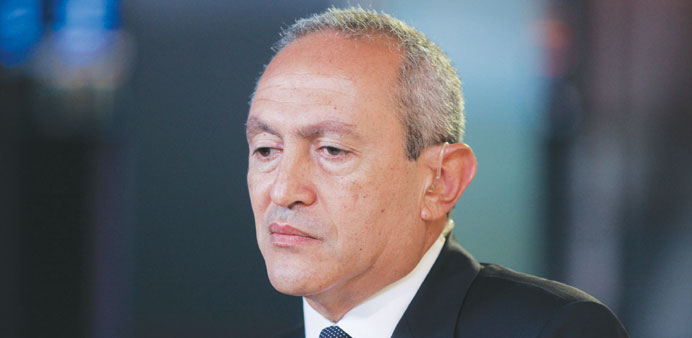
The public prosecutor ordered that Nassef Sawiris, chief executive of Orascom Construction Industries, and his father Onsi Sawiris be barred from travel, state news agency Mena reported late on Sunday.
The order was part of an investigation into accusations they evaded about 14bn Egyptian pounds ($2.1bn) of taxes during the sale of Orascom Building, an OCI subsidiary, to French firm Lafarge, it said.
A banker and friend of the family told Reuters that the men were out of the country. In a statement to the bourse yesterday, OCI said beyond a previous request by the Egyptian Tax Authority for the company to pay 4.7bn pounds related to the Lafarge deal, which it had appealed, it had not received any additional claims from the government.
Shares in OCI sank 3.6% to 250 Egyptian pounds as investors feared legal problems would put its buyout offer from Dutch-listed subsidiary OCI NV in jeopardy.
OCI NV offered in January to acquire all the ordinary shares of its parent through a swap offer for its shares in Amsterdam, and gave investors an option to sell at 280 pounds per share.
“The execution of the exchange offer will most likely be delayed as the Egyptian Financial Supervisory Authority will refrain from taking this responsibility until the claim is resolved,” Pharos Holding said in a note.
All except two stocks fell in Cairo’s main index. The index retreated 2.3% to 5,375 points in its heaviest one-day loss since December 6; it reached a nine-week low.
The index’s break below major support on the late January low of 5,489 points was technically bearish, triggering a double top formed by the January and February highs; the pattern points down to around 5,200 points in coming weeks.
Beyond the immediate impact on OCI, the Sawiris news fuelled concern about poor relations between Egypt’s post-revolution government and senior members of the pre-revolution business community, which could fuel capital flight from the country.
“Criminally pursuing the CEO of Egypt’s largest listed company after the government drafted a law to reconcile with businessmen sends a very contradictory signal,” said Mohamed Radwan, director of international sales at Pharos Securities.
In Saudi Arabia, banks led declines as investor sentiment continued to weigh on the sector in the wake of last month’s fourth-quarter earnings, which mostly showed weak growth. Al Rajhi Bank and Samba Financial Group each slipped 1.1%.
The kingdom’s benchmark dropped 0.5% to its lowest close since January 2.
Elsewhere, UAE markets declined with property-related stocks the main drag. Dubai builder Arabtec plunged 10% to a 13-month low of 2.17 dirhams as investors dumped the stock ahead of a planned capital increase that will be dilutive to shareholders.
The stock has fallen 27% in three sessions since the company announced plans to raise $1.8bn in capital. Analysts said it could continue to fall until it reached around 1.50 dirhams, a price at which the rights issue would be factored in.
Dubai’s benchmark retreated 1.9% to a two-week low.
In neighbouring Abu Dhabi, shares in Aldar Properties and Sorouh Real Estate, which plan to merge, tumbled to two-week lows as investors booked recent gains. The pair dropped 5.2 and 3.7% respectively.
Both stocks have more than doubled in price over the past year in anticipation of the state-backed merger. Sorouh is still up 43.7% in 2013, while Aldar has gained 14.8%.
A majority of shareholders at both companies approved the merger on Sunday. Sorouh shareholders will receive 1.288 Aldar shares for every share they hold in Sorouh, which will then be delisted on completion of the merger.
“Aldar and Sorouh should be trading within the range of the swap - people may be reducing some positions after the news of the merger,” said Ali Adou, portfolio manager at The National Investor. Aldar was expected to be under slight selling pressure as it adjusts to the swap, he added.
Abu Dhabi’s index slipped 0.3%, down for a third consecutive session since Wednesday’s 40-month peak.
Elsewhere in the Gulf, Kuwait’s index climbed 0.2% to 6,487 points; Oman’s measure advanced 0.3% to 6,001 points, while Bahrain’s index slipped 0.3% at 1,094 points.
Egypt currency reserves edge further below ‘critical’ level
A slide in Egypt’s foreign reserves slowed sharply in February, central bank data showed yesterday, but their low levels kept Cairo under heavy pressure to secure an IMF loan.
The central bank, which has been tightly rationing dollar supplies, said on its website that reserves slipped to $13.5bn at the end of last month from $13.6bn at the end of January.
February’s drop was marginal compared with the $1.4bn dive in January, which was exacerbated by a $650mn debt repayment to the Paris Club of creditor nations.
However, reserves remain under $15bn, a figure that would cover just three months’ imports. “Egypt’s foreign exchange reserves are still extremely low and below what the central bank previously called a critical minimum level,” said William Jackson, an economist from Capital Economics.
“At the moment they are managing to stem the decline in reserves by tightening capital controls but this is unsustainable in the long run,” he added.
Reserves now stand at little more than a third of the $36bn Egypt held immediately before the popular uprising that removed President Hosni Mubarak from power in February 2011.
Egypt’s Islamist government has produced an economic reform plan which it wants to use in negotiating a $4.8bn loan with the International Monetary Fund. The deal was agreed in principle in November but put on hold at Cairo’s request during street violence the following month.
When the central bank began currency auctions in late December, it sold $75mn to commercial banks daily.
However, those sales have dwindled to just three a week, with the amount on offer reduced to about $40mn.
Egypt’s pound has lost more than 8% against the dollar since the currency auctions began.
While this slide has slowed in recent weeks, Jackson said the central bank is not well prepared for any big drop in the pound provoked by a deepening of the rift in Egyptian politics between the ruling Islamists and opposition parties, most of which say they will boycott parliamentary elections to be held between April and June.
“Our bigger concern is if there is a fresh eruption in political turmoil, and investors and Egyptians lose confidence. This could put such pressure on the pound that the central bank could not support it with its limited reserves,” he said.
Visiting US Secretary of State John Kerry said at the weekend that it was “paramount, essential, urgent” to steady the Egyptian economy and urged political parties to unite in supporting an IMF deal.