


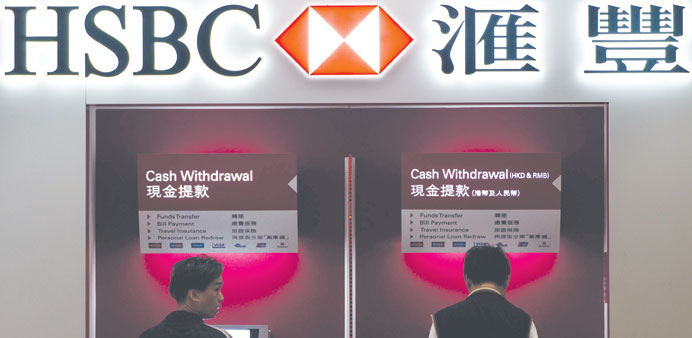
HSBC shrugs off profit fall, raises dividend
HSBC is to increase dividend payouts this year, a sign that Europe’s largest bank has regained its financial strength even though full-year profits fell more than expected.
The London-based bank is in the last year of a three-year restructuring under chief executive Stuart Gulliver, where it has closed or sold 47 businesses and cut 38,000 jobs. This has squeezed costs and cut back on risk to re-establish HSBC as one of the world’s most strongly capitalised banks.
Already one of the highest dividend payers among Britain’s blue-chip companies, HSBC said yesterday it would bump up its first three interim payouts on 2013 earnings by 11% to 10¢ per share.
“This is the beginning of the return to a more normal usage of our earnings,” Gulliver said in a conference call.
But a weak global economy and increased cost of regulation imposed since the financial crisis across dozens of countries has made improving profitability more difficult.
Banks around the world have had to cut jobs and adapt to much stricter regulations after the crisis, making it tougher to produce the high returns the industry had grown used to.
HSBC’s 2012 pretax profit fell 6% from the previous year to $20.6bn, below the average forecast of $22.7bn from 28 analysts polled by Reuters.
This partly reflected a $5.2bn loss on the value of the bank’s own debt.
Gulliver, who took the helm at the start of 2011, insisted the bank could still meet a 2013 target for return on equity, a key measure of banking sector profitability, of 12-15% despite it falling to 8.4% last year.
“Whilst the operating environment for financial institutions remains difficult, our core business will continue to reap the benefit of recovering economic growth in mainland China and its positive impact on other faster-growing regions,” he said.
HSBC’s shares fell more than three% in London, lagging the benchmark Stoxx Europe 600 Banks Index, which was 1.4% lower. HSBC’s stock had risen nearly 30% over the past 12 months, outperforming the benchmark’s 9% gain in the same period.
“The results have been slightly disappointing from an earnings perspective,” said Gary Greenwood, analyst at Shore Capital, which has a “Hold” recommendation on the stock.
“This time last year people were disappointed with its capital position but during the year it resolved that.”
HSBC’s annual report, also published yesterday, gave Gulliver got top marks for building up the bank’s capital strength and dividend payout. But he got zero for return on equity, cost efficiency and compliance.
The bank was fined a record $1.9bn in December for anti-money laundering lapses in the US and Mexico which Gulliver called “shameful.”
He is hoping a more streamlined structure will ensure risk and compliance are better managed across a bank that spans 80 plus countries and 60mn customers.
The bank said yesterday it had set aside an extra $1.4bn in 2012 to cover claims for mis-selling insurance products and interest rate hedging products in Britain.
Cellcom
Cellcom, Israel’s largest mobile phone operator, reported a 49% rise in quarterly net profit due to cost-cutting steps, and projected further declines in revenue and profit in the first quarter of 2013 amid intense competition.
Cellcom yesterday posted fourth-quarter net profit of 113mn shekels ($30mn), up from 76mn in the year earlier period but below analysts’ estimates of 127mn, according to Thomson Reuters.
In the fourth quarter of 2011, Cellcom was hit by a number of one-time factors, including a deferred tax expense.
Revenue fell 15.5% to 1.41bn shekels, weighed down by declines in both services and equipment revenue.
Israel’s mobile phone industry was shaken up last year with the entry of six new operators, sparking a price war — with unlimited calling plans for $25 a month or lower.
Efficiency measures in 2012 including job reductions led to savings at an annual rate of 550mn shekels, Cellcom said.
Its subscriber base fell 4.5% in 2012 to 3.2mn.
Cellcom opted against paying a fourth-quarter dividend, saying it wanted to strengthen its balance sheet at this time of uncertainty. The board, it added, will evaluate its decision in the coming quarters as market conditions develop.
Yingli
Yingli Green Energy Holding, one of China’s largest solar equipment makers, reported its sixth straight quarterly loss, but forecast higher shipments for the year as it looks to sell a major chunk of its products at home. Yingli shares, however fell as much as 8% to $2.21 in early trading on the New York Stock Exchange.
Analysts call the topline growth at solar companies “profitless prosperity” as a four-year long slump in panel prices shows no signs of lifting.
Yingli is not expected to post a profit for the next eight quarters, according to Thomson Reuters.
The solar panel industry has been battered by excess capacity and subsidy cuts at top market Europe, with prices falling 30% in the past year.
Yingli said it expected to ship between 3.2 GW and 3.3 GW in 2013, higher than its 2012 shipments of 2.3 GW. “We expect to increase our module shipment volumes to China in 2013 by more than 40% compared with 2012,” the company said in an earnings presentation posted on its website.
China, the world’s top energy consumer, will more than double its installed solar power capacity this year, the government said in January.
The country plans to add 10 gigawatts (GW) of installed solar power capacity this year, putting it within reach of its target of 21 GW of installed capacity by 2015.
Yingli is looking to ramp up sales in Japan and other regions with high potentials of solar applications, such as South America, southeast Asia and Africa.
Yingli increased its annual panel manufacturing capacity by 750 megawatt (MW) to 2.45 GW last year, making it a top panel supplier in 2012. But much of this expansion was funded by debt.
Yingli’s fourth-quarter gross margin fell to negative 3.2%, from a positive 3% last year, after it wrote down inventory by $106.8mn.
Fourth-quarter revenue rose 14% to $466mn as demand in China continued to expand strongly increasing panel shipments by about 41% from the third quarter.
Yingli’s net loss fell to $200.5mn, or $1.28 per American depositary share (ADS), in the fourth quarter from $599.4mn, or $3.87 per ADS a year earlier.
Gemfields
Emerald miner Gemfields said first-half core earnings fell 39% as it held just one auction during the period compared with two in the prior year, but production climbed by two-thirds.
Demand for precious stones and jewellery has been volatile, hit by the eurozone crisis and a slowdown in growth in key markets like India and China.
Gemfields said gemstone production rose about 65% to 14.5mn carats in the first half, mainly on higher grades recovered at its Kagem mine in Zambia.
“Significant interest from downstream stakeholders in attending the Gemfields’ auctions provides sound evidence of ongoing healthy demand,” the company said.
Gemfields is scheduled to have two auctions for its second half ending June 30.
The company, which named actress Mila Kunis its brand ambassador earlier this month, mainly mines emeralds at the Kagem mine, but also has interests in ruby and sapphire deposits.
Earnings before interest, tax, depreciation and amortisation fell to $19.5mn for the six months to December 31, from $32.2mn a year earlier.
Revenue from rough and finished emerald sales decreased 39% to $27.7mn.
In November, Gemfields agreed to buy luxury jeweller Faberge, the maker of lavish Easter eggs for Russia’s last tsar, in a deal valued at $142mn.
Keller Group
British construction company Keller Group full-year profit nearly doubled as home building picked up in the US, but the company said it expected spending cuts to slow down growth in the key market.
Revenue from the company’s North American business, which accounted for a little less than half of Keller’s 2012 revenue, increased 23.5% last year and 10.8% in 2011.
Keller’s profit before tax jumped to £43.5mn ($65.3mn) in 2012 from 21.9mn pounds a year earlier.
Revenue increased 14% to £1.32bn. Revenue from its North American business rose to £581.9mn from 471.1mn a year earlier.
Spending on private residential projects in the US increased 2.2% in December, a reflection of the country’s improving housing market.
Revenue from EMEA (Europe, Middle East and Africa) fell to £358.6mn from 384.8mn, while operating margin slipped to 0.6% from 2.2%.
Atkinson said he expected the European business to “continue to struggle”, hurt by austerity measures by several governments.
Keller’s shares, which have risen about 80% in the past year, were up 1.8% at 759.5 pence on the London Stock Exchange at 1219 GMT.