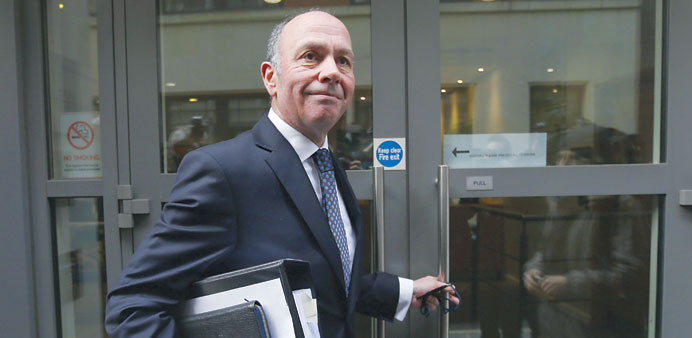
Jonathan Acton Davis, Lead Counsel to the Al-Sweady Public Inquiry, arrives for the first day of the inquiry, in central London.
By Estelle Shirbon, Reuters/London
A public inquiry in London into allegations that British soldiers killed, mutilated and tortured Iraqi detainees after a battle in southern Iraq was shown gruesome photographs of bloodied corpses yesterday.
The Al-Sweady Inquiry, ordered by the British government in 2009 to get to the bottom of disputed events in the aftermath of the battle of Danny Boy on May 14, 2004, began oral hearings after three years of exhaustive detective work.
The allegations are that soldiers captured a number of Iraqis during fighting near the Danny Boy checkpoint, about 5km from the town of Majar Al-Kabir, and took them to the Camp Abu Naji base, where some were murdered and others tortured.
The military denies any unlawful killings or ill-treatment in the aftermath of the battle.
A decade after the US-led invasion of Iraq, the issues of why the British military got involved and how the war was conducted are still hotly debated in Britain.
The Al-Sweady Inquiry, which has already cost £15mn ($22.5mn) in its pre-hearings phase, is likely to embarrass the military and stir up the public debate.
On the first morning of hearings, the inquiry heard a summary of the death certificates of more than 20 people whose bodies were handed over to the local population near the gates of Camp Abu Naji on May 15, 2004.
According to the certificates, three of the bodies bore signs of torture including missing eyes, a missing private parts and crushed bones.
The inquiry was then shown graphic photographs of dead bodies with bloody wounds. Several were almost completely disfigured.
There is no agreement about the exact number or identities of the dead and whether they died fighting at Danny Boy or in detention at Camp Abu Naji. The inquiry says it aims to establish the circumstances of 28 deaths.
The Al-Sweady hearings are expected to last about a year.
As many as 60 Iraqi witnesses will give evidence over the course of several months, either in London or via video-link from the British embassy in Beirut, and about 200 British military witnesses will follow over several more months.
Events after the battle of Danny Boy were unusual in that all bodies would normally have been left on the battlefield. In this case, an order was given to identify the dead to see if they included the main suspect in the murder of six British soldiers at Majar Al-Kabir in June 2003.
The military say that was why 20 bodies were carried away from Danny Boy to Camp Abu Naji.
Nine prisoners were also taken to the camp, and later to another detention facility at Shaibah Logistics Base, and finally handed over to Iraqi authorities on September 23, 2004.
Five of those nine detainees later alleged that they had been tortured in detention. The inquiry is named after Hamid al-Sweady, one of those allegedly murdered at the camp.
If the inquiry, which is expected to publish its report by the end of 2014, confirms the allegations, the events after the battle of Danny Boy will go on the record as one of the worst atrocities of the war. Al-Sweady is the second major British public inquiry into military conduct in Iraq.
The first, into the death of 26-year-old hotel receptionist Baha Mousa in British custody in Basra in 2003, reported in 2011 that he had died after suffering “an appalling episode of serious gratuitous violence” at the hands of British troops.
5 policemen killed in Mosul attack
A suicide bomber in a car killed at least five policemen and wounded 12 people, including civilians, yesterday in Iraq’s northern city of Mosul, police and medics said.
It was not immediately clear who carried out the attack but suicide bombings are the hallmark of Al Qaeda’s local wing, the Islamic State of Iraq, which aims to take back ground lost to the Iraqi security forces.
The bomber drove a vehicle packed with explosives up to a federal police headquarters in Mosul, and detonated it.
In separate incidents, two soldiers and three policemen were wounded when two roadside bombs exploded in eastern Mosul.
Mosul is a stronghold of the Islamic State of Iraq and the rate of attacks on security forces deployed there has increased significantly since the beginning of the year.
The violence is stoking fears of a return to intercommunal strife following the withdrawal of US troops in December 2011.
People across Iraq have staged more than two months of protests against Prime Minister Nuri al-Maliki’s Shia-led government over what they say is the marginalisation of the minority sect and the misuse of terrorism laws to target Sunnis.