


Deputy News Editor
 |
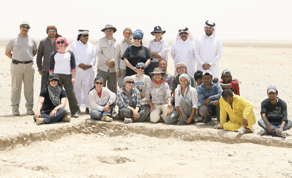
| The archaeological excavation team from the University of Birmingham and their local support personnel are seen with officials from Qatar Museums Authority, in front of a test pit at Wadi Debayan. PICTURE: Shaji Kayamkulam |
The initial survey had identified the presence of a flint scatter at Wadi Debayan, situated on the northwestern side of Qatar, to the south of the site of Al Zubara and the Ra’s Ushayriq peninsula.
It was further mapping and test pitting that began to yield more interesting information on Wadi Debayan, the exploration of which is a part of the Remote Sensing and Qatar National Historical Environment Record (QNHER) project.
The flint tools found were of the Arabian bifacial tradition (worked on both sides), typically dating to nearly 7,000-8,000 years ago.
The tools included arrowheads (suggesting hunting and also for defence purposes) and scrapers (generally used for scraping and preparing animal hides, bones and in woodworking).
The excavations so far have thrown up some mammal bones and vast quantities of fish bones, the latter indicating a possibility that the ancient inhabitants of Wadi Debayan may have exported dried fish.
“Though there are no signs of pearling at the moment, we know that they were pearling. Some of the earliest pearls in the Gulf date to round about 6,500 to 7,000 years ago,” QNHER project co-director Richard Cuttler told Gulf Times.
QNHER is being developed as part of the Remote Sensing Project, a joint initiative between the Qatar Museums Authority under the guidance of Faisal al-Naimi (head of antiquities), and the University of Birmingham, where Cuttler is a research fellow.
There is very good evidence at Wadi Debayan for trade, proved by the discovery of nearly 180 shards of Ubaid pottery (the Ubaid period lasted approximately between 6500-4000BC) from southern Mesopotamia.
This is by far the biggest assemblage of Ubaid pottery found within Qatar. Ubaid pottery has a greenish buff colour with distinctive black-slip geometric designs.
“The second thing about trade is that we have found here obsidian, which has been source-matched to eastern Turkey. So we are looking at round about 7,000 years ago when there was a trade network extending more than 3,000km, probably along the Tigris and Euphrates rivers up into eastern Turkey,” al-Naimi said.
A site similar to Wadi Debayan has been found in Kuwait and three or four in Saudi Arabia - and all of these are around the coast and part of the trade network, he added.