


 |
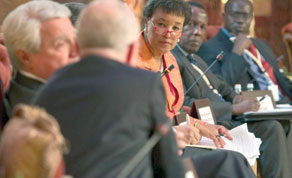
| Panellists participating in a discussion on corruption and the rule of law |
Baroness Scotland, former Attorney General of England and Wales, chaired the opening session on “Anti-corruption – the rule of law and economic, political and social development,” with participants from Egypt, Zambia, Hungary, Qatar and the World Bank providing valuable insights into what measures can be taken to eliminate corruption globally and from the perspective of their own countries and organisations.
The panel was united in agreeing that fighting corruption is vital to the strong rule of law and that secretive practices must be replaced with transparency and accountability. The discussion recognised corruption as a hindrance to international commerce most damaging to the countries that are in greatest need of development.
The objective of the Qatar Law Forum is to foster a global commitment to the rule of law and, in keeping with this spirit, yesterday’s debate posed the question of how the world is to tackle corruption and whether a set of universal standards could be applied globally.
This resulted in a set of components suggested as essential to a universal solution, that included eliminating opportunities for corruption in the public sphere, stronger enforcement against corruptive practices, better intelligence-gathering and financial independence of the judiciary from the government’s leadership.
This year’s Qatar Law Forum revolved around ‘The rule of law in a time of change’ and included a session dedicated to recent events and changes in the Arab world. More than 400 delegates attending the panel heard the startling statistic that 60% of Arab countries have made changes to their constitutions in the past year and not just those directly involved in the Arab Spring. This and many other topics of interest were covered in a discussion paper presented by Judge Hassan al-Sayed, Justice of the Qatar International Court and Dispute Resolution Centre (QICDRC).
Recurring reasons for these changes as offered by Abdulhafeez Ghoga, Former Vice-President of the National Transitional Council in Libya, were a lack of basic human rights, corruption and dictatorship. Lord Phillips, President of the Supreme Court of the UK and chair of the panel, summarised the discussion by stating that the Arab Spring appeared to be a revolt against absolute executive power which was not exercised benevolently.
He stated that absolute executive power did not in itself cause the Arab Spring; it was the abuse of this power and a lack of respect for the rule of law.
Highlights of the afternoon included an examination of the role of ethics and law in finance, chaired by HE Sheikh Abdullah bin Saud al-Thani, Governor of the Central Bank of Qatar, and a session on resolving disputes over Islamic finance.
The Qatar Law Forum 2012 continues today with a key note from HE Sheikh Hamad bin Jassim bin Jabor al-Thani, Qatar’s Prime Minister and Minister of Foreign Affairs, followed by a panel of chief justices from around the world including the UK, Qatar, Afghanistan, Bangladesh and Azerbaijan discussing “Achieving a global understanding of the rule of law”.