


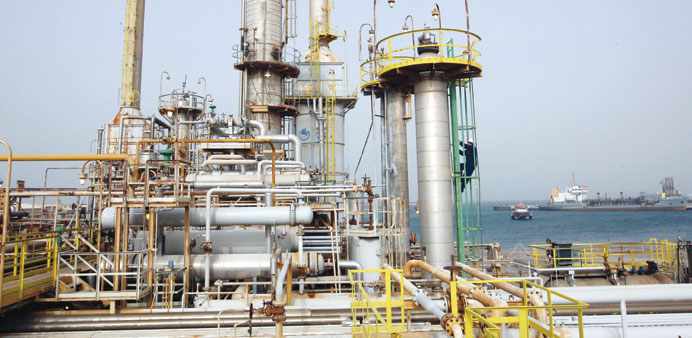
Libyan employees of the Sirte Oil Company operate in the oil refining section of the company, in Brega, eastern Libya (file). Libyan output increased 130,000 barrels to 1.24mn this month, the biggest gain of any member. Production rose because of the reopening of the country’s Zueitina export terminal early this month.
Bloomberg/New York
Opec crude output rose for the first time in six months as rising Libyan production outpaced a cut by Saudi Arabia, which has implemented a programme aimed at curbing excess supply and supporting prices, a Bloomberg survey showed.
Output in the 12-member Organisation of Petroleum Exporting Countries increased 97,000 barrels, or 0.3%, to an average 30.699mn bpd this month from a revised 30.602mn in January, the survey of oil companies, producers and analysts showed. The January total was revised 123,000 bpd higher, mostly because of a change to the Kuwaiti production estimate.
Brent crude for April settlement dropped 49¢, or 0.4%, to end the session at $111.38 a barrel yesterday on the London- based ICE Futures Europe exchange. Brent is the benchmark contract for more than half the world’s oil. West Texas Intermediate oil for April delivery fell 71¢, or 0.8%, to $92.05 a barrel on the New York Mercantile Exchange, the lowest settlement since December 31.
“The most interesting point is that the Saudis are sticking to their line,” said Julius Walker, global energy markets strategist at UBS Securities LLC in New York. “They’ve reduced production from nearly 10mn barrels in less than a year. This shows their intention to do what it takes to keep prices at a level they are comfortable with.”
Saudi Arabia, Opec’s biggest oil producer, pumped 9mn bpd this month, the lowest level since May 2011. Output was down 100,000 bpd from January and 900,000 barrels from May, when production reached the highest level since at least January 1989.
The kingdom denied last month what it said were suggestions that it cut oil production to push prices higher and attributed the reduction to weaker demand, according to Ibrahim al-Muhanna, an adviser to Oil Minister Ali al-Naimi. Consumption fell in Saudi Arabia after peaking in the summer, al-Muhanna said. Overseas demand also dropped because of slower euro-area growth and concerns about budgetary challenges in the US, he said.
“The Saudis have done what they needed to do to eliminate a glut of crude in the market,” Emerson said. “Brent is safely above $100 a barrel so they can stop cutting back. They will probably increase production in the second quarter.”
Libyan output increased 130,000 barrels to 1.24mn this month, the biggest gain of any member, the report showed. Production rose because of the reopening of the country’s Zueitina export terminal early this month.
The Zueitina port and pipeline pumping complex shut in late December because protesters prevented employees from going to their offices, leading state-run National Oil Corp to suspend pumping crude into a pipeline. The harbour handled about 150,000 bpd of exports in 2010, according to data from the US Energy Information Administration.
Production in Libya plunged to 45,000 bpd in August 2011 from 1.585mn that January, the last month before an uprising that overthrew the government of Muammar Gaddafi disrupted output.
“There was a relatively rapid recovery after the country’s civil war but Libya’s oil industry has been hit by a number of problems,” Walker said. “Libyan capacity has yet to reach pre- war levels. The production gain is a hopeful signal.”
Nigeria’s output climbed 90,000 barrels to 2.08mn bpd in February, the survey showed. It was the second- biggest production advance. The country’s production is recovering after flooding in September and October shut oil fields in the Niger River delta.
Iran pumped 2.63mn bpd, up 30,000 barrels from January, according to the report. The country produced 2.63mn bpd last month, the lowest level since February 1990. Output was down 820,000 barrels from February 2012. Iran, the group’s biggest producer after Saudi Arabia a year ago, is now tied in sixth place.
Sanctions aimed at stopping Iran’s nuclear programme have hindered its ability to export crude oil. A European Union ban on the purchase, transport, financing and insurance of Iranian oil came into effect on July 1.
“Iran is taking a lot of the bite,” said Sarah Emerson, managing director of Energy Security Analysis Inc in Wakefield, Massachusetts. “Other members have had it easy because Iranian output is down so much from a year ago.”
The Gulf countries, the UAE and Kuwait, also bolstered output this month. The UAE increased production by 50,000 bpd to 2.65mn in February. Kuwaiti output climbed 50,000 bpd to 2.95mn, the most since September.
Angola reduced output by 80,000 barrels to 1.73mn bpd this month, the second-biggest decline, after Saudi Arabia. There were some technical problems with some offshore production blocks, Jose Miguel, a spokesman for the Petroleum Ministry, said without giving more details in a telephone interview yesterday in Luanda.
Algeria cut production by 70,000 barrels to 1.13mn bpd in February, the least since May 2003. Discoveries last year won’t offset declines in output, Algerian Energy Minister Youcef Yousfi said in Algiers on February 20.
“Opec is the midst of a delicate balancing act,” said John Kilduff, a partner at Again Capital, a New York-based hedge fund that focuses on energy. “A number of members are struggling to maintain production rates.”
Opec, provider of about 40% of the world’s oil, maintained its official production ceiling at 30mn bpd at a meeting on December 12 in Vienna. Ministers from the group’s members are next scheduled to gather May 31.