


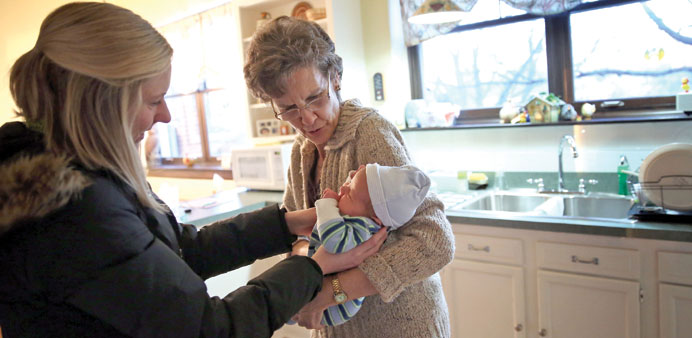
Family Resource Center social worker Leigh Pollworth hands baby Alex to Becky O’Connell, 65, at her home in Chicago, Illinois.
By Colleen Mastony
She keeps the baby clothes arranged by size in the guest room. The hand-knit caps are stacked on a table near the door. And the white wicker bassinet is always within reach.
Becky O’Connell knows the call can come at any time. And so, when the phone rings shortly after 10 on a recent morning, she crosses her kitchen and picks up on the third ring.
“He was born what day? Mm-hum. Never left the hospital? Mm-hum,” she says, the phone receiver to her ear. “It would just be overnight? Well I can do that, no sweat. See you at 4 o’clock.”
Within a few hours, a social worker is coming through the door with a tiny baby, just 3 days old. The child has big, blue eyes, dark hair and a round, ruddy face. His name is Alex. “Oh,” gasps O’Connell. “Look at those cheeks.”
This is how it begins. At 65 years old, O’Connell is tall and willowy, with coiffed brown hair, gold-rimmed glasses and a no-nonsense personality. And at this moment, shortly after 4pm on a bitterly cold Monday, she is falling hard for tiny Alex.
Officially, O’Connell is a temporary foster care worker.
But love, she says, is her real line of work.
“You know how quickly you attach?” she says. “It takes about 30 seconds. You get a baby in your arms and it’s your baby.”
It is a sad reality that the youngest children are the most vulnerable to abuse and neglect in the US, said Dave Clarkin, spokesman for the Illinois Department of Children and Family Services. Of the 4,454 children taken into protective custody last year, “the vast majority were under the age of 5,” Clarkin said. “And many, many are under the age of 1.”
There is a huge shortage of people like O’Connell — the human safety nets of the child welfare system. Over the last decade, O’Connell has cared for 77 infants. That is at least seven babies a year. Babies who arrive on a moment’s notice, and who can stay anywhere from one night to four months.
Some have been abandoned. Others have been abused. Most are in the process of being adopted. All are in desperate need of someone like O’Connell, a volunteer who says simply: “My job is to fall in love with these babies.”
On this day, when the newborn arrives, there’s already a 3-week-old dozing in a bassinet set up in the sun-filled dining room.
In the kitchen, O’Connell is waving goodbye to the social worker. “His name is Alex, right?” So many children pass through, it’s easy to get confused. Then, O’Connell lifts her newest arrival — “You’re a big boy!” — and lays him on a foam pad on the counter.
Gently, she cleans his ears, files his nails and clips off the hospital ankle band. All the while, as he wriggles and cries, she talks to him in soft, reassuring tones. “I know it’s cold, isn’t it?” she coos as she begins to change his diaper. “Don’t pee on me!”
As afternoon turns to evening, O’Connell performs a delicate dance. When Alex is bathed and dressed in a blue fleece nightgown, his 3-week-old roommate begins to howl. All evening, O’Connell calmly pivots between the two — juggling pacifiers and bottles, patting backs and changing clothes.
“I’m just an old girl who is doing what I love,” she says. “When you do what you love, you can do it in your sleep — which I sometimes do.”
When she first heard that a local adoption agency was looking for foster parents, she had just emerged from the darkest period of her life.
In 1999, the younger of her two sons, Ian, was killed in a car accident on the expressway.
“When my oldest was born, it was the happiest day of my life,” she says. “Ian’s death was the saddest.
“For years and years after (his death), I couldn’t concentrate,” she says. “I looked and acted like a normal person, but you don’t feel like a normal person.
“You’d sleep and you’d dream about it. Then you’d wake up and you didn’t know if you were still dreaming.”
By 2002, she was just beginning to regain her balance. One afternoon, a newsletter arrived from a local adoption agency. In it, she spotted a notice seeking temporary foster parents for newborns. To O’Connell, who had always loved babies, it sounded like a dream job.
At the time, she was helping run a busy parenting programme for underprivileged families in Edgewater, Illinois. But the notice in the newsletter called to her. Within a few short months she and her husband, Ed, who had built a 30-year career in adoption law, received their licence. On a warm day in the autumn of 2002, a social worker arrived with the O’Connells’ first baby.
The child was big and bright, with dark eyes and a calm, gentle presence. Over the next few days as O’Connell cared for the baby — washing her in the kitchen sink and changing her diaper — O’Connell’s world seemed to come into focus.
She wrote in a diary entry: “(The baby) loves the light and makes eye contact. We stood at the window for ten minutes today and we watched the trees in the high wind. No need to use a pacifier. She’s so calm.”
O’Connell hadn’t expected it, but as she soothed that dark-eyed baby, the baby seemed to be soothing O’Connell, too.
“Give her an upset baby and it won’t be upset for long,” says Jane Turner, associate director of Family Resource Centre, the Edgewater-based adoption agency that O’Connell works with. “She has a gift for making a baby feel calm and soothed.
“Some people,” Turner says, “call her the baby whisperer.”
O’Connell isn’t paid for her work. She buys diapers, formula and clothing herself. As for taking care of babies, she says, that’s always been second nature. From the time she was a young child she crisscrossed her Indianapolis neighbourhood, helping mothers with their kids. In college she spent her summers nannying, and after graduation she worked in a day care centre. She raised her two sons, and later made a career volunteering at hospitals and other programmes for children.
If she has a secret, she says, it is simply giving each child her undivided attention. It doesn’t hurt that O’Connell likes to read medical literature, studying up on reflux, jaundice and colic. She is also a big believer in keeping detailed logs of each baby’s sleep and eating habits, which helps her suss out problems and patterns.
There are other tricks, too. Washing a baby’s hair over the sink — beauty salon-style — while the baby is fully clothed to prevent a chill. Warming the baby lotion in the microwave before rubbing it on the skin. Calming a child by stroking his or her forehead.
“People think that babies bring a lot of disorder and confusion to a household,” she says. “But I’m here to tell you it’s not the babies who are disordered and confused.
“It’s the adults.”
By evening, the house is quiet. Ed O’Connell is away for the week, and Becky is alone with her babies.
Alex is asleep in his bassinet, and O’Connell is sitting in the kitchen, giving the 3-week-old a bottle. He is a tiny baby, with a crown of strawberry blond peach fuzz.
“I love how they get all connected to you. You pick them up and they just nestle into your arms,” she says. The baby yawns and burps in seeming agreement.
As happy as these moments can be, O’Connell knows she will have to say goodbye soon. Parting is a moment that always comes with a bit of heartbreak. And so, from the day a baby arrives, she keeps a bag packed, with a change of clothes and a few handmade toys.
All around her, the walls and bookshelves of her elegant brick home in Chicago’s Rogers Park neighbourhood are filled with photos of the kids she calls “my graduates.” Many of the adoptive parents keep in touch, sending photos, drawings, report cards.
“We call them Aunt Becky and Uncle Ed,” said Becky Ward, 31, whose adopted son stayed with the O’Connells for a month before his adoption was finalised. Ward still calls O’Connell for all sorts of advice, from sleep issues to baby sitters. Being close to O’Connell is, Ward said, like having a second mom. “They’re like family to us.”
O’Connell keeps a stack of index cards on which she records every child’s name and the dates the baby stayed with her.
All of them will grow up and go their own way. None will remember the woman who cared for them in the first days of their lives.
“Of course, I remember them,” O’Connell says. “Any mother would be the same way.” — Chicago Tribune/MCT
US seniors increasingly
putting off retirement
By Rick Armon
Even at age 70, Ron Hustwit has no itch to retire.
He has taught philosophy full time at the College of Wooster in Wooster, Ohio for 46 years and, unlike many friends and colleagues who chose to retire long ago, he still enjoys going to work.
“I don’t have any days when I say I have to put in another day at the office,” he said.
Hustwit, who lives across the street from the college campus, is one of a growing number of seniors in the United States who are opting to remain in the workforce.
The US Census Bureau reported that the percentage of people 65 or older still working rose from 12.1% in 1990 to 16.1% in 2010, driven largely by women.
And the bureau’s latest American Community Survey report shows even higher numbers. The figure was 19% nationwide. The reasons are varied. Some seniors are doing it strictly for the money, knowing they don’t have enough saved to retire or they are worried that they’ll outlive their savings.
Others like Hustwit know they would miss the social interaction at work or they have no burning desire to take up a hobby such as golf or travelling.
Then there’s a less obvious reason: A growth in service and office jobs doesn’t require major physical labour, allowing seniors to work longer or even enter the workforce later in life.
“People are living longer, and they are healthier,” said Paul Magnus, vice president for workforce development at Mature Services Inc, an Akron, Ohio non-profit that helps older workers find jobs. “To look at age 65 and think you have two decades left of active lifestyle, work is part of it.”
Why work?
During a recent jobs programme at Mature Services, the Beacon Journal asked people — not all were over 65 — why they wanted to return to the workforce.
The No. 1 answer involved money.
Some said they or their friends didn’t plan well enough for retirement. Or, because of the recession, they started raising their grandchildren and needed the income.
Another popular reason was social. They don’t want to sit at home alone. Some said people who live longer seem to have two things in common: They work as long as they can, and they eat oatmeal every day.
“I like to keep working because it’s good for my brain,” said Victoria Anania of Akron. Anania, who would only say that she’s over 65, worked for years as a nurse and now wants to return to the workforce.
“Age is just a number anyway. It’s how you feel inside,” she said.
Rose Schaffer, 85, of Norton, works part time at Akron Monument & Granite Co Each Monday, she comes into the office for several hours to keep the books, prepare invoices and answer the phone.
On other days, she works at home, spending an hour or so reading newspaper obituaries and sending condolence letters to potential customers.
“Work is good therapy,” she said. “I think that’s what has kept me young.”
Why change it?
Hustwit, the Wooster college professor, admitted he’s afraid to retire. He fears he would miss the intellectual stimulation, friendships and reason to get out of the house each day. He also has no plan for what to do next.
“My picture of retirement is really just sitting around and wondering what I’m going to do,” he said.
His wife, Barb, 68, had no such hesitation. She retired seven years ago from her job as a student writing consultant at the college.
She loves retirement and wrote a book, Never Far from Home: Willa Cather, On Choosing Names from Frederick County, Virginia, for Her Literary Characters.
“I understand why he wants to continue working,” she said. “He still enjoys teaching and the challenge of it.”
Hustwit knows he won’t be able to work forever. He can’t imagine walking into the classroom at 80, but as long as his good health remains, he’ll keep teaching. “My life is flourishing, and as good as it is, why change it?” he said. — Akron Beacon Journal/MCT