


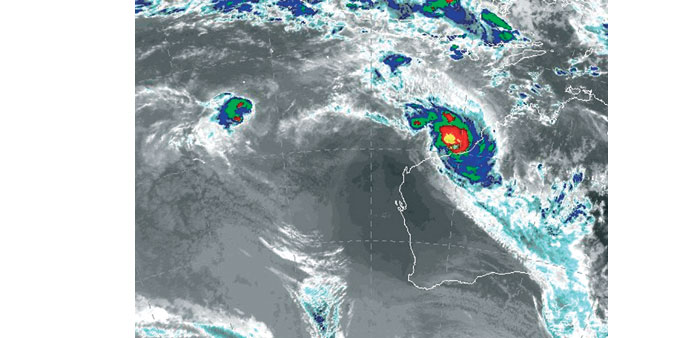
In this false-colour infrared satellite image originally processed by the Australian Bureau of Meteorology from the geostationary satellite MTSAT operated by the Japan Meteorological Agency, severe tropical cyclone Rusty passes over the Pilbara region in western Australia at 2232 GMT on Tuesday.
Reuters/Perth
A powerful cyclone, that brought half the world’s seaborne-traded iron ore to a halt, yesterday spared Australia’s Port Hedland shipping hub yesterday, making landfall about 120km to the east.
Cyclone Rusty, with destructive winds up to 200kph, is expected to flood inland iron ore mine operations and rail links with heavy rain expected overnight and today.
“Port Hedland will escape Rusty’s worst winds,” the Bureau of Meteorology said.
Residents of the Pilbara iron belt had been told to prepare for a prolonged battering given the storm’s slow advance, suggesting it could be several days or more before iron ore mining and shipping operations return to normal.
Satellite tracking by meteorologists showed the cyclone crossing the coastline near Pardoo, a small mining town and cattle station just east of Port Hedland, but the port town remained on high alert. Cyclones are erratic and can quickly change direction.
Atlas Iron which operates a mine in Pardoo yielding around 2.5mn tonnes of ore a year, has evacuated the site. Calls to local residents and businesses went unanswered.
Australia’s three main iron ore ports, Port Hedland, Dampier and Cape Lambert, were closed on Monday. Offshore oil and gas fields have also been shut down.
Severe weather warnings extend as far as 500km inland to the mining camps and towns of Tom Price, Mt Newman and Nullagine, operated by Rio Tinto , BHP Billiton and Fortescue Metals Group.
The Pilbara, a sparsely populated and inhospitable outback part of Australia, is the world’s largest source of iron ore.
Rusty strengthened yesterday morning to a category four storm on a scale of one to five. “This is a large tropical cyclone and its slow movement is likely to result in an extended period of destructive winds near the track, with rainfall that is heavier than that associated with a typical system,” the Bureau of Meteorology said.
Areas hardest hit by the storm could receive up to 600mm of rain in 24 hours. Such extensive flooding threatens to submerge hundreds of kilometres of rail lines owned by the miners and used to transport ore to the ports.
“Extreme weather preparations continue across our mining operations in anticipation of the cyclone moving further inland,” BHP said in a statement emailed to Reuters. “Additional operations will be suspended if necessary.”
Rusty is the fourth cyclone to form during Australia’s 2012-13 “cyclone season” which runs November to end April. There are typically 11 cyclones per season off Australia northwest and northeast coasts.