


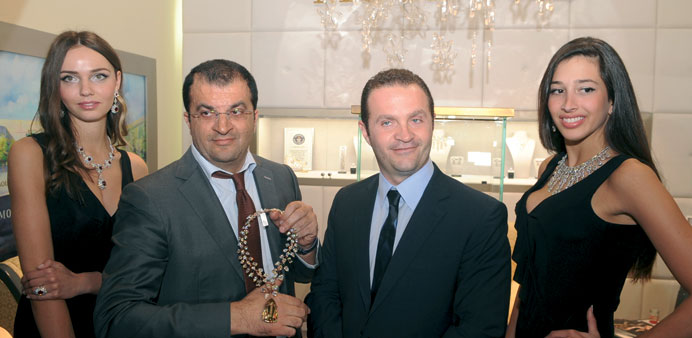
Alain Mouawad (second left) and Pascal Mouawad (second right) display the Mouawad L’Incomparable Diamond Necklace at the exhibition.
Mouawad, the luxury jewellery and timepieces company, revealed its latest masterpiece creation , the ‘ Mouawad L’Incomparable Diamond Necklace’ featuring 91 diamonds totalling 637 carats in weight at the 10th Doha Jewellery and Watches Exhibition (DJWE) for the first time yesterday .
The diamond necklace embraces the ‘ Incomparable Diamond’, the world’s largest internally flawless diamond weighing 407.48 carats. The ‘Mouawad L’Incomparable Diamond Necklace’ will be on display at the Mouawad booth throughout the show.
Pascal Mouawad, Guardian of the Mouawad Retail Division said, “Through creativity, patience and verve, the artisans at Mouawad have crafted an impressive and sublime diamond necklace– giving the famous diamond a permanent throne.”
He continued, “Befitting of a royal court, the necklace leaves nothing to be desired except to grace the neck of a Queen or a very special woman that absolutely deserves nothing less.”
The coloured shield step-cut diamond is now suspended gracefully from a strikingly diamond necklace featuring a cavalcade of pristine, radiant diamonds of various cuts sublimely intertwined by 18K rose gold.
Fred Mouawad, Guardian of the Mouawad Diamond Division said, “This is our fifth year at DJWE and for the third consecutive year we have chosen the show as the location for the global debut of our one-of-a-kind jewellery creations. The unveiling of our ‘L’Incomparable Diamond Necklace’ is Mouawad’s special gift for the 10th anniversary of what we believe is the top event for the luxury market in the Middle East.”
In its rough state weighing 890 carats, the ‘Incomparable Diamond’ made a long serendipitous journey before reaching Mouawad. It was in 1980 in the Democratic Republic of Congo that a little girl found the diamond in a rubble pile of kimberlite that was sorted out, because it was considered to be too bulky to possess any diamonds. The diamond exchanged hands and was made public in 1984 in its polished form. It was then put on display at several museums with the first one being the Smithsonian Institute in Washington DC.